
Jun 27, 2026
Last Updated: June 27, 2026
Accessible minibus leasing allows care facilities to operate modern, purpose-built vehicles without significant capital expenditure. Rather than purchasing vehicles outright, leasing provides predictable monthly costs whilst ensuring your fleet remains compliant and road-ready. A typical lease agreement (2-4 years) includes maintenance, servicing, MOT, tyre replacement, and roadside assistance in one transparent monthly payment.
According to Care England's operational guidance, accessible transport is a regulatory expectation. Leasing transfers ownership risk to the leasing company whilst keeping your organisation focused on care delivery, not fleet management.
When you buy a minibus outright, you're responsible for depreciation (40-50% over three years), maintenance, repairs, MOT testing, insurance, and disposal. A single gearbox failure costs £3,000-£5,000. Annual insurance runs £2,000-£3,500 for care home operations.
Leasing flattens these variables. Your monthly payment covers all maintenance, servicing, tyres, MOT, and roadside assistance with no surprise repair bills.
Fixed monthly payments enable precise financial forecasting. Your care home knows exactly what transport costs will be across the entire contract term. You avoid the budgeting nightmare of ownership, where major repairs can deplete contingency reserves.
The payment structure consolidates all servicing and maintenance into one figure, reducing administrative burden. Your finance team processes fewer vendor invoices and spends more time on strategic planning.
Purchasing a new accessible minibus requires £35,000-£55,000 capital outlay. Leasing eliminates this requirement entirely, preserving working capital for care improvements and staff development. From an accounting perspective, lease payments are operational expenses rather than capital assets, improving financial ratios that matter to funders and regulators.
Care homes cannot lease any minibus. Vehicles must meet specific accessibility standards and safety regulations under the Equality Act 2010 that protect vulnerable residents and shield your organisation from legal exposure.
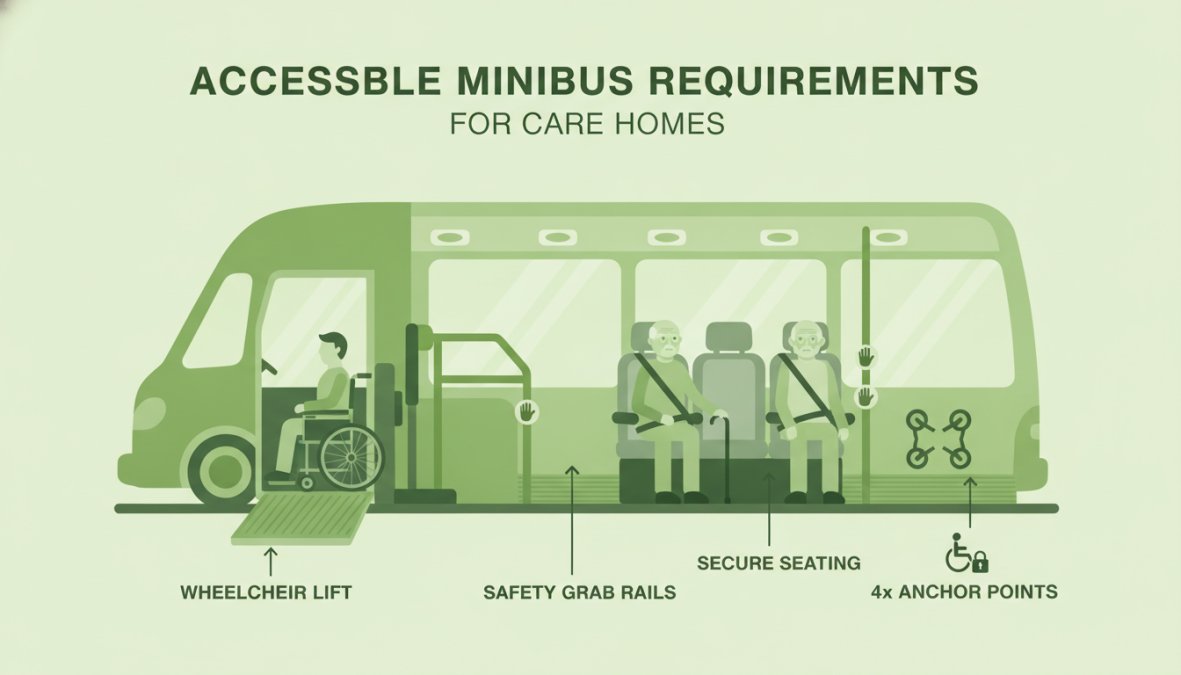
A properly specified accessible minibus includes:
These features prevent falls, protect spinal health during transport, and ensure dignity for residents with mobility challenges. Minibus Leasing UK specifies vehicles against these standards from the outset, ensuring your fleet meets accessibility requirements without retrofitting.
Every minibus must pass annual MOT testing covering braking systems, steering, suspension, lights, seatbelts, wheelchair lift mechanisms, emergency exits, and emissions standards. A failed MOT can take a vehicle off the road for weeks, creating operational chaos for care homes relying on that transport.
Leasing agreements include MOT management. The leasing company handles testing, arranges repairs, and provides replacement vehicles during downtime. Care homes must also ensure vehicles comply with Section 19 permit requirements for non-commercial passenger transport, involving notification to the local traffic commissioner and maintenance of passenger records. Minibus Leasing UK's account managers guide care homes through these regulatory requirements.
Not every care worker can legally drive a minibus. Licensing requirements depend on vehicle size and seating capacity.
A standard car driving licence (category B) permits operation of vehicles up to 3,500kg with up to 8 seats. Minibuses with 9-16 passenger seats require a D1 category licence. Vehicles with 17+ seats require a full D (bus) licence. Operating a minibus without the correct licence exposes your care home to prosecution, unlimited fines, and potential criminal liability.
Obtaining a D1 licence requires passing a medical examination, theory test covering passenger transport regulations, practical driving test in a minibus, and meeting minimum age requirements (typically 24 for D1). The process takes 8-12 weeks. Minibus Leasing UK can advise on driver licensing requirements and connect you with approved training providers.
A comprehensive lease agreement should be all-inclusive, with one monthly figure covering everything else.
Minibuses require servicing every 10,000-15,000 miles or annually at £400-£700 per service. A quality lease agreement includes all scheduled servicing, parts, labour, and wear-and-tear repairs (excluding accident damage). Your care home never receives invoices for servicing, brake fluid replacements, battery work, or diagnostic services, all bundled into the monthly payment.
A set of minibus tyres costs £600-£1,000. A quality lease includes tyre replacement when tyres reach minimum tread depth at no additional cost. Normal operational wear, minor scratches, and faded interior fabrics should be covered. Accidental damage (collision, impact, vandalism) typically incurs excess charges, but everyday wear should be absorbed by the leasing company.
Standard car insurance won't cover passenger transport. Care homes need specialist minibus insurance covering third-party liability, passenger accident cover, breakdown assistance, windscreen cover, and uninsured driver protection.
The monthly lease payment should include comprehensive insurance as standard. Your care home's duty of care extends to safe, accessible transport: vehicles must be maintained to safe standards (covered by the lease), drivers must hold appropriate licences (your responsibility), journey planning must account for resident needs (your responsibility), and vehicles must carry appropriate safety equipment (covered by the lease).
If investigation reveals your care home failed to maintain the vehicle or employed an unlicensed driver, insurance may not cover claims. The lease agreement protects you by ensuring vehicle maintenance, but you must ensure drivers are licensed and trained appropriately.
The typical process involves:
1. Initial consultation. Discuss your care home's needs: number of vehicles, seating requirements, accessibility specifications, contract length, and budget. A dedicated account manager is assigned.
2. Fleet specification. Specify vehicles meeting your requirements: manufacturers, seating configurations, wheelchair lift types, and additional features.
3. Quote and proposal. Receive a detailed quote showing monthly payments, what's included, contract length, and optional extras. Many leasing companies offer Minibus Leasing Special Offers that can reduce costs for care home organisations.
4. Agreement review. Your finance team reviews lease terms, payment schedules, maintenance responsibilities, mileage allowances, damage excess, and end-of-contract procedures.
5. Finance approval. Finance approval typically takes 5-10 working days.
6. Vehicle delivery. New vehicles typically take 8-12 weeks from order to delivery.
7. Ongoing support. Your account manager arranges servicing, handles warranty claims, manages insurance renewals, and addresses operational questions.
Professional leasing companies can sometimes arrange delivery within 4-6 weeks for urgent needs. Fleet management support extends beyond vehicle delivery: scheduling servicing to minimise disruption, arranging replacement vehicles during workshop time, advising on regulatory compliance, reviewing usage patterns, and supporting end-of-contract transitions.
When your lease expires, approximately 60 days before contract end, the leasing company arranges an inspection determining whether excess charges apply for damage beyond normal wear and tear.
Excess charges typically cover accident damage, mechanical damage from misuse, interior damage, and excessive mileage (if applicable). Normal wear and tear, faded upholstery, minor scuffs, and worn floor mats should not incur charges.
The leasing company arranges vehicle collection from your care home. Within 30 days of return, you receive a final invoice showing any excess charges offset against your deposit. A professional leasing company manages this transparently, providing clear information about costs and timelines well in advance.
Accessible transport for care home residents is a regulatory expectation and dignity imperative. Yet purchasing and maintaining a dedicated minibus fleet can strain care home budgets. Leasing converts unpredictable ownership costs into transparent monthly payments including maintenance, servicing, insurance, and compliance support.
Minibus Leasing UK specialises in tailored minibus procurement for care organisations, combining industry expertise with whole-life cost analysis. Our dedicated account managers provide consultative support from initial specification through end-of-contract procedures, treating your transport needs as a genuine operational partnership.
For additional regulatory context, see the UK government's guidance on accessible transport provision. For specific advice on your organisation's needs, speak with a sector specialist who understands care home operations and can recommend vehicles and contract terms tailored to your residents' requirements and budget constraints.
| Leasing Aspect | What's Typically Included | What Remains Your Responsibility |
|---|---|---|
| Monthly payments | Fixed, transparent cost | Paying on schedule |
| Maintenance and servicing | All scheduled work, parts, labour | Reporting issues promptly |
| MOT and compliance testing | Testing, repairs, replacement vehicles | Ensuring drivers hold correct licences |
| Tyres and wear items | Replacement when worn | Normal interior cleanliness |
| Insurance | Comprehensive cover as standard | Accurate mileage reporting |
| Roadside assistance | 24/7 breakdown cover | Safe vehicle operation |
| Driver training | Guidance on licence requirements | Arranging and funding D1 training |
Leasing an accessible minibus offers fixed monthly costs for easier financial planning, eliminates capital expenditure upfront, includes maintenance and servicing in most contracts, ensures vehicles remain road-ready and compliant, and provides flexibility to upgrade or adjust fleet size as your care home's needs change. Leasing also removes the burden of vehicle depreciation and end-of-life disposal.
Yes. If the minibus seats more than 8 passengers, drivers require a D1 licence (minibus category) rather than a standard B licence. A D1 licence requires additional training and medical checks. Care homes must ensure all drivers hold the correct licensing category and maintain proper documentation for compliance and insurance purposes.
A comprehensive lease agreement should include fixed monthly payments, maintenance and servicing coverage, tyre replacement, MOT compliance, insurance liability terms, accident management procedures, wear and tear allowances, and clear end-of-contract procedures. Ensure the contract specifies what happens to the vehicle at lease end and any mileage limits or usage restrictions relevant to your care home's operational needs.
Leasing typically suits care homes better because it provides predictable fixed monthly costs, eliminates vehicle depreciation risk, includes maintenance and compliance support, and offers operational flexibility. Buying requires significant capital expenditure, ongoing maintenance responsibility, and exposes you to depreciation losses. Leasing allows you to focus resources on resident care rather than fleet management.

