Jul 22, 2026
Last Updated: July 22, 2026
Non-emergency medical transport (NEMT) is safe, dignified transportation for residents requiring assistance due to mobility limitations or medical conditions. Unlike standard passenger transport, NEMT involves vulnerable populations with complex needs. A resident attending dialysis three times weekly requires different transport considerations than one attending a routine GP appointment.
According to [UK Health and Social Care(/page/minibus-legislation) standards for care home operations | gov.uk], care homes are responsible for ensuring safe, appropriate transport arrangements. This responsibility extends beyond vehicle maintenance to risk assessment, staff competency, and documented procedures demonstrating duty of care.
Regulatory compliance forms the foundation of safe care home transport. The UK framework combines Health and Social Care Act provisions, HMRC employment regulations, vehicle safety standards, and duty of care principles specific to care environments.
A D1 licence is required to drive minibuses carrying 9-16 passengers. A standard car licence (category B) does NOT permit driving a D1 vehicle; doing so exposes organisations to prosecution, invalidates insurance, and creates serious liability.
D1 licensing requires drivers to hold a PCV (Passenger Carrying Vehicle) entitlement. Existing drivers with only category B licences must pass PCV theory and practical tests, typically taking 4-6 weeks. Medical fitness standards for D1 drivers are stricter than standard car drivers: vision requirements are more demanding, and certain medical conditions require DVLA notification and assessment.
DVLA guidance on PCV and D1 licensing requirements specifies that driver medical assessments must be renewed every five years for drivers aged 45-65, and annually for those over 65.
A Section 19 permit (under the Transport Act 1985) allows charities and not-for-profit organisations to operate minibuses for specific community purposes without requiring a full operator's licence. The permit applies only when providing services to their own members or service users.
Section 19 permits require formal application to the Traffic Commissioner, evidence of charity or non-profit status, vehicle details, and proof of appropriate insurance. Insurance for care home transport differs significantly from standard fleet insurance. Minibus operators must hold public liability insurance (minimum £6 million for passenger-carrying vehicles), employer's liability insurance, and vehicle insurance specifically covering passenger transport. Standard car insurance explicitly excludes passenger carrying.
Many care homes mistakenly believe adding "passenger carrying" to existing fleet policies is sufficient. In reality, insurers require specific minibus policies with higher premiums reflecting elevated risk.
Safety in care home transport rests on three pillars: risk assessment (identifying hazards before harm occurs), patient stability (ensuring residents are medically fit to travel), and documented procedures (creating accountability and consistency).
Duty of care extends from identifying a resident needing transport through their safe return to the care home. A comprehensive risk assessment examines resident-specific factors (mobility, cognitive ability, medical conditions), journey factors (distance, duration, traffic, weather), vehicle factors (accessibility features, restraint systems), staff factors (experience, training), and environmental factors (destination facilities, transfer equipment).
Many care homes conduct informal assessments rather than documented, standardised approaches. Best practice requires written assessment forms completed before each journey or, for regular journeys, periodically reviewed and updated.
Health and Safety Executive guidance on risk assessment in care settings emphasises that risk assessment must be documented, proportionate to actual risk, and reviewed when circumstances change.
Not every resident is medically fit to travel. A resident with acute infection, uncontrolled pain, severe anxiety, or unstable vital signs should not be transported until their condition stabilises.
Physician clearance should be obtained for residents with acute illness, recent hospitalisation, new medications affecting stability, conditions affecting consciousness or continence, or long-distance journeys (over 30 minutes) with significant mobility or cognitive impairment. A note from the GP or care home nurse stating "resident is fit to travel" is sufficient, but must be documented and retained.
Staff accompanying residents must be trained to recognise signs of distress or deterioration: laboured breathing, confusion, chest pain, loss of consciousness, or severe anxiety. Transport procedures should include clear escalation pathways; if a resident becomes unwell during a journey, the driver must know whether to continue, divert to hospital, or return to the care home.
Vehicle selection determines whether safe, dignified transport is achievable. The right vehicle removes barriers; the wrong vehicle creates unnecessary risk.
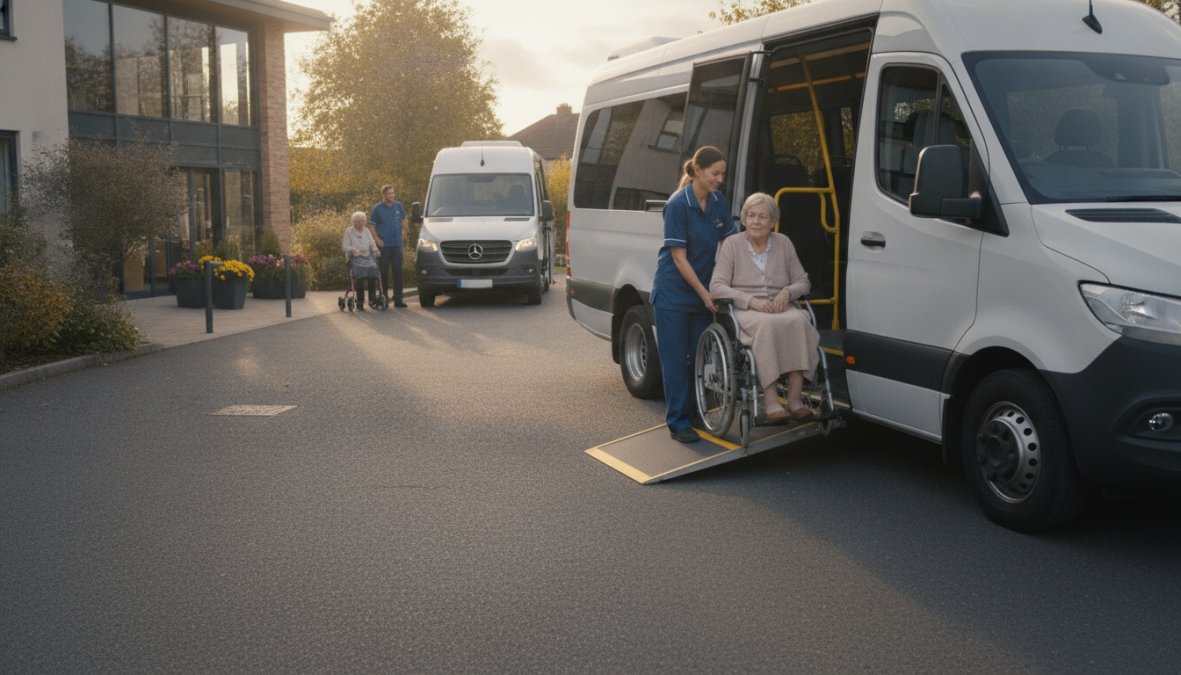
Wheelchair-accessible vehicles (WAVs) must meet specific accessibility standards. Essential features include:
Wheelchair restraint systems must meet BS 6854 standards and be regularly inspected. Monthly checks should verify restraint straps are not damaged, attachment points are secure, the system engages smoothly, and wheelchair wheels lock properly.
Transfer boards are essential for residents with reduced mobility who cannot stand independently. Staff must be trained in correct technique; improper use causes back injuries to staff and falls to residents.
Emergency equipment should include first aid kit (checked monthly), emergency contact numbers, oxygen (if needed), blanket or protective clothing, mobile phone, and incident report forms.
Operational risk assessment examines systems, processes, and controls that prevent incidents across all journeys, distinct from clinical assessment of individual residents.
Mobility assessment categorises residents into groups:
Each category requires different vehicle features, staff training, and journey planning. Medical needs documentation should travel with the resident. A simple card noting "resident requires oxygen during transport" or "resident has severe anxiety and benefits from familiar staff" ensures transport staff understand specific requirements.
Transport emergencies include vehicle breakdown, resident medical deterioration, traffic accident, and severe weather. Each requires documented response procedures.
Vehicle breakdown: If a minibus breaks down, the driver must move the vehicle to a safe location, contact breakdown service, notify the care home immediately, assess resident condition, and arrange alternative transport if the wait exceeds 30 minutes.
Resident medical deterioration: If a resident becomes unwell, the driver stops safely, accompanying staff assesses condition, and calls 999 if serious (chest pain, loss of consciousness, severe breathing difficulty) or contacts the care home for guidance if minor.
Traffic accident: If the minibus is involved in a collision, the driver ensures safety, assesses all residents for injury, calls 999 if anyone is injured, contacts the care home and families, documents the incident thoroughly, and reports to the insurer within 24 hours.
Care homes face a fundamental decision: operate transport in-house or outsource to external providers. This decision affects cost, control, flexibility, and liability.
In-house transport requires capital investment (vehicle purchase or lease), ongoing operational costs (fuel, maintenance, insurance), and staffing costs (driver salary, training, holiday cover). Outsourced transport involves per-journey fees or monthly retainers.
A care home with 40 residents making three journeys per week (60 journeys/week) might spend £45,000-£55,000 annually operating in-house transport. Outsourcing the same journeys at £25-£35 per journey could cost £78,000-£91,000 annually. However, in-house figures exclude hidden costs: manager's time, liability exposure, service disruption risk, and opportunity cost of capital.
Outsourced transport offers flexibility, risk transfer, and access to specialist services. The trade-off is reduced control over scheduling, vehicle condition, and driver familiarity with residents. For care homes considering in-house operation, Minibus Leasing Special Offers can help reduce capital outlay and provide access to well-maintained vehicles with flexible terms.
Transport staff-to-patient ratios depend on resident mobility and medical complexity:
| Resident Category | Journey Duration | Recommended Staff Ratio |
|---|---|---|
| Independent | Under 30 min | Driver only |
| Independent | Over 30 min | 1:4 residents |
| Assisted | Under 30 min | 1:4 residents |
| Assisted | Over 30 min | 1:3 residents |
| Dependent | Any duration | 1:2 residents |
| Specialist medical | Any duration | 1:1 resident |
Many care homes operate with inadequate ratios to save costs. A minibus with six dependent residents and one staff member is unsafe.
Transportation management systems (TMS) automate scheduling, reduce errors, and provide visibility into transport operations. Many care homes still use spreadsheets or paper-based systems creating inconsistency and limiting oversight.
A TMS captures resident transport requests, vehicle availability, driver availability, journey tracking, and compliance documentation. Digital platforms provide real-time visibility and automated alerts. Implementation typically requires 2-4 weeks of setup and staff training. A care home with 60+ journeys per week typically recovers the investment within six months through improved scheduling and reduced staff time.
Real-time tracking allows managers to see vehicle location and estimated arrival time. However, tracking raises privacy and data protection concerns. UK care homes must comply with GDPR and the Data Protection Act 2018. Tracking resident location is permissible only if residents have consented, tracking is necessary for safety or operational purposes, data is stored securely, and residents can opt out.
Many TMS platforms track vehicle location, not resident identity, respecting privacy while providing operational visibility. Data security is critical; transport data includes resident names, medical information, and location history. A TMS should be cloud-based (automatically backed up, encrypted in transit), accessed via secure login credentials, and audited for unauthorised access.
Driver competency is the single most important factor in safe care home transport. D1 licensing is the baseline, but best practice requires additional training:
Each certification has a validity period. First aid typically expires after three years, safeguarding after two years. Care homes should maintain a training matrix showing each driver's certifications and renewal dates with automated reminders.
Ongoing performance monitoring should include annual appraisals, review of incident reports, observation of actual journeys, and feedback from residents and staff. A driver with a valid D1 licence for five years without incident may still have developed poor habits creating risk. Annual observation ensures standards remain high.
Care home transport combines vehicle management, regulatory compliance, clinical assessment, and staff development. Many care homes approach it reactively, investing only when incidents occur or regulations force change. The organisations achieving the best outcomes take a proactive approach: comprehensive risk assessment, documented procedures, regular training, and investment in vehicles and systems supporting safe, dignified transport.
Whether you operate in-house or outsourced transport, the principles remain constant. Residents deserve safe, timely, and respectful transport. Staff deserve training and support enabling safe provision. Care home managers deserve systems and partners making transport management straightforward and compliant.
Care homes must ensure drivers hold appropriate D1 licensing (or grandfather rights) for passenger transport. Section 19 permits are required if operating non-commercial services. All vehicles must pass regular safety inspections, and staff must receive training in safe handling, patient dignity, and emergency procedures. HMRC regulations and local authority guidance also apply. Consult your regulatory body to confirm all compliance obligations for your specific care setting.
Conduct a documented risk assessment before each journey, evaluating mobility level, medical conditions, medication effects, and cognitive ability. Determine whether the resident requires stretcher transport, wheelchair-accessible transport with restraints, or standard seating. Obtain physician clearance for residents with complex medical needs. Document any behavioural concerns or communication difficulties. Reassess regularly, especially after changes in health status or mobility. This assessment guides vehicle selection and staff-to-patient ratios.
Essential features include wheelchair lifts or ramps (with weight capacity matching your residents), secure restraint systems, adequate headroom for standing transfers, non-slip flooring, and climate control. Vehicles should have grab handles, accessible seating, and space for mobility aids. Consider features like hydraulic suspension to reduce jolting and easy-access doors. Ensure regular maintenance schedules are documented. Vehicle choice depends on your patient population, stretcher-equipped vehicles differ from standard wheelchair-accessible minibuses.
In-house fleets offer control, consistency, and familiarity with residents but require capital investment, maintenance expertise, driver recruitment, and compliance management. Outsourced providers reduce operational burden and capital outlay but require careful vetting and ongoing coordination. A cost-benefit analysis should include vehicle acquisition, maintenance, insurance, staff salaries, training, and compliance overhead versus outsourcing fees. Many care homes use a hybrid approach, in-house for routine appointments, outsourced for specialist or long-distance medical travel.

