Aug 23, 2026
Last Updated: August 23, 2026
No, learner drivers cannot carry passengers in the UK. This is one of the most important rules you need to understand if you're supervising a learner or managing a fleet that includes learner drivers. The only person permitted to sit in the car alongside a learner driver is the supervising driver, who must meet strict legal requirements.
Understanding can learner driver carry passengers rules is essential for compliance and safety. Whether you're an education manager organising student transport, a care home coordinator arranging staff training, or a business owner with apprentices learning to drive, getting this wrong carries real penalties. The supervising driver is responsible for ensuring no unauthorised passengers are in the vehicle, and breaching this rule puts both the learner and the organisation at legal risk.
At Minibus Leasing UK, we work with schools, care homes, and commercial operators across the UK who manage fleets with learner drivers. Knowing the regulations inside out, from who can supervise to insurance requirements, is fundamental to running a compliant operation. Below, we'll walk you through the exact rules, the supervising driver's responsibilities, and what happens if you breach them.
The supervising driver is the legal cornerstone of learner driver transport. This person must be at least 21 years old and hold a full, valid driving licence for the category of vehicle being driven. They cannot be learning themselves, and they must be in a position to exercise effective control and supervision at all times.
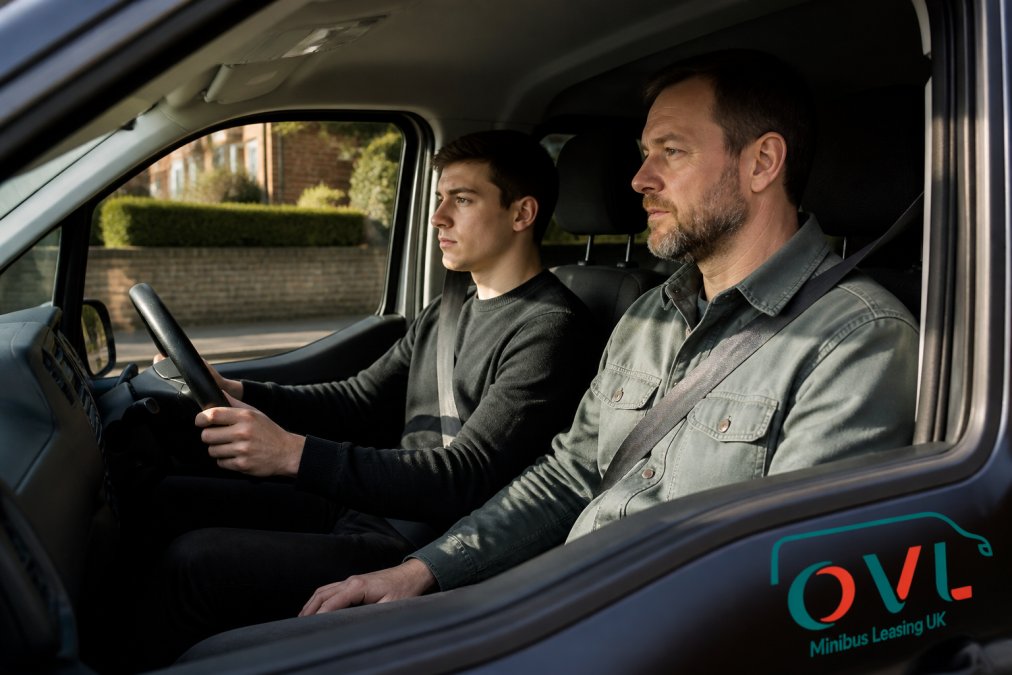
The supervising driver sits in the front passenger seat, this positioning is mandatory and has nothing to do with preference. It ensures they can see the road, reach the controls if necessary, and communicate clearly with the learner. They must be alert and capable of intervening immediately if something goes wrong. If the supervising driver is distracted, tired, or impaired in any way, they've failed in their legal duty.
The supervising driver must be at least 21 years old and hold a full driving licence that covers the vehicle category. For a standard car, they need a Category B licence. For larger vehicles, vans, minibuses, or HGVs, they need the appropriate category licence. A provisional licence does not count. Neither does a licence from outside the UK unless it's recognised under GB driving licence rules.
If the supervising driver holds a full licence but is disqualified from driving, they cannot supervise. Similarly, if they hold a licence but have never driven that particular category of vehicle, they shouldn't attempt to supervise a learner on that category, they lack the experience to teach or intervene effectively.
The accompanying driver must sit in the front passenger seat. This is not negotiable. The reason is straightforward: from the front passenger seat, the supervising driver has a clear view of the road, the learner's actions, and any hazards. They can reach the handbrake, speak clearly to the learner, and grab the steering wheel or brake pedal if needed.
Some people ask whether a supervising driver can sit in the back if there's an adult passenger in the front. The answer is no. The supervising driver must be in the front passenger seat, period. If you place them anywhere else, you've breached the law and invalidated your insurance coverage. The learner must be in the driver's seat, and the supervising driver must be in the front passenger seat. No exceptions.
Supervising a learner driver is not passive. The supervising driver is legally responsible for the learner's conduct, the safety of the vehicle, and compliance with traffic law. They cannot sit quietly and hope for the best. They must actively supervise, guide, and correct the learner throughout the journey.
The supervising driver must ensure the learner obeys all traffic laws and road signs. If the learner is about to make a mistake, pulling out unsafely, speeding, or ignoring a red light, the supervising driver must intervene before the mistake happens. This means giving clear, timely instructions and taking control if necessary.
The supervising driver is also responsible for ensuring no unauthorised passengers are in the vehicle. This is where the rule about learner driver carry passengers becomes practical. You cannot have friends, family members, colleagues, or anyone else in the car except the supervising driver. The only exception is for the learner driver and the supervising driver, that's it.
The supervising driver must be fit to drive. If they're tired, unwell, or under the influence of alcohol or drugs, they cannot supervise. Their judgment, reaction time, and ability to intervene depend on being fully alert. Many accidents involving learner drivers happen when the supervising driver is distracted or incapacitated.
Learner drivers cannot drive on motorways at all (gov.uk). This is an absolute ban. The supervising driver has no authority to permit it, and no amount of experience changes this rule. Learner drivers must stay on ordinary roads and dual carriageways where the national speed limit applies, but only if the supervising driver is confident the learner can handle it.
Dual carriageways present a higher risk than single-track roads. The supervising driver must assess whether the learner is ready. If the learner is nervous, inexperienced, or has only recently passed their test, the supervising driver should avoid dual carriageways altogether. The responsibility lies entirely with the supervising driver to decide what is safe.
Insurance for a learner driver is more restrictive than insurance for a fully qualified driver. Most learner driver insurance policies are explicit: the vehicle can only carry the learner driver and one supervising driver. Any additional passenger voids the policy. If an accident occurs and there was an unauthorised passenger in the vehicle, the insurance company may refuse to pay out. This leaves you personally liable for all costs, medical bills, vehicle damage, third-party claims.
When you arrange insurance for a learner driver, check the policy wording carefully. It should state clearly that only the learner and supervising driver are permitted in the vehicle. If you're unsure, ring the insurer and ask. Don't assume. If you're managing a fleet, whether it's school minibuses, care home transport, or commercial vehicles, make sure every policy is checked and documented. Organisations working with Minibus Leasing UK benefit from guidance on insurance compliance as part of fleet management, because a single policy breach can expose your entire operation to liability.
Some organisations ask whether they can add a named passenger to the policy. The answer is no. Learner driver insurance does not permit additional passengers under any circumstances. The only person in the vehicle besides the learner must be the supervising driver.
Get a Bespoke Quote or Speak to a Sector Specialist →
Nobody can sit in the back of a learner's car. Not children, not colleagues, not family members, not anyone. The vehicle must contain only the learner driver and the supervising driver. The back seats must be empty.
This rule applies regardless of the reason. Even if you need to transport a child, a patient, or an employee, you cannot do it with a learner driver. If the child or passenger has nowhere else to go, you must use a fully qualified driver instead. If you're an education provider, a care home, or a commercial operation, this constraint means you need qualified drivers for any journey that requires passengers beyond the supervising driver.
The reason is straightforward: the supervising driver must focus entirely on the learner. Any additional passenger, especially a child or vulnerable person, divides their attention and creates risk. A passenger in the back might distract the learner, or the supervising driver might be tempted to attend to the passenger rather than monitor the learner's driving. The law removes this risk by forbidding it entirely.
Breaching the learner driver rules carries serious penalties. If a learner driver is caught carrying unauthorised passengers, the learner faces a fine of up to £1,000 (gov.uk). The supervising driver also faces a fine of up to £1,000 for failing to ensure compliance. Both the learner and the supervising driver can receive penalty points on their licence, up to 6 points each in some cases.
Beyond the immediate fine, there are longer-term consequences. Penalty points accumulate on your driving record. If you accumulate 12 points within three years, you face automatic disqualification from driving (gov.uk). For a learner driver, this means the learning process stops. For a supervising driver, perhaps a manager or trainer, it could affect their employability.
Insurance implications are severe. If an accident occurs and there was an unauthorised passenger in the vehicle, the insurance company may refuse to pay. You become personally liable for all costs. If the accident injured someone, you could face a personal injury claim. If the accident involved a third party, another vehicle, a pedestrian, you're liable for their damages too.
Organisations that breach these rules face reputational damage. If a school, care home, or charity is caught transporting passengers with a learner driver, parents, residents, and funders lose confidence. Regulatory bodies, Ofsted for schools, the Care Quality Commission for care homes, may investigate. For organisations with Section 19 permits or D1 licensing, breaches can result in permit suspension or revocation. Compliance with learner driver rules is essential to protecting your entire fleet's legal status.
If you operate minibuses or larger vehicles for passenger transport, learner driver rules become even more critical. A minibus typically carries multiple passengers. A learner driver cannot operate a minibus in any scenario that involves carrying paying passengers or passengers as part of an organised transport service. This applies regardless of whether you hold a Section 19 permit or a D1 licence.
Organisations that provide student transport, care home transport, or staff shuttles must use fully qualified drivers. If you're training a driver to operate a minibus, they must complete their training in an empty vehicle with only a supervising driver present. Once they pass their test and receive their full licence, they can then operate the minibus with passengers.
For educational institutions, this means apprentices or trainee drivers cannot be used for student transport while they're still learning. For care homes, staff members learning to drive cannot transport residents. For commercial operators, apprentice drivers cannot operate crew vans or minibuses carrying employees or goods as part of a service.
The rule is absolute: learner driver carry passengers is prohibited. No exceptions exist for minibuses, no exceptions for educational settings, no exceptions for care homes. The vehicle must contain only the learner and the supervising driver.
Understanding these rules protects your organisation, your staff, and the learner drivers in your care. The regulations exist because learner drivers lack experience, and passengers create distraction and liability. Compliance is not optional, it's the foundation of safe, legal transport operations.
If you're managing a fleet that includes learner drivers or you're arranging transport for staff training, Minibus Leasing UK can help you navigate compliance requirements. Our team understands Section 19 permits, D1 licensing, insurance obligations, and the specific constraints of learner driver transport. We work with schools, care homes, and commercial operators across the UK to ensure every vehicle, every driver, and every journey meets legal standards. Explore our Minibus Leasing Special Offers to find cost-effective solutions for your fleet, or get in touch to speak to a sector specialist who can review your current transport arrangements and identify any compliance gaps.
A: No, a learner driver cannot carry passengers other than the approved accompanying driver in the front passenger seat. The vehicle must only contain the learner driver and the supervising driver. Carrying additional passengers is a breach of regulations and can invalidate insurance.
A: The accompanying driver must hold a full UK, EU, EEA, or other approved driving licence for the category of vehicle being driven. They must be at least 21 years old, be able to exercise effective control over the vehicle if needed, and sit in the front passenger seat. The accompanying driver should be capable of communicating clearly with the learner and must not be under the influence of alcohol or drugs.
A: No, a learner driver cannot carry children as passengers. The vehicle must only contain the learner driver and the supervising driver. This rule applies regardless of the passenger's age or relationship to the learner or supervisor.
A: Most learner driver insurance policies are explicit that the vehicle can only carry the learner driver and one supervising driver. Any additional passenger voids the policy. It is crucial to check your specific policy wording, as carrying unauthorised passengers can lead to the insurer refusing to pay out in the event of an accident.

