Jul 28, 2026
Last Updated: July 28, 2026
Learning how to check minibus driver licence eligibility is essential if you operate passenger transport vehicles in the UK. Whether you're running a community transport service, managing a school fleet, or operating commercial passenger routes, understanding your driving entitlement is non-negotiable for legal compliance and passenger safety.
Your driving licence determines what vehicle you can legally operate and under what conditions. Get this wrong, and you face fines, vehicle impoundment, and potential criminal liability. This guide walks you through the five key verification steps, explains the licence categories that matter most, and reveals what most operators overlook when checking their eligibility.
Before you log in to the DVLA portal, gather your National Insurance number, postcode, driving licence number, and the issue date from your licence. If checking eligibility for a specific vehicle, have the vehicle registration number (VRM) and Gross Vehicle Weight Rating (GVWR) to hand.
Your current driving licence is the foundation of this check. If your licence is lost or expired, apply for a replacement via the DVLA website (1-2 weeks processing).
Medical fitness matters if you're over 70. Drivers in this age bracket must meet specific health standards and may need to submit a medical declaration form (D4) to the DVLA. This is especially important for professional minibus drivers, as Group 2 medical standards are stricter than Group 1 requirements.
Category D1 is the primary licence category for minibus driving in the UK. It permits you to drive vehicles designed to carry 9-16 passengers (including the driver) with a Gross Vehicle Weight Rating not exceeding 7,500 kg.
To hold a D1 licence, you must be at least 18 years old and have held a full Category B (car) licence for at least two years. You cannot jump straight to D1 if you've just passed your car test. Medical standards follow Group 2 requirements: vision standards (corrected or uncorrected acuity of at least 6/7.5 in each eye), hearing requirements, and no conditions affecting safe driving such as diabetes requiring insulin or severe cardiovascular disease. Drivers over 70 must renew their D1 entitlement annually with medical certification.
The DVLA issues D1 licences for five-year periods (or until age 70, whichever comes first).
Category D1 covers minibuses (9-16 passengers), whilst Category D covers full-size buses (17+ passengers). The weight and passenger capacity thresholds determine which category applies.
Category D requires the same two-year B licence holding period and similar medical standards to D1. However, D drivers often need additional professional qualifications such as a Driver Certificate of Professional Competence (CPC), especially if operating for hire and reward.
A D1-only operator can legally drive vehicles up to 7,500 kg GVWR with up to 16 passengers. Exceeding either threshold requires a D licence.
You must be at least 18 years old to apply for a D1 licence, but you must have held a full Category B (car) licence for a minimum of two years before the DVLA will issue D1 entitlement. This means the earliest you can legally drive a minibus is age 20.
Drivers aged 65-70 can hold and renew a D1 licence but must undergo annual medical checks. At age 70, the licence automatically expires and must be renewed annually thereafter with medical certification.
Not every minibus operation requires a D1 licence. Understanding when you can operate without it saves considerable time and cost, particularly for volunteer-run organisations and small charities.
A full Category B (car) driving licence permits you to drive vehicles up to 3,500 kg GVWR and carry up to eight passengers (nine including the driver). This covers only small van conversions or accessible vehicles designed for fewer passengers. Most minibus operations require D1 entitlement.
Gross Vehicle Weight Rating (GVWR) is the maximum weight the vehicle is designed to carry, including passengers, cargo, and fuel. This figure, not the vehicle's actual weight, determines your licence requirements. Always check the GVWR plate on the vehicle itself or the V5C registration document.
For D1 licence holders, the GVWR limit is 7,500 kg. Vehicles exceeding this require a Category D licence. A vehicle designed to carry 16 passengers is classified as a minibus regardless of how many seats are actually installed. You cannot downgrade a 16-seat minibus to a van classification simply by removing seats.
A Section 19 permit (formally called a "permit under Section 19 of the Transport Act 1985") allows non-commercial organisations to operate minibuses for passenger transport without holding a full Public Service Vehicle (PSV) operator's licence.
You need a Section 19 permit if your organisation operates a minibus (9-16 seats) for non-commercial purposes and you're not an established bus operator. Non-commercial means you're not operating for hire and reward. Community transport, educational trips, and volunteer-run services typically fall into this category.
The permit is issued by your local traffic authority. The application process involves demonstrating your organisation's legitimacy, providing insurance details, and confirming your vehicles meet safety standards. Processing takes 4-6 weeks typically.
Importantly, a Section 19 permit does not exempt you from driver licensing requirements. Your drivers still need appropriate categories (D1 or D) unless they're operating under specific volunteer exemptions.
Volunteer drivers operating minibuses can sometimes drive without a D1 licence, but only under very specific conditions. The exemption applies to vehicles registered for use by a non-profit body where the driver receives no payment.
This exemption is narrow and often misunderstood. The safest approach is to ensure all drivers hold appropriate categories regardless of volunteer status. If your organisation operates under a Section 19 permit and uses volunteer drivers, confirm the specific terms with your traffic authority.
Educational minibus operations have additional requirements beyond standard passenger transport. Schools, colleges, and educational providers must comply with both driving licence regulations and safeguarding standards.
Schools operating minibuses must ensure all drivers hold appropriate categories (typically D1 for 9-16 seat vehicles). The school itself doesn't need an operator's licence if the minibus is used exclusively for school purposes. However, if the school hires the vehicle to external organisations, a full operator's licence becomes necessary.
Many schools use Section 19 permits for school-specific transport. This simplifies licensing but still requires drivers to hold valid categories. All school minibuses must pass annual MOT testing and meet specific safety specifications including seat belt provision, emergency exits, and wheelchair accessibility (where required).
Drivers transporting school-age children must pass a Disclosure and Barring Service (DBS) check. This is a separate requirement from driving licence eligibility but is mandatory for any adult regularly transporting young people.
Medical standards remain the same (Group 2 for D1 drivers), but schools often impose additional fitness requirements. Many require annual medical checks even for drivers under 70.
The DVLA's digital check code service is the fastest way to verify your driving entitlement. This service generates a temporary code that you can share with employers or vehicle operators, allowing them to check your licence details directly.
Visit the DVLA's official website and navigate to the "View your driving licence information" service. You'll need your National Insurance number, postcode, and driving licence number. The system generates an eight-character check code that remains valid for 21 days. The entire process takes 2-3 minutes online. No appointment or phone call is necessary.
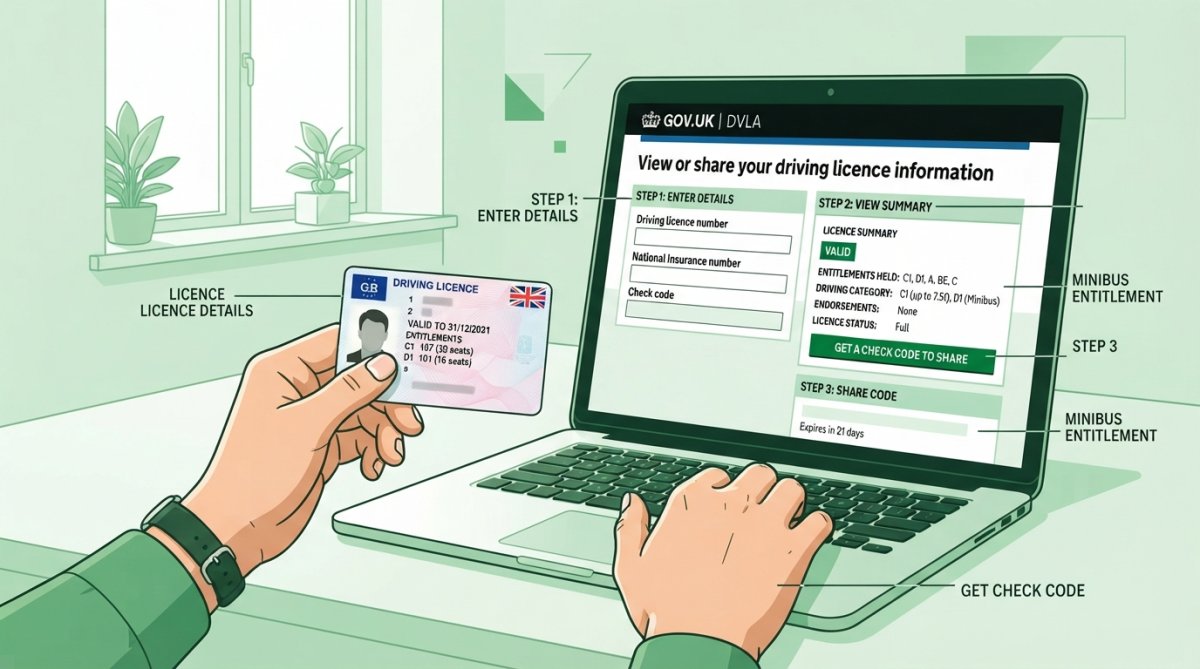
Once you have your check code, the operator can enter it into the DVLA's employer check service. This displays your full licence details including all categories you're entitled to drive, any restrictions, and the expiry date of your licence.
The results clearly show Category D1 entitlement if you hold it. The display also indicates any medical conditions or restrictions that affect your driving. If you're over 70, the system shows your annual renewal requirement.
For minibus operators, this check code service is essential. It provides legal proof of entitlement without requiring physical licence inspection.
Insurance requirements for minibus drivers differ significantly depending on whether you're operating commercially or non-commercially. Getting this wrong creates serious legal exposure.
Commercial minibus insurance covers vehicles operated for hire and reward (paid passenger transport). Premiums are higher because the vehicle is in constant use and carries commercial risk.
Non-commercial insurance covers minibuses used by charities, schools, and community organisations where passengers don't pay directly. Using non-commercial cover for commercial operations invalidates your insurance entirely, leaving you personally liable for any claims.
Passenger liability insurance covers injuries sustained by passengers during transport. This is mandatory for any minibus operation. Standard cover includes legal liability up to a specified limit (typically £5-10 million for passenger claims).
Fleet operators managing multiple minibuses need coordinated insurance covering all vehicles under a single policy. Each vehicle must be individually declared with its specific use (commercial, educational, community, etc.). Driver liability is equally important. If a driver causes an accident, both the driver and the vehicle operator can be sued. Regular safety audits, driver training records, and maintenance documentation all support your insurance position.
Most eligibility issues stem from misunderstanding licence categories or confusing weight and passenger restrictions.
The most common error is assuming a D1 licence permits driving any minibus. In reality, D1 has strict limits: maximum 7,500 kg GVWR and maximum 16 passengers. Vehicles exceeding either threshold require a Category D licence.
Another frequent mistake is assuming Category B (car) licence holders can drive minibuses if they remove seats. The vehicle's design classification determines your licence requirement, not the number of seats actually installed.
Drivers over 70 often overlook their annual renewal requirement for D1 licences. The licence doesn't automatically renew; the driver must apply with medical certification. Operating with an expired licence is illegal.
Medical conditions can invalidate your licence even if you hold the correct category. Conditions such as diabetes requiring insulin, certain cardiovascular diseases, and neurological disorders can result in licence withdrawal. If you develop such a condition, you must notify the DVLA immediately.
A Category B licence allows you to drive vehicles up to 3,500 kg Gross Vehicle Weight Rating (GVWR) with a maximum of eight passenger seats (excluding the driver). If your minibus exceeds these limits, you'll need a Category D1 or full Category D licence. Always check your specific vehicle's weight classification and passenger capacity against your licence entitlement using the DVLA check code service to confirm eligibility.
A Category D1 licence permits you to drive minibuses with 9-16 passenger seats and a maximum length of 8 metres. You must be at least 21 years old and have held a full Category B licence for a minimum of two years. A full Category D licence covers vehicles with more than 16 seats. Many minibus operators require D1 licensing to ensure regulatory compliance and passenger safety, particularly for hire-and-reward or community transport operations.
A Section 19 permit authorises non-commercial passenger transport (e.g., community groups, charities, or educational organisations) to operate minibuses without a full Public Service Vehicle (PSV) operator's licence. You'll need a Section 19 permit if you're charging passengers for transport but operating on a non-profit basis. Volunteer drivers operating under a Section 19 permit may have different licensing requirements, check with your local traffic commissioner to confirm your specific circumstances and compliance obligations.
Visit the DVLA's online driving licence check service and request a check code using your driving licence number, postcode, and National Insurance number. You'll receive a unique check code valid for 30 days. Use this code to verify your licence categories, including D1 or D entitlements, and any medical conditions or endorsements that affect your eligibility. This digital verification is essential before operating a minibus commercially or for organised transport services.

