Jul 03, 2026
Last Updated: July 3, 2026
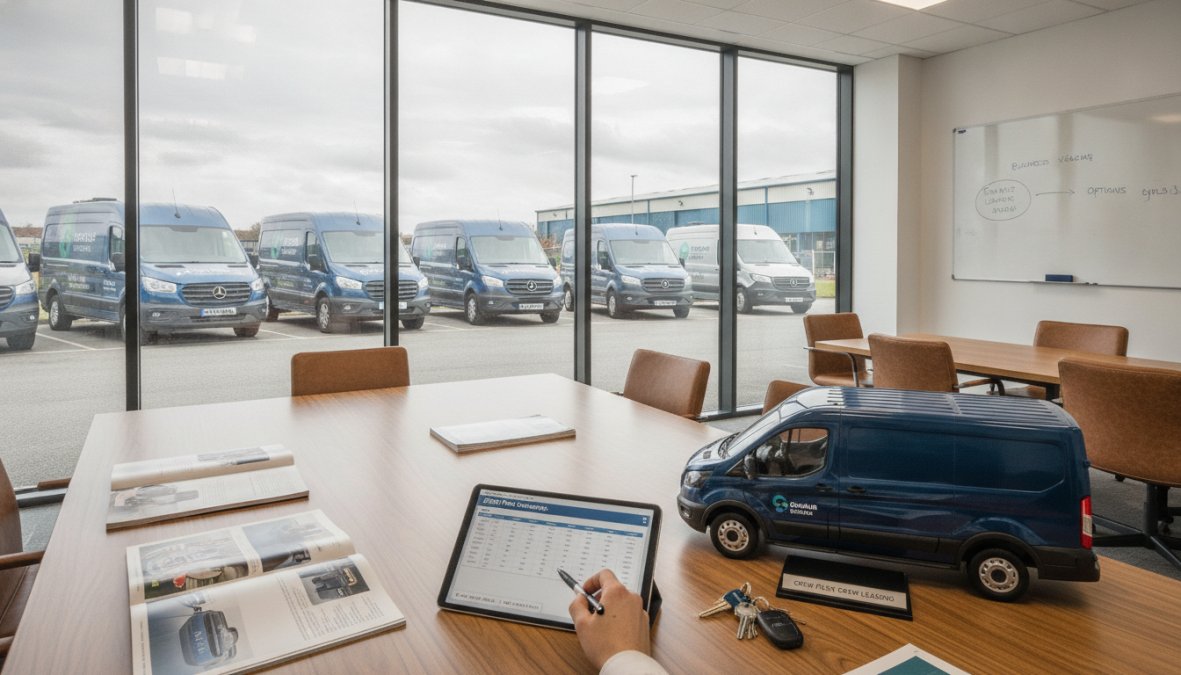
Crew van leasing offers a practical alternative to purchasing vehicles outright. Businesses rent purpose-built crew vans on fixed monthly terms, typically 24 to 60 months, paying a single fee that covers the vehicle, maintenance, insurance, and roadside assistance. At lease end, you return the van with no depreciation risk or residual value concerns.
A crew van combines cargo capacity with passenger seating, allowing teams to transport both equipment and personnel in one vehicle. This dual functionality eliminates the need for separate transport solutions, reducing fleet complexity and operational costs.
The leasing model transfers maintenance, compliance, and mechanical upkeep to the lessor, freeing your business to focus on core operations rather than fleet administration.
Choosing between a crew van and a panel van depends on whether your team travels with your cargo. A crew van prioritises passenger comfort alongside cargo space, typically seating 5-9 people with a bulkhead separating the crew cabin from cargo. This works well for trades where teams travel together: electricians, plumbers, construction crews, and maintenance teams.
Panel vans maximise cargo volume by eliminating passenger seating beyond the driver and front passenger. They offer superior payload capacity, making them ideal for courier services and goods transport.
Payload capacity represents the maximum weight a vehicle can safely carry. Most crew vans carry 800-1,200 kilograms; a Ford Transit Custom Crew handles approximately 1,000 kg. Panel vans of equivalent size typically manage 1,500-1,800 kg because they lack passenger safety reinforcement.
Crew van cargo space ranges from 4.5 to 7 cubic metres, while panel vans offer 8-15 cubic metres. The bulkhead protects passengers from shifting loads but reduces overall volume.
If your team travels together carrying moderate loads, a crew van provides the right balance. If you're primarily moving goods, a panel van's superior capacity justifies the trade-off.
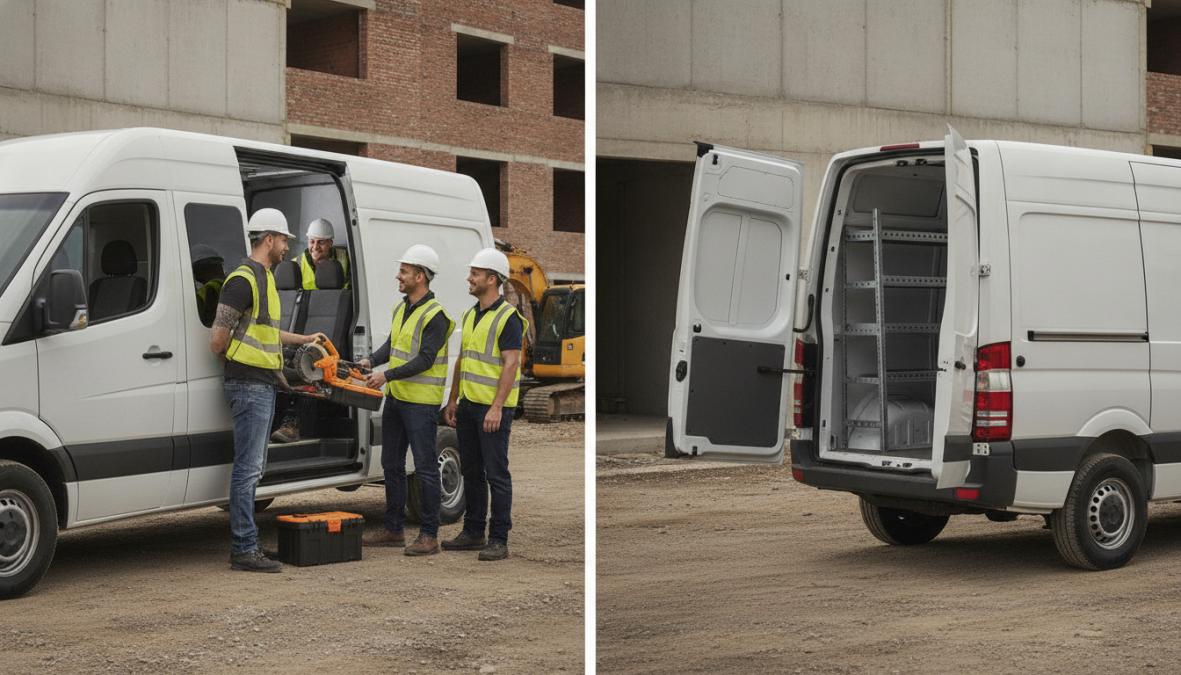
Crew vans typically seat 5-9 passengers depending on configuration. Most common models offer seating for 6-8 people. Passenger comfort influences both safety and productivity; crew members spending hours in cramped vehicles experience fatigue, reducing on-site focus.
Modern crew vans address this through improved suspension, climate control, and ergonomic seating. Vehicles with heated seats, air conditioning, and modern infotainment systems improve driver retention and team morale.
Legally, vehicles carrying more than 8 passengers (including the driver) fall under different insurance classifications and may require additional licensing, affecting whether you can use standard commercial auto insurance or must upgrade to specialist crew transport policies.
The lease-versus-buy decision hinges on total cost of ownership, which extends far beyond the purchase price. Purchasing a crew van requires capital outlay (typically £25,000-£45,000), plus ongoing costs: vehicle tax, insurance, maintenance, tyres, repairs, and depreciation. A 5-year-old crew van loses 40-50% of its original value. Unexpected repairs can cost £3,000-£8,000 and disrupt operations.
Leasing eliminates these variables. Your monthly payment covers the vehicle, comprehensive maintenance, roadside assistance, and most insurance. You avoid depreciation risk and drive brand-new vehicles with the latest safety features and fuel efficiency.
An operating lease treats the vehicle as a rental. You pay monthly fees, and the leasing company retains ownership. At lease end, you return the vehicle with no further obligation. Operating leases appear as operational expenses on your profit and loss statement, not as balance sheet assets.
A finance lease functions more like ownership with a loan component. You make monthly payments and hold legal title at lease end. Finance leases appear as assets and liabilities on your balance sheet. This structure suits businesses planning to keep vehicles beyond the lease term or wanting to claim capital allowances for tax purposes.
The tax treatment differs significantly. Operating leases allow you to deduct the full monthly payment as a business expense. Finance leases let you claim capital allowances on the vehicle's cost, which may offer greater tax relief depending on your circumstances.
For a crew van leased over 36 months at £450 monthly:
Compare that to purchasing a £35,000 crew van:
Leasing costs roughly one-third of ownership, freeing capital for hiring, expansion, or emergency reserves.
Tax treatment of crew van leasing differs between operating and finance leases, and understanding this distinction can substantially reduce your tax liability.
When you purchase a vehicle, you cannot immediately deduct the full purchase price as a business expense. Instead, you claim capital allowances, a gradual tax relief spread over several years. Under current UK rules, most commercial vehicles qualify for the Annual Investment Allowance (AIA), allowing you to deduct up to £1,000,000 of capital investment annually. You could claim the full purchase price of a £35,000 crew van against your profits in the year of purchase.
However, capital allowances come with conditions. The vehicle must be new, and you must use it in your business. If you later sell the vehicle for more than its written-down value, you may face a balancing charge.
Operating leases sidestep this complexity. The monthly lease payment is a straightforward business expense, deducted against your profits each month, with no capital allowance calculations or balancing charges.
New businesses face additional scrutiny from leasing companies. Established firms with trading history can access leasing easily, but startups must navigate stricter eligibility criteria.
Leasing companies assess creditworthiness through personal credit history, business accounts and bank statements, and sometimes require a personal guarantee. Most require at least 6-12 months of business accounts showing positive cash flow.
If your business is younger, you may need to provide a larger initial deposit (3-6 months' lease payments), secure a personal guarantee from a director with strong credit, or demonstrate that your business model is sound through detailed projections and evidence of customer demand.
All crew van leases require commercial auto insurance, distinct from personal vehicle coverage. Leasing companies typically require you to maintain insurance at a specified level with the lessor named as an interested party.
Crew vans carrying more than 8 passengers (including the driver) may trigger additional licensing requirements. Your drivers might need a minibus licence (Category D1) rather than a standard car licence, depending on the vehicle's maximum authorised mass and seating capacity.
Compliance also extends to vehicle maintenance records. Leasing companies mandate regular servicing at approved centres to preserve warranty coverage and ensure roadworthiness.
One of leasing's strongest advantages emerges when managing multiple vehicles. Fleet management, coordinating maintenance, tracking vehicle usage, and ensuring regulatory compliance, becomes substantially simpler under a leasing arrangement.
Leasing companies typically include comprehensive maintenance in the monthly payment: scheduled servicing, replacement of wear items (tyres, brake pads, windscreen wipers), and repairs to mechanical and electrical systems. You drive to an approved service centre and walk away, no invoices or surprise costs.
Most leasing packages include full servicing, tyre replacement, brake pad replacement, electrical and mechanical repairs, roadside assistance, and vehicle inspections. The trade-off: you must use the leasing company's approved network, typically major chains like Halfords, Kwik Fit, and manufacturer dealerships. This standardisation ensures consistent quality and keeps detailed service records.
As your lease approaches its end, planning the transition prevents operational disruption and unexpected costs. Leasing companies conduct a vehicle inspection 8-12 weeks before expiry, assessing condition against the lease agreement's wear-and-tear standards. Normal wear is acceptable, but damage beyond ordinary use can trigger end-of-lease charges.
To minimise charges, address outstanding maintenance issues before inspection, clean the vehicle thoroughly, document its condition with photographs, review the lease agreement's wear-and-tear clauses, and arrange replacement vehicle delivery to coincide with the old lease end.
Crew van leasing offers flexibility in both payment structures and vehicle configuration. Many businesses assume leasing means accepting a standard vehicle as-is, but modern leasing agreements accommodate customisation and varied payment approaches.
Upfitting, modifying a vehicle to suit specific operational needs, is often possible within leasing agreements with lessor approval. Common requests include installing shelving, tool racks, storage systems, bulkheads, roof bars, ladder racks, or specialist equipment.
Some leasing companies include basic upfitting in the lease package. Others allow third-party installation with lessor approval. Modifications must be reversible and cannot permanently alter the vehicle or void the warranty.
Leasing agreements specify an annual mileage allowance, typically 10,000 to 30,000 miles. Exceeding your allowance incurs overage charges, usually 8-15 pence per excess mile. Underestimating mileage is expensive; a business planning 15,000 annual miles but driving 22,000 faces charges of approximately £1,050-£1,225.
To estimate accurately, track actual miles for 2-3 months, multiply by 12, and add 15% for seasonal variation. If usage is unpredictable, negotiate a higher allowance upfront.
Lease terms offer flexibility. While 36 months is standard, many companies offer 24-month terms (for frequent vehicle updates), 48-month terms (for lower monthly payments), or 60-month terms (for maximum cost reduction). Shorter terms suit growing businesses; longer terms work for stable operations.
Selecting a crew van leasing provider requires evaluating multiple dimensions beyond the monthly payment. The cheapest quote often masks hidden costs, inflexible terms, or poor service quality.
Assess your operational requirements first. Define how many vehicles you need, what payload and passenger capacity each must handle, and what annual mileage you'll drive. Specify any upfitting or customisation needs.
Compare total cost of ownership, not just monthly payments. Request itemised quotes showing what's included in the monthly fee. Does it cover insurance, maintenance, roadside assistance, and vehicle tax? What happens if you exceed your mileage allowance?
Evaluate the lessor's service quality and account management. You'll interact with this company for 36-60 months. Do they respond promptly? Do they have a dedicated account manager who understands your business? Can they handle urgent vehicle swaps if your van breaks down?
Review the lease agreement's terms carefully. What constitutes excess wear and tear? What are early termination penalties? Can you adjust your mileage allowance mid-lease? Understanding these details prevents expensive surprises.
Check the available vehicle range and current offers. Does the lessor offer the specific models and configurations you need? Do they have vehicles in stock for quick delivery? Can they provide vehicles with the latest safety features and fuel efficiency? Many providers, including those offering Minibus Leasing Special Offers, regularly update their pricing to help businesses access better value.
| Evaluation Criterion | What to Assess | Why It Matters |
|---|---|---|
| Total Monthly Cost | Insurance, maintenance, tax, roadside assistance included? | Lowest payment ≠ lowest total cost |
| Vehicle Range | Models available, customisation options, stock levels | Ensures you get vehicles suited to your operations |
| Account Management | Dedicated manager, response times, flexibility | Good service prevents downtime and frustration |
| Lease Terms | Mileage allowance, wear-and-tear standards, early exit penalties | Protects you from unexpected costs and inflexibility |
| Compliance Support | Insurance guidance, licensing advice, regulatory updates | Reduces your legal and operational risk |
Crew van leasing transforms how organisations manage transport assets. By converting a capital expenditure into a predictable operational cost, leasing frees working capital for growth while eliminating depreciation risk and maintenance headaches. Whether you're a construction firm needing reliable crew transport, a utilities business requiring rapid fleet expansion, or a service company scaling operations, the right leasing partnership delivers flexibility, compliance, and cost control.
Get a bespoke quote today and discover how crew van leasing can simplify your fleet operations and reduce your transport costs.
A crew van is a commercial vehicle designed to transport both workers and equipment to job sites. Businesses use crew vans because they combine passenger capacity with cargo space, making them ideal for construction, maintenance, logistics, and service-based operations. Unlike panel vans, crew vans prioritise passenger comfort with dedicated seating, whilst maintaining sufficient payload capacity for tools and materials. They're essential for businesses that need to move teams and resources together efficiently.
Yes. Under an operating lease, monthly payments are typically treated as a business expense and may be fully deductible from your corporation tax or self-assessment income. Finance leases may offer different treatment depending on your accounting method. Unlike purchasing, leasing avoids depreciation concerns and capital expenditure write-downs. However, you cannot claim VAT recovery on operating lease payments the same way you might on a purchase. Consult your accountant to understand the specific implications for your business structure.
Leasing typically offers lower upfront costs, predictable monthly payments, and included maintenance through service packages. Buying requires capital expenditure but builds asset value and offers long-term cost savings if you keep the vehicle beyond the lease term. Your total cost of ownership depends on annual mileage, how long you need the vehicle, and whether you prefer fixed budgeting. Leasing is ideal for businesses wanting flexibility and predictability; buying suits those with stable, long-term transport needs and the capital available.
Standard lease terms range from 24 to 60 months, with most businesses choosing 36 or 48-month contracts. Monthly payments depend on the vehicle specification, lease duration, mileage allowance, and whether you select additional services like maintenance and breakdown cover. Lease agreements typically include a down payment, fixed monthly costs, and a residual value assessment at the end. Flexible financing options allow you to adjust mileage allowances and customisation (such as bulkhead or shelving) to match your operational requirements and budget.

