
Sep 26, 2026
Last Updated: September 25, 2026
Crew van safety features for employee transport are the systems, structures and specifications that protect the people travelling in your vehicle and the loads they carry. Get them right and you meet your legal duties; get them wrong and an incident on the A45 can become a corporate liability case.
This guide from Minibus Leasing UK covers the features that matter, the duty of care that sits behind them, and how to lease a compliant vehicle for operations in Northampton and across the United Kingdom.
The stakes are straightforward. A crew van is a workplace on wheels, and the Health and Safety at Work etc. Act 1974 places the same duty on employers for a vehicle as for a workshop floor. Health and Safety Executive guidance on work-related vehicle safety sets out that duty plainly: vehicles used for work are work equipment, and they must be safe, maintained and fit for purpose. Most fleet managers we speak to focus on the vehicle's price and payload, then treat safety as a checkbox. That is backwards.
A compliant crew van starts with two systems: occupant protection and driver assistance. Everything else supports those two.
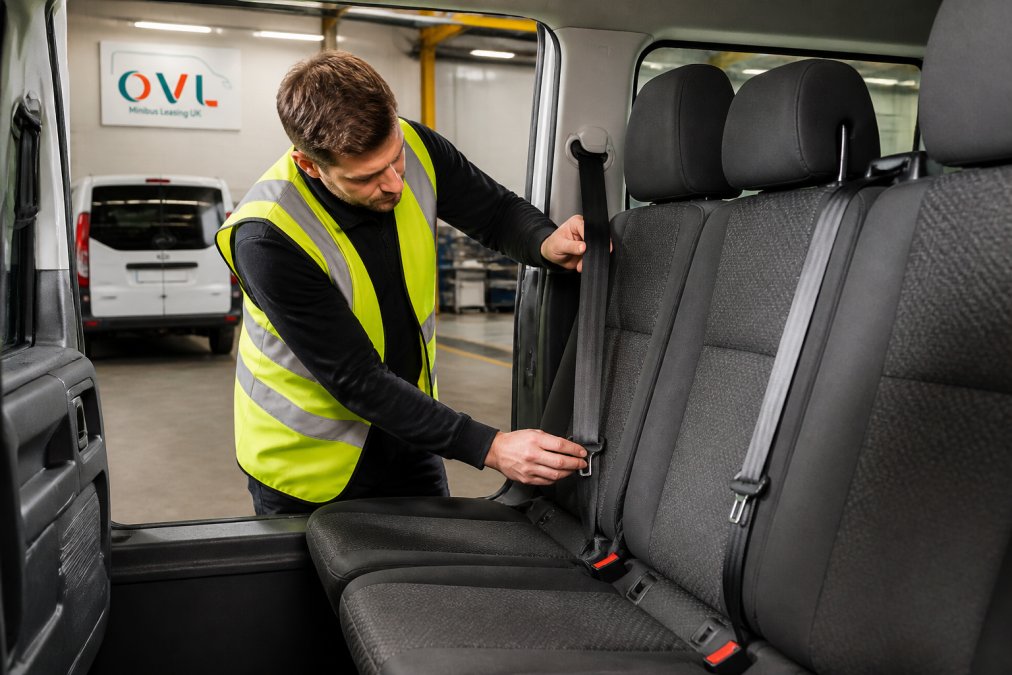
Every seat in a crew van should be a proper, manufacturer-fitted seat with a three-point belt and a head restraint. This is not a detail you can compromise on. Bench seats retrofitted by a third party, or belts bolted through a plywood bulkhead, are a common cost-cutting shortcut and a common cause of serious injury.
Check for these before you sign anything:
A properly specified crew van protects the second row as carefully as the driver. That is the whole point of choosing a crew van over a converted panel van.
Electronic stability control and autonomous emergency braking should be non-negotiable, not optional extras. These two systems do more to prevent collisions than any other technology on the market.
Look for adaptive cruise control, lane-keeping assistance, blind-spot monitoring and a reversing camera or sensors. Tyre pressure monitoring is now standard on most new vans, and it matters more than drivers realise: a slow puncture on a fully loaded crew van changes braking distance noticeably.
Crew van duty of care requirements mean an employer must ensure the vehicle, the driver and the journey are all safe before staff travel. This is a legal obligation, not a policy preference.
The duty covers four areas. First, the vehicle must be roadworthy, taxed, insured and properly maintained, with a documented servicing schedule. Second, the driver must hold the correct licence for the vehicle's weight and be competent to drive it. Third, the journey must be planned sensibly, with realistic schedules that do not encourage speeding. Fourth, you must keep records that prove all of the above.
What most guides miss is the paperwork. If the Health and Safety Executive investigates an incident, your maintenance log, driver licence checks and risk assessments are the evidence that you met your duty. Employers who run informal arrangements, with no written checks, have no defence when something goes wrong.
A practical approach is a simple driver and vehicle file for each crew van, reviewed quarterly. It takes minutes to maintain once it is set up.
Load restraint regulations UK require that any load carried in a crew van is secured so it cannot move, and that the restraint system is strong enough for the weight involved. The rules apply whether you are carrying tools, equipment or materials.
The core principle is simple: a load must be restrained to withstand the forces of emergency braking and cornering, not just to sit still when parked. A loose toolbox in a crew van becomes a projectile in a collision, and it will strike whoever is sitting in front of it.
Get a Bespoke Quote or Speak to a Sector Specialist →
For fleet operators, this means:
DVSA guidance on securing loads explains the standards enforcement officers apply at roadside checks. Non-compliance can lead to prohibition notices and, in serious cases, prosecution. For a crew van carrying both people and cargo, this is the regulation most likely to catch you out.
Van safety technology for fleets should be specified at the point of order, not retrofitted later. Retrofitting is more expensive, less reliable and often leaves gaps in warranty cover.
The specification list we recommend to fleet managers covers three categories: prevention, protection and monitoring. Prevention means autonomous emergency braking, stability control and lane assistance. Protection means airbags, a reinforced bulkhead and properly rated seats. Monitoring means telematics, driver behaviour reporting and a reversing camera.
Telematics deserves particular attention. Modern systems can flag harsh braking, speeding and excessive idling, giving you the data to coach drivers before an incident happens rather than after. For employers managing duty of care, that data is also evidence that you are actively managing risk.
| Safety Category | Feature to Specify | Why It Matters |
|---|---|---|
| Prevention | Autonomous emergency braking | Reduces rear-end collisions in traffic |
| Prevention | Electronic stability control | Prevents skidding when loaded |
| Protection | Full steel bulkhead | Stops cargo entering the cabin |
| Protection | Three-point belts at every seat | Protects all crew positions |
| Monitoring | Telematics with driver reporting | Provides duty of care evidence |
| Monitoring | Reversing camera or sensors | Cuts low-speed manoeuvring incidents |
Leasing a compliant crew van is usually more cost-effective than buying outright, because it spreads the cost of a brand-new, fully specified vehicle across a predictable monthly term and keeps maintenance within the agreement.
At Minibus Leasing UK, we work with operations managers, school business managers, care home managers and charity directors across Northampton and the wider United Kingdom to specify vehicles that meet both their safety obligations and their budgets. Our approach starts with a whole life cost analysis, so you can see the true cost of running a vehicle over its term rather than just the headline monthly figure.
Three questions to settle before you lease:
Answer those honestly and the specification writes itself. Get them wrong and you either under-specify, which is a safety risk, or over-specify, which wastes budget.
We also handle the compliance side that catches many operators out, including Section 19 permits and D1 licensing for passenger-carrying vehicles.
Employers must comply with the Health and Safety at Work etc. Act 1974, which requires safe transport as part of wider duty of care. Crew vans need valid MOT, road tax and insurance, and drivers must hold the correct licence category. Seats must have working seatbelts, and the vehicle must be maintained to a roadworthy standard. The Health and Safety Executive expects employers to risk-assess employee journeys, including the vehicle, driver and route, not just the work itself.
The Act places a duty on employers to protect employees' health and safety 'so far as is reasonably practicable', and this extends to work-related travel. For crew van transport, that means assessing driver competence, vehicle condition, journey length and load security. Employers should keep records of vehicle inspections, driver checks and any incidents. Following crew van duty of care requirements helps demonstrate compliance and reduces the risk of enforcement action or civil claims after an accident.
Prioritise three-point seatbelts for every seat, head restraints, electronic stability control, autonomous emergency braking and a reversing camera or sensors. For vans carrying both crew and cargo, a robust bulkhead or cargo barrier protects rear passengers from shifting loads. Look for tyre pressure monitoring, adaptive cruise control and lane-keeping assistance on newer models. When leasing, confirm the specification includes these as standard rather than optional extras, and check that seating capacity matches your typical team size.
Follow load restraint regulations UK guidance by using rated straps, bars or nets to secure every load, and never rely on friction alone. Loads should be restrained against forward, rearward and sideways movement. Where a crew van carries both people and equipment, fit a tested bulkhead and keep the cargo area separate from seating. Train drivers to check restraints before each journey and after any stop where the load may have shifted. Document these checks as part of your fleet safety policy.

