Jul 26, 2026
Last Updated: July 26, 2026
A D1 licence permits you to drive vehicles designed to carry between 9 and 16 passenger seats, covering most minibuses used by schools, charities, and care providers in the United Kingdom. Understanding D1 driving licence requirements is essential if you operate such vehicles, as the compliance implications are serious. Operating a vehicle without the correct licence category exposes your organisation to legal and insurance consequences, invalidates insurance, results in penalty points, and creates liability if an incident occurs.
The distinction matters because many operators assume their standard car licence (category B) covers minibus driving. It doesn't. The DVLA enforces strict rules about vehicle classification.
The D1 category applies to vehicles with a maximum authorised mass not exceeding 7,500 kilograms and designed to carry a maximum of 16 passenger seats, including the driver. Your vehicle's classification depends on its design specification, not how many passengers you actually carry. A minibus built to accommodate 15 seats remains a D1 vehicle even if you only transport 8 passengers that day.
If your minibus seats between 9 and 16 passengers, your drivers need a D1 licence. School transport minibuses, care home vehicles, and community transport buses typically fall into this category. Smaller vehicles carrying 8 or fewer passengers remain within the standard car licence scope.
Educational institutions, care organisations, charities, and voluntary organisations operating passenger transport services must ensure their drivers hold D1 entitlement. This includes schools, colleges, care homes, day centres, supported living providers, social services departments, and local authorities running community transport schemes.
The minimum age for D1 driving is 24 years old. Drivers aged 21-23 can obtain D1 provisional entitlement if they are employed as professional drivers and have held a full category B licence for at least two years. Provisional D1 entitlement requires a fully qualified D1 driver to accompany you, seated beside you in the cab, until you pass your practical test.
Your existing category B licence is a prerequisite for D1 driving. You cannot hold D1 entitlement without first holding a full car licence.
The DVLA applies rigorous medical standards to all D1 drivers to protect passengers and other road users. Medical fitness to drive requires ongoing compliance with specific health criteria.
When you apply for a D1 licence, you must complete a medical assessment by a registered GP or occupational health practitioner using form D4 (Medical Examination Report for Large Goods and Passenger Vehicles). The D4 form examines your cardiovascular health, neurological fitness, eyesight, mental health, and substance misuse history.
The form costs money, and you must arrange and pay for this assessment yourself. Your GP or occupational health provider will send it directly to the DVLA. Processing typically takes 4-6 weeks from submission.
Your eyesight must meet strict DVLA standards. The minimum visual acuity requirement is 6/7.5 in each eye (or 6/6 if you have only one eye). If you wear glasses or contact lenses, you must wear them whenever you drive. You must have a visual field of at least 160 degrees horizontally.
Ensure your prescription is up to date before your D4 assessment. An outdated prescription could result in you failing the visual standards, even if a new prescription would bring you within limits.
Obtaining a D1 licence requires passing both theory and practical tests, which are more demanding than the standard car driving test.
The D1 theory test covers 50 multiple-choice questions. You have 90 minutes to complete the test. The pass mark is 43 out of 50. The test focuses on large vehicle operation, passenger safety, and specific regulations applying to D1 vehicles, including vehicle stability, blind spots, passenger boarding procedures, emergency procedures, and the "not for hire or reward" restriction.
You can take your theory test at any approved test centre. Booking typically requires 2-4 weeks' notice. If you fail, you must wait at least 3 working days before your next attempt.
The D1 practical test lasts approximately 90 minutes and assesses your ability to safely operate a larger vehicle. An approved DVLA examiner will assess your performance across multiple competencies.
The test includes an eyesight check at the start. If you fail this initial check, the test ends immediately. You'll then complete an uncoupled vehicle check, a walk-around inspection of the minibus checking lights, mirrors, tyres, and other safety-critical items.
The driving element includes urban driving, rural roads, and motorway driving. You'll demonstrate smooth gear changes, appropriate mirror use, safe positioning, and hazard awareness. You'll perform an emergency stop, reverse the vehicle, and complete an independent drive section. The pass mark is based on driving faults and serious faults. Any serious fault results in immediate failure.
"Not for hire or reward" means you cannot charge passengers for their transport. This restriction applies to all D1 licences issued since 1997, unless you specifically obtained exemption through a Section 19 permit.
The term "reward" is broad. It includes obvious charges and indirect payments such as employer reimbursement or passenger donations. A school can use a D1-licensed driver to transport pupils (no charge); a care home can use a D1 driver for resident transport (no charge); a charity can use a D1 driver for volunteer community transport (no charge). But a coach company cannot use a D1 driver for paying passengers.
If you want to operate a minibus carrying passengers for payment, you need a Section 19 permit from your local traffic authority. This permit exempts you from the "not for hire or reward" restriction, allowing your D1-licensed drivers to legally transport paying passengers.
Section 19 permits are issued under the Transport Act 1985 and typically apply to charities, voluntary organisations, and not-for-profit bodies. Applying involves submitting an application to your local traffic authority with evidence of your organisation's charitable status, details of services, and insurance documentation. The process typically takes 4-8 weeks. Once granted, the permit lasts five years.
All D1 drivers must complete periodic Driver Certificate of Professional Competence (Driver CPC) training to maintain their licence validity. The requirement applies to drivers who have held their D1 licence for more than two years.
Driver CPC training consists of 35 hours of accredited training every five years. Training covers road safety, vehicle maintenance, fuel efficiency, passenger safety, and driver health and wellbeing. Training can be delivered through driving schools, employer-run programmes, or specialist training organisations.
Failure to complete your periodic CPC training within the five-year cycle results in your D1 licence becoming invalid. You cannot legally drive a D1 vehicle without current CPC training.
| Training Element | Frequency | Duration | Consequence of Non-Compliance |
|---|---|---|---|
| Periodic CPC training | Every 5 years | 35 hours minimum | D1 licence becomes invalid |
| Medical reassessment (D4 form) | Every 5 years (ages 45-65), annually (age 65+) | 1 appointment | Licence renewal refused |
| Eyesight check | At each renewal | Minutes | Immediate failure if not met |
The application process for a D1 licence involves several stages and requires careful attention to documentation.
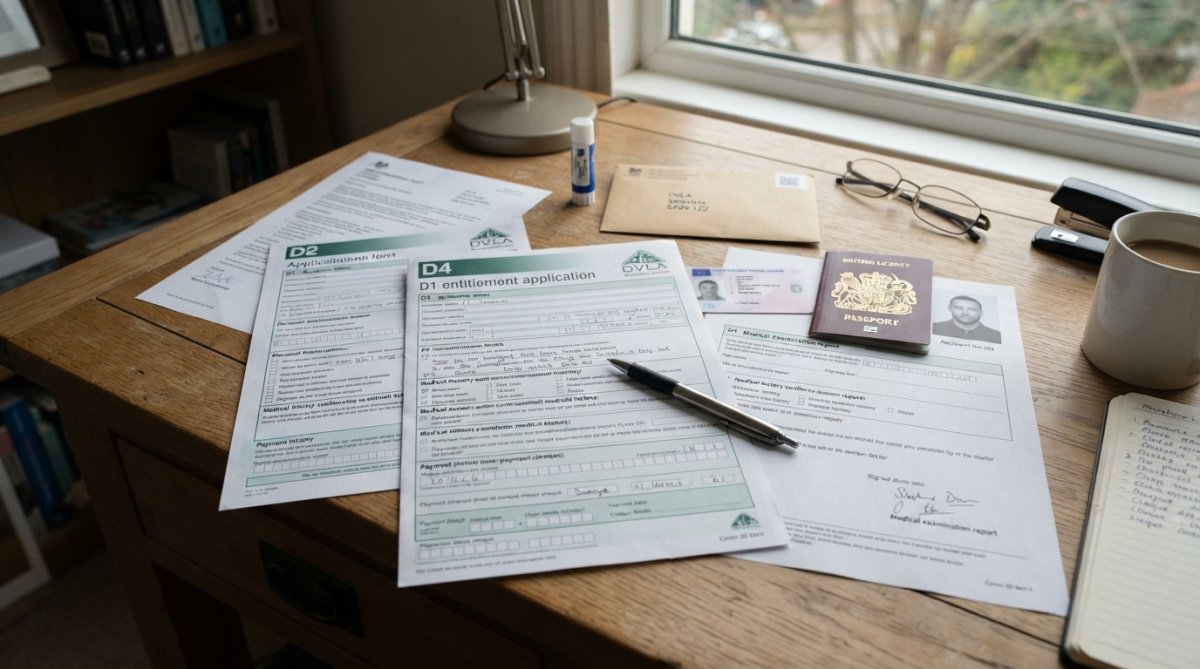
Your application begins with form D1, the Application for a Large Goods or Passenger Vehicle Driving Licence. The form requires detailed personal information: your full name, date of birth, address, and national insurance number.
You'll declare your medical history, including any conditions affecting your fitness to drive. Be thorough and honest. The DVLA cross-checks medical information with NHS records, and any discrepancies can result in your application being refused. You'll also declare your driving history, including any offences, penalty points, or disqualifications.
You'll confirm that you meet the age requirement and declare your medical fitness.
Your application requires a passport-sized photograph meeting DVLA standards: 45mm × 35mm, in colour, against a plain background, showing your face clearly without glasses or sunglasses, taken within the last six months.
You'll need to provide your current photocard driving licence, proof of identity (passport or national ID card), and proof of address (utility bill, council tax bill, or mortgage statement dated within the last three months).
If you've changed your name, provide evidence of the name change: a marriage certificate, divorce decree, or deed poll.
Your completed D1 form, medical assessment form (D4), photograph, and supporting documents should be sent to the DVLA at the address specified on the form. Do not send your original photocard licence; send a photocopy. The DVLA will return your photocard when your new D1 licence is issued.
Once the DVLA receives your application, processing typically takes 4-6 weeks. If the DVLA needs clarification or additional information, processing will take longer.
You'll receive notification when your D1 licence is issued. Your new photocard will arrive by post, typically within 7-10 days of approval. From the moment your new photocard arrives, you can legally drive D1 vehicles.
The most common rejection reason is incomplete or missing documentation. Applications missing the D4 medical form, passport-sized photograph, or proof of identity are returned immediately.
Medical assessment failures represent the second-largest category of rejections. Conditions affecting eyesight, cardiovascular health, or neurological function can result in refusal. If you have any medical history, arrange your D4 assessment early and discuss any concerns with your GP.
Discrepancies between your application form and your medical history are flagged by the DVLA. Accuracy and consistency across all documents is essential.
Driving history issues occasionally result in refusal. Multiple recent penalty points, a recent disqualification, or a conviction for dangerous driving may trigger additional scrutiny.
Name change documentation errors cause delays. Always provide evidence of any name changes. Address mismatches occur when your application address doesn't match your photocard address. Update your photocard address before applying for D1 entitlement.
Providing false information on your application is grounds for immediate refusal and potential prosecution.
Operating minibus services for education, care, and community sectors requires drivers with appropriate licensing. The D1 driving licence requirements explained in this guide form the legal foundation for safe, compliant passenger transport. Whether you're establishing a new transport service or reviewing your existing fleet, organisations across these sectors benefit from partnering with experienced fleet operators who understand driver licensing compliance. [Minibus Leasing Special Offers](https://www.minibusleasinguk.co.uk/page/minibus-leasing-offers) provide tailored solutions for schools, care homes, and charities seeking to optimise their passenger transport operations whilst maintaining full DVLA compliance.
EXTERNAL CITATIONS & SOURCES:
The guidance reflects current DVLA regulations and official requirements as of 2026. For the most up-to-date information on D1 licensing, medical standards, and application procedures, consult the DVLA's official D1 driving licence guidance, which provides downloadable forms, checklists, and detailed procedural information. Information on Section 19 permits and passenger transport regulations is available through the Department for Transport's guidance on community transport. Driver CPC training requirements and accredited providers are listed on the Driver and Vehicle Standards Agency (DVSA) website, which maintains the register of approved training organisations.
A D1 licence allows you to drive minibuses with between 9 and 16 passenger seats (including the driver). The vehicle must not exceed 3,500 kg maximum authorised mass. This category is widely used in education, care, and community sectors. However, the 'not for hire or reward' restriction (code 101) typically applies, meaning you cannot charge passengers unless you hold a Section 19 permit or operate under specific exemptions.
You must meet DVLA medical standards for group 2 large vehicles. This includes vision testing (minimum 6/7.5 in each eye, corrected if necessary), blood pressure checks, and assessment for conditions like diabetes, cardiovascular disease, and neurological disorders. You may need to complete a D4 medical form and provide reports from your GP. Medical standards are stricter than for standard car licences (category B).
Yes. Even if you hold a full category B (car) licence, you must pass both a theory test and a practical test specific to D1 vehicles. The practical test assesses your ability to handle a larger vehicle safely, including mirror checks, reversing, and passenger safety awareness. The theory test covers minibus-specific regulations and safety procedures.
Code 101 ('not for hire or reward') means you cannot charge passengers for transport. However, you can operate a minibus for non-commercial purposes such as transporting staff, students, or care service users as part of an organisation's operations. To carry paying passengers, you need a Section 19 permit (for not-for-profit organisations) or a Public Service Vehicle (PSV) licence, which requires additional Driver CPC training and compliance.

