
Sep 19, 2026
Last Updated: September 18, 2026
The person or business named on the lease is responsible for insuring a leased crew van. If your organisation holds the lease, your organisation holds the policy. The finance company owns the van, but you carry the risk.
That single fact catches out a lot of fleet managers. This guide from Minibus Leasing UK explains how to insure a leased crew van in 2026, from minimum cover to the gap between payout and settlement.
Getting it wrong is expensive. Drive a leased crew van uninsured and you risk the lease agreement being cancelled, plus a fine and penalty points. So the cover must be in place before the keys change hands.
Most lease contracts state the required cover level in writing. Check that clause first.
Commercial van insurance requirements UK law sets a clear floor: you must hold at least third-party cover to drive on public roads. That is the legal minimum under the Road Traffic Act.
But third-party cover only pays for damage you cause to others. It pays nothing towards the van itself. Since the finance company expects its asset back in working order, most leases demand fully comprehensive cover instead.
The lease agreement is the document that decides this. Read it before you shop around.
You need three things before the van goes on the road:
The DVLA guidance on vehicle insurance confirms it is illegal to keep an uninsured vehicle. Even a van sitting idle on your yard needs cover or a Statutory Off Road Notification.
Business van insurance vs private cover is the difference between carrying tools and passengers for work, and driving for personal reasons only. A crew van rarely qualifies as private.
Private cover suits one named driver using the van for social, domestic and pleasure purposes. It excludes business use entirely.
Business cover allows you to carry equipment, tools and colleagues as part of your work. That is what a crew van is built for.
The moment you carry a colleague to a job, or load the van with tools, you are using it for business. Private cover will not pay out in a claim.
Ask your insurer three questions:
If any answer is no, you need a different policy. Getting this right matters most for care homes, schools and charities moving staff or residents.
Gap insurance for leased vans covers the shortfall between what your insurer pays out and what you still owe on the lease. Without it, a write-off can leave you paying for a van you no longer have.
Here is the problem in plain terms. Your insurer pays the market value at the time of the claim. That figure drops fast in year one. Your lease settlement figure does not drop at the same speed.
| Scenario | Insurer Pays | Lease Settlement | You Owe |
|---|---|---|---|
| Write-off in month 6 | Market value | Higher early balance | The shortfall |
| Write-off in month 30 | Market value | Lower balance | Little or nothing |
| Theft, never recovered | Market value | Outstanding balance | The shortfall |
The gap is widest in the first year. That is when gap cover earns its place.
Get a Bespoke Quote or Speak to a Sector Specialist →
Insuring a leased crew van takes five steps: confirm the lease's cover requirements, gather driver and vehicle details, compare quotes, add gap cover if needed, and send proof to the finance company. Most fleets complete this in a few working days.
Follow the sequence below and you avoid the common hold-ups.
Before you request a single quote, pull the paperwork together. Missing details are the main reason quotes stall.
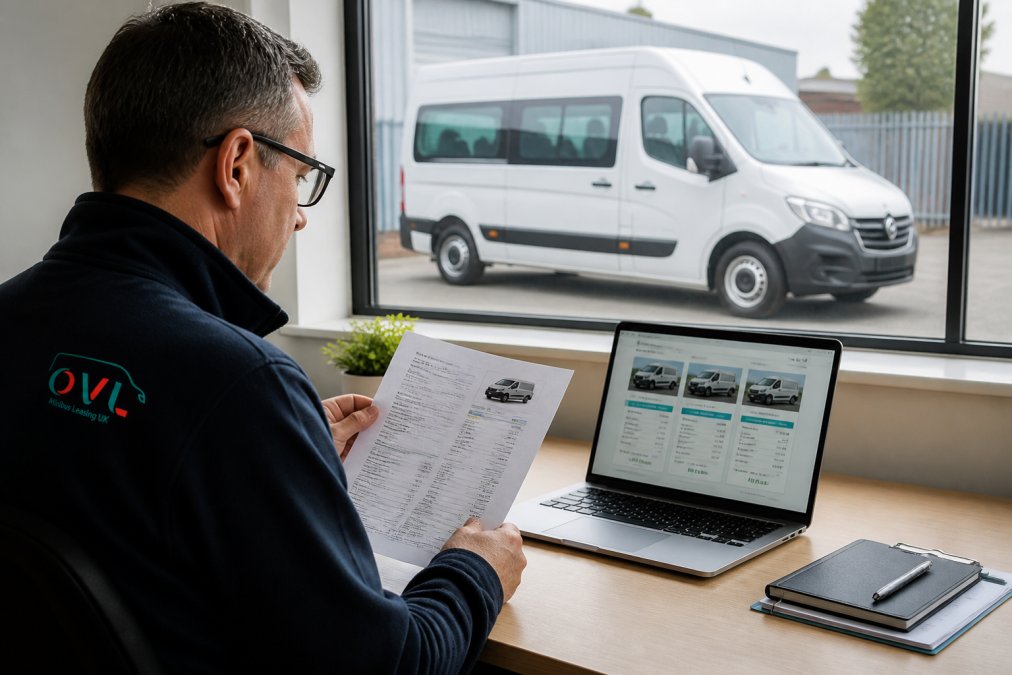
Then work through the steps:
Expected result: a valid certificate in place before you drive away.
Premiums for a leased crew van depend on the van's value, your drivers, your trade and where the van sits overnight. A higher-value van costs more to replace, so cover costs more.
The main factors insurers weigh:
There is no single figure that fits every fleet. Pricing depends on your drivers, usage and van specification, so request a tailored quote rather than relying on a headline rate.
The costliest mistakes are quiet ones. They surface only when you make a claim.
A common mistake is treating a leased van like an owned one. The finance company's interest changes what cover you need.
The challenge is simple to state and easy to get wrong: the leaseholder carries the insurance risk, and the lease contract sets the rules. Get the cover level, the named drivers and the gap protection right before the van arrives.
Minibus Leasing UK helps education, care, community and commercial fleets get this right from day one. Our team offers consultative fleet management, whole life cost analysis and expertise in regulatory compliance, including Section 19 permits and D1 licensing. We supply brand-new vehicles tailored to your operation.
Get a bespoke quote or speak to a sector specialist, and check our current van leasing services and offers to see what fits your fleet. It is also worth browsing our Minibus Leasing Special Offers to see the latest deals available across our range.
Most lease agreements require fully comprehensive cover, and it is the practical choice for a crew van used for work. Comprehensive policies pay out for damage to your own vehicle as well as third-party claims, which matters when the van is a leased asset you must return in good condition. Third-party only cover leaves you liable for repair or replacement costs, so check your lease terms before choosing a policy.
No, insurance is not normally included in a lease agreement. The lessee is responsible for arranging and maintaining valid cover for the full lease term. Your lease contract will state the minimum level of cover required, and failing to hold it can breach the agreement. Always confirm the insurance clause with your leasing provider before the van is delivered so there is no gap in cover.
Gap insurance for leased vans covers the difference between your insurer's payout and the amount still owed on the lease if the van is written off or stolen. Without it, you could face a shortfall. Whether you need it depends on your deposit, remaining lease balance, and the van's depreciation. It is worth considering for newer, higher-value crew vans where the gap could be significant.
Private cover usually excludes commuting to multiple sites or carrying work equipment and colleagues. Business van insurance covers commercial use such as transporting staff, tools, or goods between locations. If your crew van is used for any work purpose, you need business cover. Using private cover for work use can void your policy, so always match the policy class to how the van is actually used.

