Jul 19, 2026
Last Updated: July 19, 2026
Fleets adopting structured maintenance protocols spend significantly less on emergency repairs and experience fewer operational disruptions. Preventive maintenance separates operators who control costs from those who react to crises. When a minibus fails unexpectedly, you lose revenue, disappoint passengers, and face potential regulatory penalties.
Reactive maintenance costs substantially more than prevention. Every pound spent on scheduled servicing saves three to four pounds on unplanned repairs.
If your minibus carries more than 8 passengers (including the driver), you operate under D1 licensing requirements, triggering mandatory safety standards: seat belts for all passengers, emergency exits, fire extinguishers, and specialist insurance.
Section 19 permits require proof of roadworthiness and insurance compliance. Enforcement officers conduct spot checks, and a failed inspection can suspend your permit immediately. The MOT for a minibus is more rigorous than a standard car, examining passenger seating integrity, handrails, emergency equipment, and wheelchair accessibility.
The Health and Safety at Work Act places responsibility on operators to ensure vehicles are safe for use. Your maintenance records must demonstrate due diligence. Treat your maintenance schedule as a compliance document: every oil change, brake check, and fluid top-up should be logged with date, mileage, and technician name.
GOV.UK guidance on minibus and coach regulations
Your maintenance schedule is the backbone of fleet reliability.
Before a minibus leaves the depot, the driver must conduct a pre-trip inspection in 10-15 minutes, catching 80% of problems before they become roadside emergencies.
The driver's checklist should include:
Weekly checks (30-45 minutes):
Monthly checks (in addition to weekly):
Build these into a Friday afternoon routine. Consistency is key: same day, same checklist, same person responsible.
Your minibus manufacturer specifies service intervals, typically every 10,000-15,000 miles or annually. Full servicing includes oil and filter changes, fluid replacements, spark plug inspection, brake system inspection, suspension checks, and diagnostic scans. Interim services (every 6 months or 6,000 miles) typically include oil changes and filter replacements only.
A full service costs £400-£800; an interim service costs £150-£300. These investments prevent £3,000+ engine repairs or £5,000+ gearbox failures. Book services during quieter periods to minimise fleet downtime.
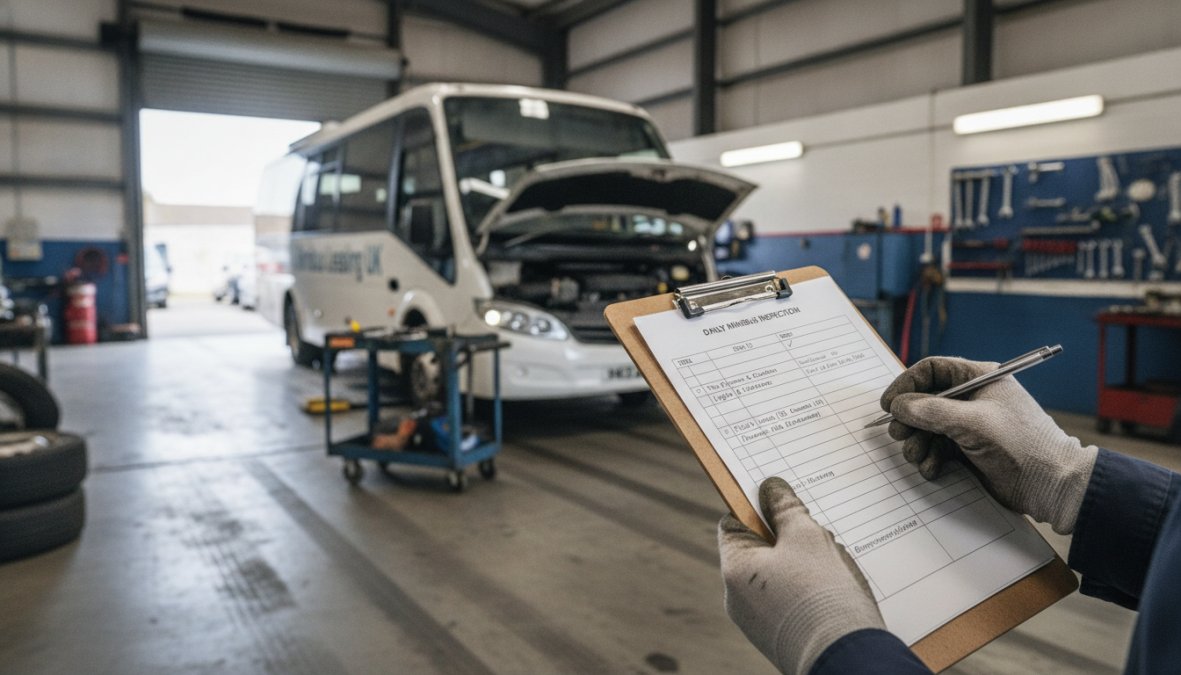
A maintenance checklist transforms best practices into concrete daily actions.
These four areas represent 70% of minibus failures.
Fluid levels checked weekly: engine oil (between minimum and maximum marks), coolant (low levels indicate leaks), brake fluid (low levels suggest brake pad wear or leaks), transmission fluid (dark or burnt-smelling fluid means stress), and windscreen washer fluid.
Tyres deteriorate faster on minibuses. Check pressure monthly and inspect for uneven wear, bulges, cuts, tread depth (minimum 1.6mm by law; 3mm safer for minibuses), and sidewall cracks. Rotate tyres every 12,000 miles. A set of minibus tyres costs £800-£1,200; regular rotation saves money and prevents blowouts.
Brakes require monthly inspection: pad thickness (at least 3mm), brake fluid colour (clear or slightly amber; dark brown means contamination), brake performance (listen for squealing or grinding), and pedal feel (firm and responsive, not spongy).
Lights checked before every journey: headlights, brake lights, indicators, hazard warning lights, interior cabin lights, and emergency lighting. A single failed brake light results in a £100 fine and puts passengers at risk.
Engine checks: Listen for unusual knocking or rattling, check for smoke or unusual odours, monitor idle quality, and watch for dashboard warning lights. If the engine runs rough or produces excessive smoke, stop using the vehicle and arrange diagnostic testing.
Electrical systems: Battery terminals clean and tight, battery voltage (12.6V when off, 13.5-14.5V when running), alternator output, and wiring for damage or loose connections.
Battery care: Keep terminals clean, ensure tight connections, test voltage monthly, and replace every 3-5 years. In winter, battery performance drops 30-50%, so check condition before cold season.
HVAC maintenance: Test heating and cooling functions, check cabin air filters (replace annually), inspect refrigerant levels, and listen for unusual noises.
Passenger safety equipment: Seatbelts (inspect for fraying or damage), emergency exits (ensure doors and roof hatches operate smoothly), fire extinguisher (check pressure gauge and expiry date annually), first aid kit (restock after use and check expiry dates), handrails and grab handles (secure and damage-free), and wheelchair ramps or lifts (test operation monthly).
Documentation is critical. Your maintenance records are evidence that you've fulfilled legal obligations and provide data for smart fleet decisions.
When an enforcement officer inspects your minibus, they ask to see maintenance records. Detailed, consistent records demonstrate due diligence and serve multiple purposes: regulatory compliance, liability protection, warranty and insurance coverage, cost control, and resale value. Retain maintenance documentation for at least one year; best practice is to keep records for the entire vehicle lifespan.
DVSA guidance on vehicle maintenance records
Drivers are your eyes and ears on the road. Implement a simple fault reporting system: paper-based notebook, digital app, or checklist form. Each report should capture vehicle registration, date and time, mileage, problem description, driver name, and severity level.
When a fault is reported, create a work order with date received, description, priority level, assigned technician, date completed, parts used, cost, and root cause notes. This creates a complete audit trail revealing recurring problems and informing replacement decisions.
For fleets of 5 or more minibuses, fleet management software transforms chaos into order.
Telematics systems use GPS and on-board diagnostics to monitor vehicle health in real time, alerting you when engine warning lights activate, fuel levels drop unexpectedly, harsh braking occurs, vehicles deviate from planned routes, or maintenance is due. Asset management tools centralise all vehicle information: service history, maintenance schedules, MOT and permit dates, driver assignments, fuel and mileage records, and repair costs.
Small operators (1-5 vehicles): A spreadsheet or simple tool like Airtable or Google Sheets works for tracking service dates, mileage, and costs.
Medium operators (6-20 vehicles): Dedicated fleet management software becomes worthwhile. Tools like Verizon Connect fleet management platform or Samsara offer maintenance scheduling, driver reporting, and compliance tracking at £30-£100 per vehicle monthly.
Large operators (20+ vehicles): Enterprise solutions like Geotab or Teletrac IVECO integrate telematics, maintenance management, fuel tracking, and driver safety.
When evaluating software, prioritise ease of use, mobile access, integration with existing systems, customer support, and compliance features.
Maintenance costs are predictable if you plan for them. Reactive repairs are expensive and disruptive.
Routine costs: Oil and filter changes (£80-£150 per service), tyre rotations (£100-£200), brake pad replacement (£200-£400), fluid replacements (£150-£300), and full annual service (£400-£800).
Unexpected costs: Engine repairs (£1,500-£5,000+), gearbox repairs (£3,000-£8,000+), electrical system failures (£500-£2,000), suspension repairs (£800-£2,500), and brake system overhaul (£1,000-£3,000).
A typical minibus costs £1,500-£3,000 annually in routine maintenance. Budget an additional £2,000-£5,000 for unexpected repairs depending on vehicle age. Many operators set aside £300-£500 per vehicle monthly as a maintenance reserve.
Prevention is cheaper than cure. An oil change costs £100; engine failure from missed oil changes costs £4,000. Over a vehicle's 10-year lifespan, consistent preventive maintenance costs £15,000-£30,000 in routine work and minor repairs. Neglected vehicles cost £40,000-£70,000 in breakdowns, emergency repairs, and premature replacement. If your maintenance costs are straining your budget, exploring [Minibus Leasing Special Offers](https://www.minibusleasinguk.co.uk/page/minibus-leasing-offers) could provide an alternative to ownership, shifting maintenance responsibility to a leasing provider and helping you forecast costs more predictably.
Safe for in-house (with trained staff): Oil and filter changes, fluid top-ups, air filter replacement, wiper blade replacement, light bulb replacement, basic cleaning and inspection, and tyre pressure checks and rotation.
Require professional technicians: Brake system work, electrical diagnostics, engine work, suspension repairs, gearbox work, air conditioning service, and welding or structural repairs.
Handle simple fluid top-ups and inspections in-house, but contract professional servicing to a qualified garage.
Minibuses encounter predictable problems. Knowing how to diagnose them quickly gets vehicles back on the road faster.
Modern minibuses have on-board diagnostic systems that flag problems via dashboard warning lights: engine management light (engine fault detected; diagnostic scan required), oil pressure light (oil pressure is low; stop immediately), coolant temperature light (engine overheating; stop and let cool), battery light (charging system failure; reach a garage), brake warning light (brake system problem; check immediately), and ABS light (anti-lock braking system fault; brakes still work but without ABS assist).
When a warning light appears, diagnostic scanning (£50-£100 at a garage) reads the fault code and identifies the problem. Early diagnosis prevents guesswork and wasted money.
Despite best efforts, breakdowns happen. Driver turns on hazard lights and moves vehicle to side of road if safe, assesses the problem, contacts breakdown recovery service, and arranges alternative transport if passengers are stranded.
Most operators subscribe to breakdown cover (£150-£300 annually per vehicle). Without cover, recovery costs £400-£800 and delays are longer.
Maintenance ensures passengers are safe and your operation is legal.
Every minibus must pass an MOT annually, examining brakes, steering, suspension, tyres, lights, seatbelts, emissions, windscreen, mirrors, horn, and bodywork. Minibuses undergo more rigorous testing than standard cars, with special attention to wheelchair ramps, emergency exits, handrails, seating integrity, fire extinguishers, and first aid kits.
An MOT failure means the vehicle cannot legally be used until repairs are made and it passes re-test.
Section 19 permits require demonstration of roadworthiness and insurance compliance. Enforcement officers conduct unannounced spot checks examining MOT certificates, maintenance records, insurance documentation, and vehicle condition.
A failed spot check can result in permit suspension, vehicle impoundment, fines (£1,000-£5,000), and prosecution. D1 licensing requires drivers to hold a D1 category on their driving licence. The vehicle must meet specific safety standards. Maintenance of these safety features is non-negotiable.
DVSA guidance on [minibus safety(/blog/minibus-safety-your-obligations) standards | dvsa.gov.uk]
Use this summary table as your operational reference.
| Task | Frequency | Duration | Responsibility | Cost Range |
|---|---|---|---|---|
| Pre-trip inspection | Daily (before use) | 10-15 min | Driver | £0 |
| Weekly fluid and light checks | Weekly | 30-45 min | Maintenance attendant | £0 |
| Monthly tyre and brake inspection | Monthly | 20-30 min | Maintenance attendant | £0 |
| Interim service (oil, filters) | Every 6 months or 6,000 miles | 1-2 hours | Professional garage | £150-£300 |
| Full service | Annually or per manufacturer | 3-4 hours | Professional garage | £400-£800 |
| MOT test | Annually | 1-2 hours | Approved test centre | £50-£100 |
| Tyre rotation | Every 12,000 miles | 1-2 hours | Professional garage | £100-£200 |
| Battery testing | Annually | 30 min | Professional garage | £0-£50 |
| Brake system inspection | Annually | 1-2 hours | Professional garage | £80-£150 |
| Air conditioning service | Annually or as needed | 1-2 hours | Professional garage | £100-£300 |
Effective maintenance management follows a simple principle: consistency beats crisis response. Daily pre-trip checks, weekly fluid monitoring, scheduled professional servicing, and meticulous record-keeping create a culture of reliability.
Operators who treat maintenance as an investment thrive. Those who treat it as a cost to minimize struggle. Start with the basics: ensure every driver completes a pre-trip inspection, designate someone responsible for weekly checks, book annual services without fail, and log everything. Within months, you'll notice fewer breakdowns, lower repair bills, and passengers who trust your fleet.
For operators managing multiple minibuses, fleet management software accelerates this process. For smaller operators, even a simple spreadsheet and consistent discipline deliver results. The regulatory environment is strict for good reason: passenger safety depends on well-maintained vehicles. Your maintenance programme is your commitment to that safety.
A robust minibus maintenance schedule combines daily driver inspections, weekly fluid and tyre checks, monthly brake and electrical system reviews, and scheduled service intervals based on manufacturer recommendations, typically every 10,000 to 15,000 miles or annually. Preventive maintenance for minibuses should also include MOT compliance checks and regulatory inspections required for Section 19 permits and D1 licensing. Consistent scheduling prevents unexpected breakdowns and extends vehicle lifespan.
Preventive maintenance is the most cost-effective strategy. By addressing wear and tear early through regular inspections, fluid top-ups, filter replacements, and tyre rotations, you avoid expensive emergency repairs. Keep detailed maintenance records to identify patterns and plan parts replacement efficiently. Negotiate service contracts with trusted suppliers, train drivers to report faults promptly, and use fleet management software to track service intervals. Budgeting consistently for routine maintenance prevents financial surprises and protects your vehicle investment.
A comprehensive minibus maintenance checklist covers: daily checks (lights, wipers, mirrors), weekly inspections (fluid levels, tyre condition, brakes), monthly reviews (battery, electrical systems, HVAC), and scheduled services (oil changes, filter replacements, lubrication). Include passenger safety equipment, wheelchair lifts (if applicable), and emergency supplies. Document all checks via driver reports and maintain records for compliance. Tailor your checklist to your minibus model and operational requirements, ensuring it aligns with regulatory standards and manufacturer guidelines.
The best minibus fleet management software depends on your fleet size and budget. Look for platforms offering telematics for real-time diagnostics, automated service interval reminders, driver report integration, and maintenance record storage. Features like asset management, parts tracking, and compliance reporting are valuable for managing multiple vehicles. Choose software that scales with your organisation, small charities may prefer simpler tools, while larger education and care providers benefit from advanced analytics and integration with your existing systems.

