Jul 21, 2026
Last Updated: July 2026
Managing a minibus fleet is fundamentally different from running a standard vehicle operation. The regulatory landscape is stricter, safety obligations are more complex, and financial stakes are higher. A single compliance failure can result in an O-Licence suspension, stopping your operation entirely. Poor maintenance scheduling leads to unexpected breakdowns that disrupt services to vulnerable passengers. Yet many organisations still treat minibus fleet management as an afterthought.
Minibus fleet management is the systematic operation, maintenance, compliance, and optimisation of a group of minibuses and light commercial vehicles. It encompasses vehicle procurement, regulatory compliance, driver management, maintenance scheduling, safety oversight, and cost control.
Core responsibilities include maintaining O-Licence compliance, ensuring all drivers hold valid D1 category licences, scheduling preventative maintenance, monitoring driver behaviour and safety, tracking fuel consumption and mileage, and managing insurance and vehicle tax obligations. Each area has specific regulatory requirements, and missing one creates legal exposure.
The cost of poor fleet management is measurable. Unplanned breakdowns cost significantly more than scheduled maintenance because they require emergency call-outs and premium repair rates. Compliance failures trigger DVSA fines and potential licence suspension. Driver incidents create personal injury claims and increased insurance premiums. Over three years, poor fleet management can cost an organisation tens of thousands of pounds more than a properly structured operation.
Leasing versus ownership is the fundamental financial decision shaping your fleet strategy. Many organisations assume ownership is cheaper because there's no monthly payment. This assumption is almost always wrong.
Ownership creates hidden costs. You carry full depreciation risk, minibuses lose value rapidly in the first three years. You're responsible for all maintenance, repairs, and unexpected failures. You manage insurance, vehicle tax, and MOT compliance. The total cost of ownership typically runs 30-40% higher than leasing for small to medium fleets.
Leasing transfers these risks to the finance provider and includes maintenance, repairs, and often breakdown cover. You know your exact monthly cost upfront with no depreciation risk or surprise repair bills.
Tailored procurement for education, care, and commercial sectors requires understanding specific vehicle needs. Schools need durable vehicles for high mileage and frequent use. Care providers require accessible minibuses with wheelchair lifts. Commercial operators need vehicles configured for crew transport. Standard procurement doesn't account for these differences, leading to vehicles that don't fit operational requirements.
Minibus Leasing UK specialises in sector-specific vehicle selection, ensuring vehicles meet DVSA safety standards whilst providing the durability and features needed for each sector's actual operational requirements. We also offer Minibus Leasing Special Offers that help organisations reduce their vehicle acquisition costs without compromising on quality or compliance.
Regulatory compliance is non-negotiable in minibus operations. Different vehicle sizes and operational types trigger different licensing requirements.
O-Licence requirements apply to any organisation operating more than three minibuses for commercial purposes. An O-Licence demonstrates appropriate financial resources, professional competence, and transport management systems. The DVSA assesses these areas during initial application and periodic inspections. Losing an O-Licence stops your business.
Section 19 permits provide an alternative for non-commercial operations. Schools, charities, and community organisations can operate minibuses under Section 19 permits, which are simpler to obtain but carry specific restrictions. You can only transport passengers for educational or community purposes, not commercial hire. The permit must be renewed annually with the same safety and maintenance standards as O-Licence holders.
D1 category driving licences are mandatory for all minibus drivers. A standard car licence doesn't permit driving minibuses over 3.5 tonnes. Every driver must hold a valid D1 licence, and you must maintain records proving this.
DVSA compliance and safety inspections determine whether your fleet is fit to operate. The DVSA conducts roadside inspections and can issue prohibition notices if vehicles are unsafe. Common failures include defective brakes, worn tyres, faulty lighting, and inadequate maintenance records. Preventative maintenance schedules, regular safety checks, and documented maintenance records are your defence against prohibition notices.
Real-time vehicle tracking and data analytics have transformed how operators manage fleet safety and efficiency. Modern telematics systems monitor vehicle location, speed, fuel consumption, driver behaviour, and maintenance alerts, feeding into a centralised dashboard.
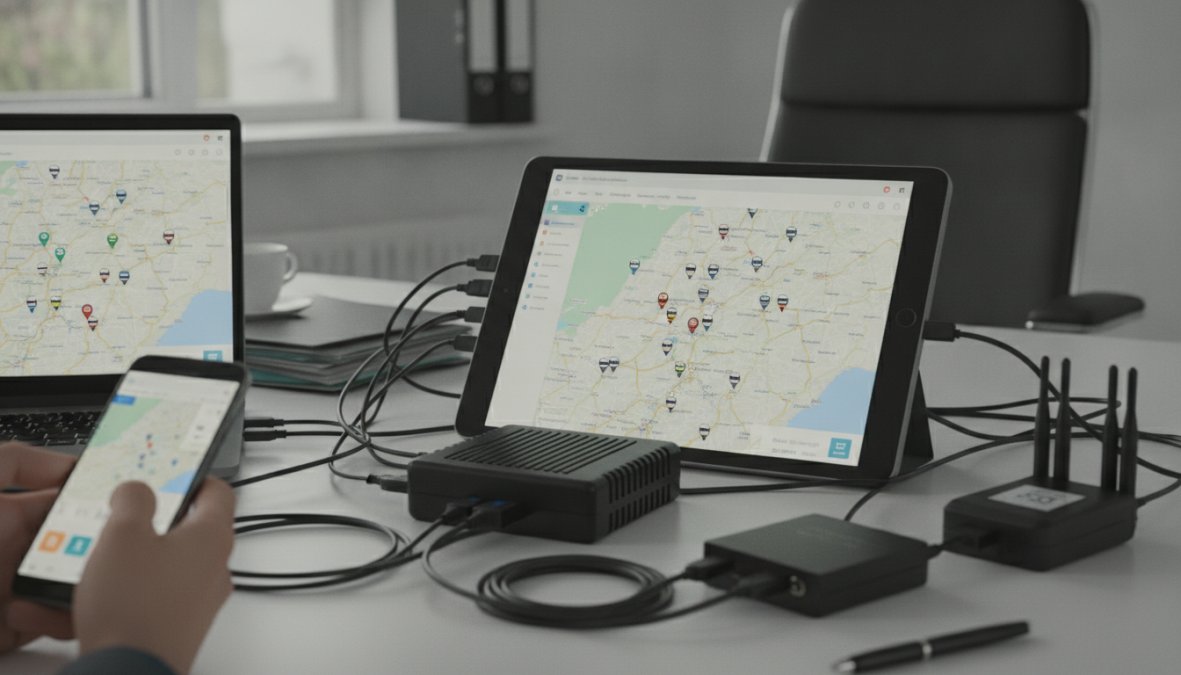
You can respond immediately to breakdowns, optimise routes, identify fuel consumption anomalies, track maintenance schedules automatically, and monitor driver behaviour. Driver behaviour monitoring is where telematics delivers measurable safety improvements. Systems track speeding, harsh acceleration, rapid deceleration, and aggressive cornering. Organisations using driver behaviour monitoring typically see 15-20% reductions in incident rates within the first year.
FleetCheck is a cloud-based platform specifically designed for UK fleet compliance, integrating O-Licence compliance features, driver defect reporting, maintenance scheduling, and driver licence checking. It starts from £3 per vehicle per month. Larger fleets often choose more comprehensive solutions like Trakm8 Prime, which offers live tracking and driver behaviour scoring, providing 60-second GPS updates and automated service reminders from £5.99 per vehicle monthly.
Duty of care is a legal and moral obligation to take reasonable steps to prevent harm to passengers and staff. In minibus operations, this extends beyond vehicle maintenance to encompass driver training, risk assessment, and incident reporting.
Managing driver risk requires a documented system. You must assess risks your drivers face, implement controls to mitigate those risks, provide driver training covering defensive driving and passenger handling, maintain training records, and investigate incidents to identify systemic problems.
Fleet audits and preventative maintenance schedules are your practical tools for managing duty of care. An audit examines vehicle condition, driver records, maintenance documentation, and compliance procedures, identifying gaps before regulators do. A preventative maintenance schedule specifies exactly when each maintenance task must be completed based on vehicle age, mileage, and manufacturer recommendations.
| Audit Element | Frequency | Responsibility | Documentation |
|---|---|---|---|
| Vehicle safety inspection | Monthly | Fleet manager | Checklist signed and dated |
| Driver licence verification | Annually | HR/admin | Copy of licence and check date |
| Maintenance completion | Per schedule | Technician/contractor | Service records and sign-off |
| Incident investigation | After each incident | Fleet manager | Written report with actions |
| Regulatory compliance review | Quarterly | Fleet manager | Checklist against current regulations |
The decision between managing your fleet in-house or outsourcing to a specialist provider shapes your operational costs and capabilities.
In-house fleet management requires dedicated staff. For a fleet under 15 vehicles, you typically need one part-time fleet manager. For 15-50 vehicles, you need a full-time fleet manager. Salary costs alone quickly exceed £30,000 annually. Add vehicle maintenance facilities, software systems, and compliance training, and the total cost becomes substantial.
The advantage of in-house management is direct control. The disadvantage is building expertise from scratch. Fleet management best practices aren't intuitive, and regulatory requirements change continuously.
Outsourced fleet management transfers responsibilities to a specialist provider. You pay a monthly fee that typically includes vehicle maintenance, breakdown cover, and compliance management. The advantage is gaining access to expertise and systems you couldn't build alone. The disadvantage is reduced direct control.
Fuel management, vehicle uptime, and cost reduction are the measurable outcomes separating effective fleet management from poor management. A poorly maintained vehicle consumes 15-20% more fuel than one properly serviced. Telematics systems tracking fuel consumption can identify problems and trigger corrective action.
Vehicle uptime, the percentage of time vehicles are available for operation, directly affects your ability to deliver services. Preventative maintenance schedules keep vehicles on the road. Rapid response to breakdowns minimises downtime. A well-managed fleet costs 20-30% less to operate than a poorly managed one.
Schools face unique fleet management challenges. Vehicles operate intensively during school hours but sit idle during holidays. Passengers are children requiring different safety considerations. Routes are fixed and predictable. Funding is often constrained.
Sector-specific needs for schools include accessible vehicles accommodating children with disabilities, appropriate seating for young passengers, safety features like CCTV and emergency exits, and compliance with safeguarding requirements. Educational providers need vehicles specified for their actual requirements.
Dedicated account managers and consultative support are essential for education providers because decision-making involves multiple stakeholders. A consultative provider works with the school to understand needs, proposes solutions fitting their budget, and provides ongoing support when circumstances change.
Minibus Leasing UK has worked with over 200 schools across the UK. We understand education trusts operate under budget constraints that commercial operators don't face. Our dedicated account managers remain with each school, building relationships and understanding their evolving needs.
Mobile servicing and preventative maintenance bring maintenance to your vehicles rather than requiring delivery to a workshop. A mobile technician completes routine servicing on-site, minimising disruption to service delivery.
Preventative maintenance schedules are based on vehicle age, mileage, and manufacturer recommendations. Brake pads are replaced before wear-through. Oils and filters are changed at specified intervals. This approach prevents expensive emergency repairs and vehicle downtime.
24/7 breakdown cover ensures help is available immediately when something goes wrong. For minibus operations carrying passengers, 24/7 cover is essential because breakdowns are service failures affecting passengers who depend on you.
Driver training programmes address specific skills minibus drivers need. Specialist training covers defensive driving, passenger assistance, wheelchair handling, and emergency evacuation. Regular refresher training keeps skills current and identifies drivers needing additional support.
Managing a minibus fleet effectively requires balancing regulatory compliance, operational efficiency, safety standards, and cost control. Many organisations choose to partner with specialist providers rather than managing everything in-house. At Minibus Leasing UK, we handle vehicle procurement, compliance management, maintenance coordination, and driver support, allowing you to focus on delivering services to your passengers. Our whole life cost analysis ensures your fleet investment delivers genuine value, and our dedicated account managers provide the consultative support that education, care, and community organisations need. Get a bespoke quote from Minibus Leasing UK and discover how outsourced fleet management can reduce your costs whilst improving your compliance and safety standards.
Minibus fleet management encompasses vehicle procurement, compliance, maintenance, tracking, and driver support. It's critical because UK minibus operators must meet O-Licence regulations, DVSA safety standards, and Section 19 permit requirements. Poor management risks regulatory penalties, vehicle downtime, safety incidents, and escalating costs. Effective fleet management ensures compliance, enhances driver safety, optimises vehicle uptime, and reduces operational expenses, particularly important for education, care, and community sectors.
Minibus tracking systems provide real-time vehicle location, driver behaviour insights, and automated maintenance alerts. They enable route optimisation, reduce fuel waste, improve response times, and support duty of care obligations. Telematics data identifies speeding, harsh braking, and inefficient driving, allowing targeted driver training. For compliance, tracking systems generate audit-ready reports for HMRC and regulatory bodies. This data-driven approach reduces insurance claims, extends vehicle lifespan, and cuts operational costs significantly.
UK minibus operators must comply with DVSA safety standards, obtain appropriate O-Licence or Section 19 permits, and meet D1 licensing requirements for drivers. Vehicles require regular safety inspections, maintenance records, and driver licence checks. Operators must maintain duty of care documentation, accident reporting procedures, and insurance compliance. HMRC regulations govern fuel, mileage, and vehicle tax. Failure to meet these requirements results in fines, vehicle impoundment, or operating licence suspension. Specialist fleet management services ensure ongoing compliance and reduce regulatory risk.
Costs vary significantly based on fleet size, vehicle type, and service level. Whole life cost analysis typically compares leasing (predictable monthly costs including maintenance, insurance, and breakdown cover) against ownership (purchase price, repairs, servicing, fuel, insurance, and downtime). Leasing often reduces total cost of ownership by eliminating unexpected repair bills, ensuring vehicle reliability, and providing brand-new, compliant vehicles. For small charities and education providers, outsourced fleet management reduces administrative burden and capital expenditure. Request a bespoke quote to compare your specific situation.

