Aug 15, 2026
Last Updated: August 15, 2026
Care homes face a constant tension: residents need reliable transport for medical appointments, social outings, and day-to-day activities, yet purchasing and maintaining vehicles drains operational budgets and ties up capital. Minibus leasing for care homes resolves this by shifting from ownership to a flexible, predictable service model.
The core advantage is financial clarity. Rather than absorbing unexpected repair costs, managing depreciation, and handling compliance updates, care homes pay a fixed monthly fee that typically includes maintenance, servicing, and breakdown assistance. This allows management teams to forecast budgets accurately without surprise expenses that plague vehicle ownership.
At Minibus Leasing UK, we combine deep industry expertise with data-driven whole life cost analysis to ensure your fleet remains compliant, safe, and cost-effective. Vehicles are brand-new, fully compliant with current safety standards, and purpose-built for accessible transport. Staff focus on resident care rather than vehicle troubleshooting.
Beyond cost control, leasing addresses regulatory burden. Care homes must ensure their transport meets strict accessibility requirements, safety standards, and driver licensing rules. A reputable leasing partner manages these compliance obligations, reducing administrative load and mitigating legal risk.
Understanding D1 driving licence regulations is non-negotiable for care homes. The DVLA (Driver and Vehicle Licensing Agency) classifies minibuses under strict licensing categories, and operating a vehicle with an incorrectly licensed driver exposes your organisation to significant liability and penalties.
A D1 licence permits drivers to operate minibuses carrying between 9 and 16 passengers, excluding the driver. Drivers holding only a standard car licence (category B) cannot legally operate a minibus, regardless of experience.
The rules changed in December 2021. Drivers who obtained their car licence before that date may hold grandfathered D1 rights, but anyone who passed their test after December 2021 must hold an explicit D1 licence. Many care homes discover this requirement only when recruiting new staff or checking existing driver credentials. The DVLA website provides detailed guidance on D1 licence requirements for organisations managing transport fleets.
Your staff must also comply with periodic medical checks and Driver Certificate of Professional Competence (CPC) requirements if operating under a Section 19 permit, which most care homes do for passenger transport. These obligations fall on the care home, not the vehicle lessor, but a knowledgeable leasing partner will flag these requirements and help you maintain compliance.
Care homes serve residents with varying mobility needs. Some residents walk independently; others require wheelchairs, walking frames, or assistance. Your minibus must accommodate this diversity safely and with dignity.
Wheelchair lifts and low-floor access are fundamental features for accessible minibuses. A tail lift (hydraulic or electric) deploys from the rear, lowering to ground level to allow wheelchair users to board without steps. Modern tail lifts are tested to withstand repeated cycles and equipped with safety sensors that prevent operation if doors are open or passengers are in the deployment zone.
Low-floor minibuses eliminate or minimise the step between the ground and the vehicle entrance, reducing physical demand on residents with reduced mobility. Combined with a tail lift or ramp, low-floor design allows residents to board independently or with minimal assistance, preserving autonomy and reducing strain on care staff.
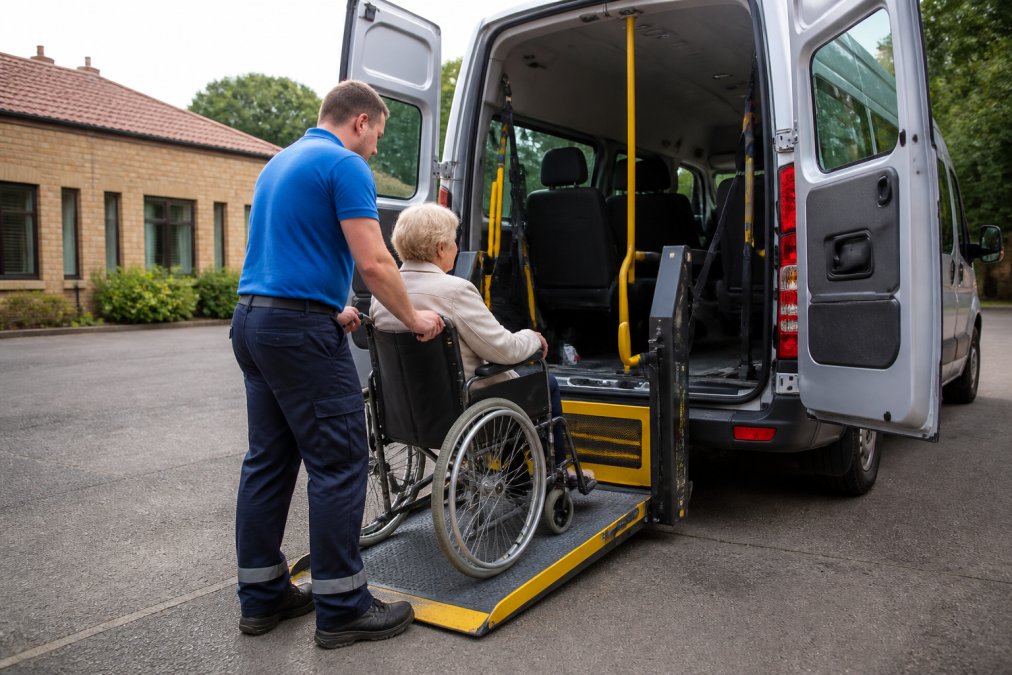
Tail lifts come in two main types: hydraulic and electric. Hydraulic lifts are durable, cost-effective, and reliable in cold weather. Electric lifts operate faster and are quieter, which matters when residents are sensitive to noise. Both types meet safety standards and are regularly serviced as part of a comprehensive leasing package.
The lift must secure wheelchairs during transport using either wheelchair-integrated seating (where the wheelchair itself is the seat) or separate wheelchair securing systems that lock the chair in place using straps or mechanical clamps. These systems must meet EN 14041 and EN 14042 standards, which specify load testing and durability requirements.
Low-floor entry heights typically range from 600mm to 800mm above ground, compared to 1,200mm or higher on traditional minibuses. This difference is substantial for residents with hip or knee issues, balance problems, or those using mobility aids. When combined with handrails positioned at ergonomic heights, low-floor design significantly reduces falls and injuries during boarding.
A care home minibus typically seats 8 to 16 passengers, depending on configuration. Seats should have adequate cushioning, backrest support, and armrests to accommodate residents with arthritis or other conditions affecting joint mobility.
Safety restraints vary by resident need. Ambulant passengers use standard three-point seatbelts. Wheelchair passengers require integrated securing systems that immobilise the chair and prevent tipping during acceleration, braking, or cornering. Residents with cognitive impairment or severe mobility limitations may need additional supervision to ensure they remain properly secured throughout the journey.
Modern minibuses include emergency exits, typically a roof hatch and side emergency door, marked with illuminated signage and clearly accessible to staff. These exits are tested regularly and must comply with Vehicle and Operator Services Agency (VOSA) standards for passenger safety.
Minibus maintenance and safety checks are often the hidden burden of ownership. A vehicle carrying vulnerable passengers must pass rigorous inspections, and any failure to maintain it exposes your organisation to liability and potential safeguarding concerns.
When you lease from a reputable provider, maintenance is typically bundled into your monthly payment. This includes:
You know exactly what you're paying each month, and you're not exposed to surprise repair bills. The lessor bears the cost of major repairs, which incentivises them to maintain vehicles to a high standard.
Care homes must also ensure their vehicles undergo annual Disabled Persons' Minibus checks if they operate under a Section 19 permit. These specialist inspections verify that accessibility features, lifts, ramps, and restraints function correctly and safely. A good leasing partner will schedule these checks proactively and provide documentation to prove compliance.
Care homes typically choose between two leasing models: operating lease and contract hire. Understanding the differences helps you select the approach that aligns with your financial and operational strategy.
Get a Bespoke Quote or Speak to a Sector Specialist →
An operating lease is a rental arrangement where the lessor retains ownership of the vehicle. You pay a monthly fee to use the minibus, but the lessor covers maintenance, servicing, insurance (third-party liability), and breakdown assistance. At the end of the lease term, typically 2 to 5 years, you return the vehicle.
Operating leases suit care homes with uncertain future transport needs. If your resident population is growing, you can increase the number of leased vehicles. If demand drops, you can reduce your fleet without penalty. This flexibility is valuable for organisations in transition or those serving a fluctuating population.
The monthly payment is an operational expense, not a capital cost, which means it doesn't appear on your balance sheet as a long-term liability. For charities and non-profit care homes, this can be advantageous when applying for grants or securing funding, as it preserves capital and improves cash flow metrics.
Operating leases typically include mileage restrictions (often 15,000 to 25,000 miles per annum). If your residents require frequent outings or your staff make multiple daily trips, you may exceed the limit and incur overage charges.
Contract hire is similar to operating lease but typically offers more flexibility on mileage and maintenance terms. You pay a monthly fee, and the lessor covers servicing and breakdown assistance, but you may have the option to purchase insurance separately or negotiate unlimited mileage.
Contract hire works well for care homes with predictable, high-mileage transport needs. If you're running daily outings, medical appointment transport, and staff commutes, the unlimited mileage option removes the anxiety of overage charges. You know exactly what your transport costs are each month.
Contract hire also typically allows greater customisation. If you need specific seating configurations, wheelchair lift specifications, or additional safety features, you can negotiate these into the contract. The lessor builds the vehicle to your specifications and maintains it throughout the lease term.
The trade-off is that contract hire contracts are often longer (3 to 5 years) and less flexible if your needs change. Breaking a contract early typically incurs penalties. For organisations with stable, long-term transport requirements, this is rarely an issue.
Many care homes ask: would it be cheaper to buy a minibus outright and maintain it ourselves? The answer depends on several factors, but leasing can often emerge as a more cost-effective option when you account for all expenses.
Consider the full cost of ownership:
Over a five-year period, the total cost of ownership can be substantial for a single vehicle. Leasing typically involves a monthly payment, and can include a brand-new replacement vehicle, full maintenance, and breakdown assistance. Many care homes find that exploring Minibus Leasing Special Offers can further improve the financial case for leasing over ownership.
Leasing also transfers risk. If a major component fails, the lessor absorbs the cost. If the vehicle is damaged in an accident, the lessor handles the repair. This risk transfer is worth quantifying, as a single catastrophic repair can exceed several months of lease payments.
Operating a minibus carrying vulnerable passengers requires more than a valid D1 licence. Your team must understand passenger safety, emergency procedures, and how to assist residents with varying mobility needs.

Comprehensive staff training should cover:
Many care homes arrange annual refresher training to ensure staff remain competent. When you lease through a professional provider, staff training resources can often be available, and the lessor can advise on best practices for passenger safety.
Reliable transport is foundational to quality care. Residents benefit from social engagement, medical care, and independence when they can access the community. Your staff need vehicles they can trust and systems they can manage without distraction.
Minibus Leasing UK specialises in helping care homes access compliant, accessible vehicles without the capital investment and operational complexity of ownership. We combine deep sector expertise with dedicated account management, ensuring your fleet remains safe, legal, and cost-effective. Our whole-life cost analysis means you understand exactly what your transport programme costs, and our commitment to regulatory compliance protects your organisation and your residents.
If you're ready to explore how tailored minibus leasing can improve your transport programme, contact Minibus Leasing UK for a bespoke quote or speak with one of our sector specialists. We understand care home transport. Let us show you how leasing delivers better outcomes than ownership.
No. If your minibus carries more than eight passengers (including the driver), you need a D1 driving licence entitlement. This applies to care home transport regardless of whether residents are paying passengers or receiving care services. Staff must hold the correct category before operating the vehicle. Leasing providers can advise on your specific vehicle configuration to clarify licensing needs.
Minibus accessibility requirements depend on your residents' mobility needs. Essential features typically include wheelchair lifts or ramps, low-floor entry, secure wheelchair restraint systems, and grab rails throughout the interior. Safety certification and compliance with relevant accessibility standards are non-negotiable. A leasing provider specialising in care home transport can specify the exact configuration your residents require.
Maintenance coverage varies by lease type. Contract hire agreements typically include servicing, repairs, and breakdown assistance as part of the monthly payment. Operating leases may have different terms. This is a key cost consideration, inclusive maintenance removes uncertainty and helps you budget accurately. Always clarify what's covered before signing, as this directly affects your total operational cost.
Ownership of older vehicles often masks rising repair and downtime costs. Leasing provides predictable monthly expenses, brand-new reliable vehicles, and included maintenance, eliminating surprise breakdowns that disrupt resident outings and medical appointments. Total cost of ownership calculations typically show leasing offers better value for care homes, particularly when factoring in staff time lost to vehicle maintenance and the risk of service interruption.

