Jul 20, 2026
Last Updated: July 20, 2026
Understanding the operational requirements for minibus fleets is essential for any organisation transporting passengers. At Minibus Leasing UK, we work with education providers, care facilities, community organisations, and commercial operators to ensure their fleets remain compliant, safe, and cost-effective. This guide covers everything you need to know about maintaining compliant minibus operations in 2026, from legal permits through to daily maintenance protocols.
Operational requirements for minibus fleets encompass legal compliance, vehicle maintenance, driver qualifications, passenger safety, and record-keeping. A minibus, defined as a vehicle with 9-16 passenger seats, operates under stricter regulations than standard vans when used for public or paid passenger transport.
Many organisations treat minibus compliance as a one-time exercise rather than an ongoing commitment. In practice, this requires establishing systems for regular inspections, maintaining detailed records, ensuring drivers hold appropriate qualifications, and conducting preventive maintenance on strict schedules.
Operating a non-compliant minibus exposes your organisation to fines, vehicle impoundment, and potential liability if an accident occurs.
Minibus operations in the UK are governed by a layered regulatory framework. Which rules apply depends on how you use your vehicles and who pays for journeys.
A Section 19 permit is required if you operate a minibus to carry passengers for hire or reward, meaning passengers pay a fare or the journey is subsidised by a third party. Educational transport, care home trips, and community group outings typically fall under this category.
The permit application requires you to demonstrate that your organisation is fit and proper to operate passenger services, including adequate insurance, proper maintenance arrangements, and drivers with appropriate qualifications. Applications are submitted to your local traffic commissioner and typically take 4-8 weeks.
A Section 19 permit requires continuous compliance. If your maintenance records fall below standard, if a driver loses their licence, or if your insurance lapses, your permit can be revoked. The traffic commissioner conducts periodic reviews, and non-compliance can result in immediate suspension.
For minibuses with 9-16 seats used for passenger transport, drivers must hold the D1 category on their driving licence.
Every minibus must pass an MOT (Ministry of Transport) test annually. Minibuses used for commercial passenger transport may require testing every six months; check with your local traffic commissioner.
The MOT tests essential safety systems: brakes, steering, suspension, lighting, tyres, and emissions. Failing an MOT means your vehicle cannot legally operate until defects are repaired and the test is retaken. Beyond the MOT, you have a legal obligation to maintain your minibus in a roadworthy condition at all times.
Compliance documentation is your proof that you are operating legally and safely. Regulators, insurers, and enforcement officers will request these records, so maintaining them systematically is non-negotiable.
Your compliance checklist should include:
Store these documents securely in both paper and digital formats. Many organisations use fleet management software to centralise documentation, making it easier to retrieve records during an inspection.
Your drivers are the frontline of operational safety. Without properly qualified, trained drivers, even the best-maintained fleet cannot deliver safe passenger transport.
To legally drive a minibus carrying 9-16 passengers, your driver must hold a category D1 endorsement on their driving licence. Obtaining a D1 endorsement requires passing a PCV (Passenger Carrying Vehicle) test, which includes a practical driving assessment, eyesight check, and medical fitness confirmation.
The Driver CPC (Certificate of Professional Competence) is mandatory for anyone driving a minibus commercially. It comprises periodic training (35 hours every five years) and a four-module initial qualification covering vehicle operation, road safety, passenger rights, and health and safety. The Driver CPC requirement applies even to volunteer drivers if the minibus is used for paid or subsidised passenger transport.
Every five years, drivers must complete 35 hours of periodic training to maintain their Driver CPC qualification. This training covers defensive driving, passenger assistance, emergency procedures, and regulatory changes. Beyond formal CPC training, implement internal driver training covering your specific fleet, procedures, and passenger groups.
A well-maintained minibus is safer, more reliable, and cheaper to operate in the long term. Preventive maintenance catches problems before they become failures.
Every driver should conduct a pre-trip inspection before operating the minibus. This walk-around check takes 10-15 minutes and covers critical safety systems: tyre condition and pressure, lighting, windscreen wipers, mirrors, doors and locks, emergency equipment, and fluid levels.
Drivers should document these checks on a daily inspection form, noting any defects. This creates a record demonstrating due diligence and alerts your maintenance team to issues needing attention.
Your minibus manufacturer provides a service schedule specifying when major maintenance is required. Key tasks include oil and filter changes (every 6-12 months), brake fluid checks and replacement (every 2 years), coolant system inspection (annually), tyre rotation (every 20,000 miles), battery testing (annually), electrical system inspection (annually), HVAC servicing (annually), and suspension and steering checks (annually).
These intervals are the manufacturer's specifications for safe operation. Skipping or delaying scheduled maintenance increases the risk of breakdown, accident, and regulatory non-compliance.
| Maintenance Task | Frequency | Why It Matters |
|---|---|---|
| Oil and filter change | Every 6-12 months | Prevents engine wear and sludge buildup |
| Brake system inspection | Annually | Ensures stopping power and passenger safety |
| Tyre rotation and check | Every 20,000 miles | Extends tyre life and improves handling |
| Coolant system flush | Every 2-3 years | Prevents overheating and corrosion |
| Electrical system test | Annually | Confirms reliable starting and lighting |
| HVAC servicing | Annually | Maintains passenger comfort and air quality |
Record every maintenance task in detail: date, mileage, work performed, parts replaced, technician name, and cost.
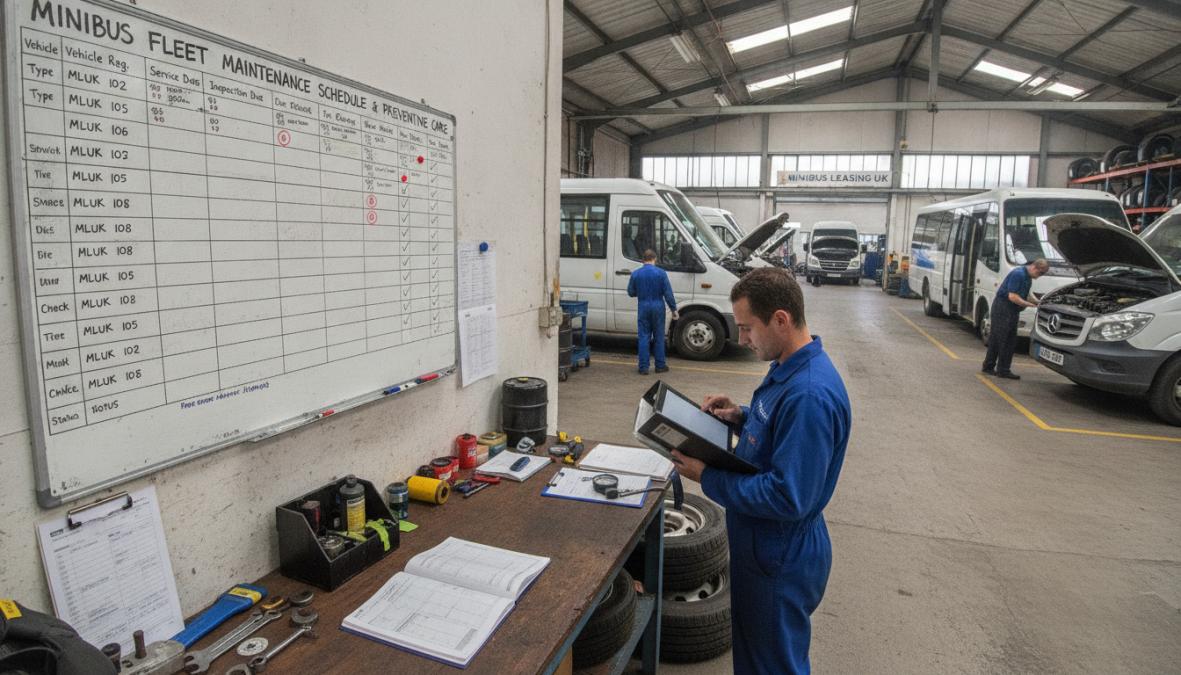
Managing compliance documentation manually is inefficient and error-prone. Fleet management software centralises maintenance records, driver qualifications, inspection logs, and compliance status in one system.
A good fleet management system allows you to schedule maintenance, track vehicle history, monitor driver compliance, manage inspections, and generate compliance reports. According to the UK Department for Transport guidance on fleet management, organisations using structured record-keeping systems demonstrate significantly better compliance outcomes during regulatory inspections.
Many software solutions are designed for small to medium-sized fleets and are affordable for organisations operating 5-50 minibuses. Implementation typically takes 2-4 weeks, with substantial return on investment through better maintenance planning, extended vehicle lifespan, and simplified compliance audits.
Passenger safety is the foundation of every minibus operation. This extends beyond vehicle maintenance to include passenger assistance, emergency procedures, and accessibility compliance.
Your minibus must be equipped with safety features appropriate to your passenger group: seatbelts for every passenger seat, handrails and grab handles, clearly marked emergency exits, first aid equipment, fire safety equipment, and wheelchair securing equipment if applicable.
If your minibus carries passengers with mobility impairments, you must ensure it meets accessibility standards. The Equality Act 2010 requires transport operators to make reasonable adjustments to ensure disabled passengers can access services. For minibus operators, this means ensuring your vehicle and staff can accommodate passengers with a range of mobility, sensory, and cognitive needs.
Minimising downtime is both a safety and business imperative. Preventive maintenance reduces unexpected breakdowns. Track your fleet's downtime and analyse root causes to inform decisions about vehicle replacement or maintenance intensity.
Understanding which issues can be addressed in-house and which require professional expertise helps you manage costs and minimise downtime.
In-house tasks include topping up fluid levels, replacing windscreen wipers, changing batteries, replacing light bulbs and fuses, and checking tyre pressure.
Professional garage tasks include any work requiring diagnostic equipment, brake system work, suspension and steering repairs, engine work beyond fluid top-ups, gearbox repairs, and MOT testing. If a repair affects passenger safety, brakes, steering, suspension, or lighting, it must be performed by a qualified technician.
Brake fade - Causes include worn brake pads, contaminated brake fluid, or a failing master cylinder. Prevention: monthly visual inspection of brake pads, annual brake fluid replacement, immediate professional attention if braking feels soft.
Overheating - Minibuses running at full capacity in summer heat are prone to overheating. Prevention: check coolant level weekly, ensure the cooling fan is functioning, flush the cooling system every 2-3 years.
Electrical failures - Battery discharge, alternator failure, or corroded connections can leave a minibus stranded. Prevention: test the battery annually, inspect alternator output, clean battery terminals.
Tyre problems - Punctures, uneven wear, or under-inflation are common. Prevention: check tyre pressure weekly, rotate tyres every 20,000 miles, replace tyres when tread depth falls below 3mm.
Most of these issues are preventable through rigorous preventive maintenance.
Operational requirements for minibus fleets include Section 19 permits for passenger transport, D1 category licensing for drivers, regular MOT testing, comprehensive maintenance schedules, driver training compliance, detailed record-keeping, and safety standards for passengers. You must also maintain vehicle roadworthiness, conduct daily pre-trip inspections, and ensure all documentation is current. The specific requirements vary depending on whether you operate for education, care, community, or commercial purposes.
Your minibus fleet maintenance schedule should be reviewed at least annually or whenever operational patterns change. Preventive maintenance intervals typically include daily pre-trip checks, weekly inspections, and scheduled service intervals based on manufacturer recommendations, usually every 10,000 to 20,000 miles or annually. Regular driver reports feed into this schedule, helping identify wear and tear early. Fleet management software can automate schedule tracking and alert you when vehicles require servicing, reducing unexpected downtime and repair costs.
Minibus drivers must hold a PCV (Passenger Carrying Vehicle) licence with a D1 category endorsement if the vehicle carries more than eight passengers. Drivers also require an enhanced DBS check for roles in education, care, and community sectors. Many operators mandate minibus driver training requirements such as professional development courses, defensive driving training, and passenger assistance certification, especially for accessible minibuses. These qualifications ensure compliance with regulatory standards and improve overall fleet safety and passenger care.
A comprehensive minibus fleet compliance checklist must cover: current Section 19 permits, valid MOT certificates, driver PCV licensing and DBS clearance, maintenance records and service history, insurance documentation, safety equipment (first aid kits, fire extinguishers), vehicle inspection reports, driver training certificates, and accessibility compliance for wheelchair-accessible vehicles. Regular audits using fleet management software ensure nothing is missed. Documentation should be retained for at least three years. This checklist protects your fleet's legal standing and demonstrates due diligence to regulators and insurers.

