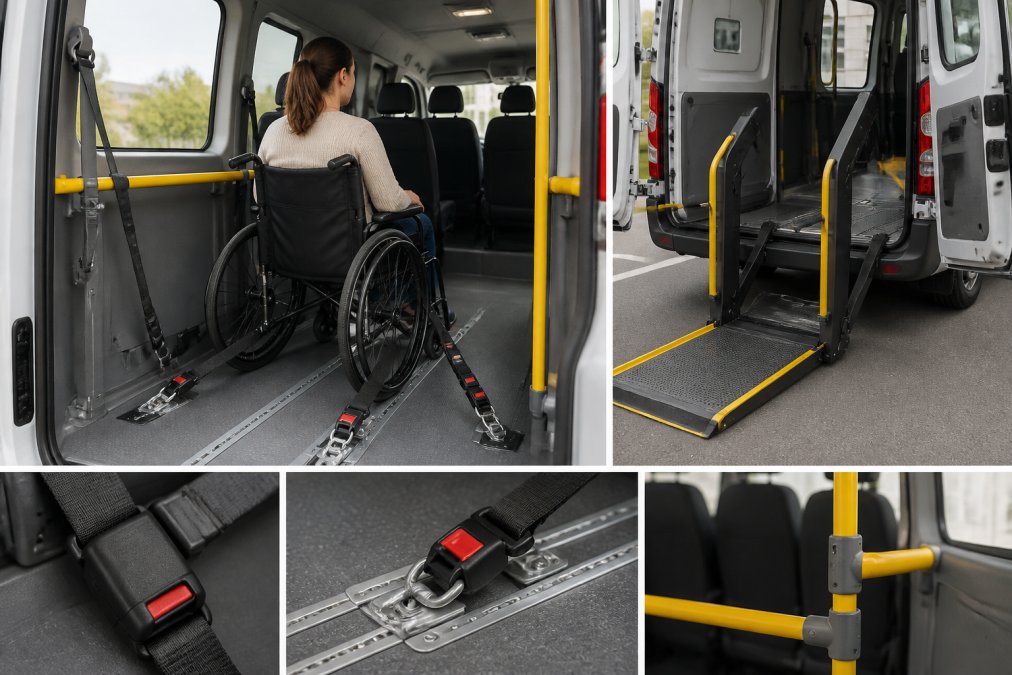
Aug 18, 2026
Transporting wheelchair users requires a fundamentally different approach to vehicle safety than standard minibus operations. The risks are measurable consequences of equipment failure, poor maintenance, or inadequate restraint systems. When a wheelchair accessible minibus lacks proper safety features, passengers face exposure to sudden deceleration forces, rollover incidents, or restraint failure that could cause serious injury.
At Minibus Leasing UK, we've worked with schools, care homes, and charities across the country to understand what separates compliant, safe transport from operations that cut corners. The difference comes down to three things: knowing which safety features actually matter, maintaining them rigorously, and choosing vehicles built to UK standards from the outset.
The Road Vehicles (Construction and Use) Regulations 1986, enforced by the DVSA, set minimum standards for wheelchair restraint systems, lift operation, and occupant protection. Beyond compliance, a minibus that meets the bare minimum isn't the same as one designed with safety as its foundation. The best wheelchair accessible minibus safety features anticipate failure modes, reduce operator error, and protect passengers during critical scenarios.
The wheelchair restraint system is the single most critical safety component in an accessible minibus. It keeps a wheelchair and its occupant in place during emergency braking, sudden acceleration, or collision.
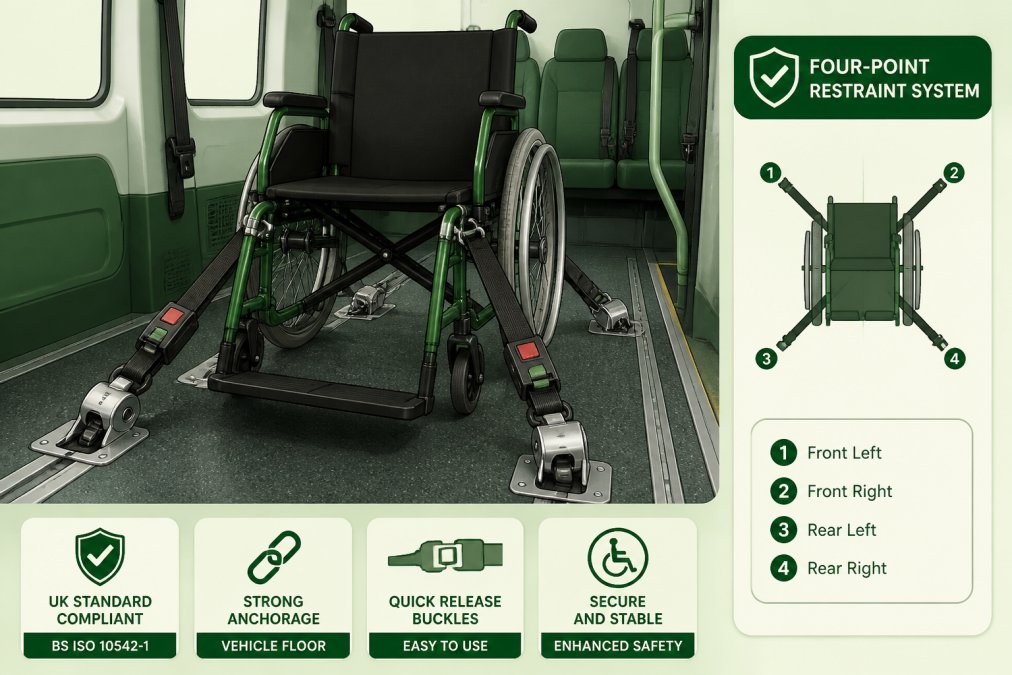
A compliant wheelchair restraint system must meet BS 6109-1, the British Standard for wheelchair securing devices. This standard specifies the force the system must withstand and how restraint points must be positioned relative to the wheelchair. Vehicles certified to this standard have been tested to hold a wheelchair in place under conditions that would otherwise cause it to tip or slide.
The most effective restraint systems use a four-point design: two straps securing the front wheels and two securing the rear of the wheelchair frame. This geometry distributes forces evenly and prevents rotation or tipping during sudden manoeuvres. Single-point or two-point systems leave the wheelchair vulnerable and don't meet current best-practice standards.
Installation matters as much as the system itself. Restraint points must be bolted to the vehicle's structural frame, not to panels or trim. Professional installation by a DVSA-approved converter is essential.
Quick-release mechanisms on restraint straps are essential for evacuation safety. In an emergency, a carer or driver needs to release a wheelchair user in seconds. Straps with push-button or lever releases are faster and more reliable than buckles requiring fine motor control under stress.
Wheelchair lifts are mechanical systems that fail. The question isn't whether a lift will eventually develop a fault, it's whether you'll catch it before it leaves a passenger stranded or drops them during operation.
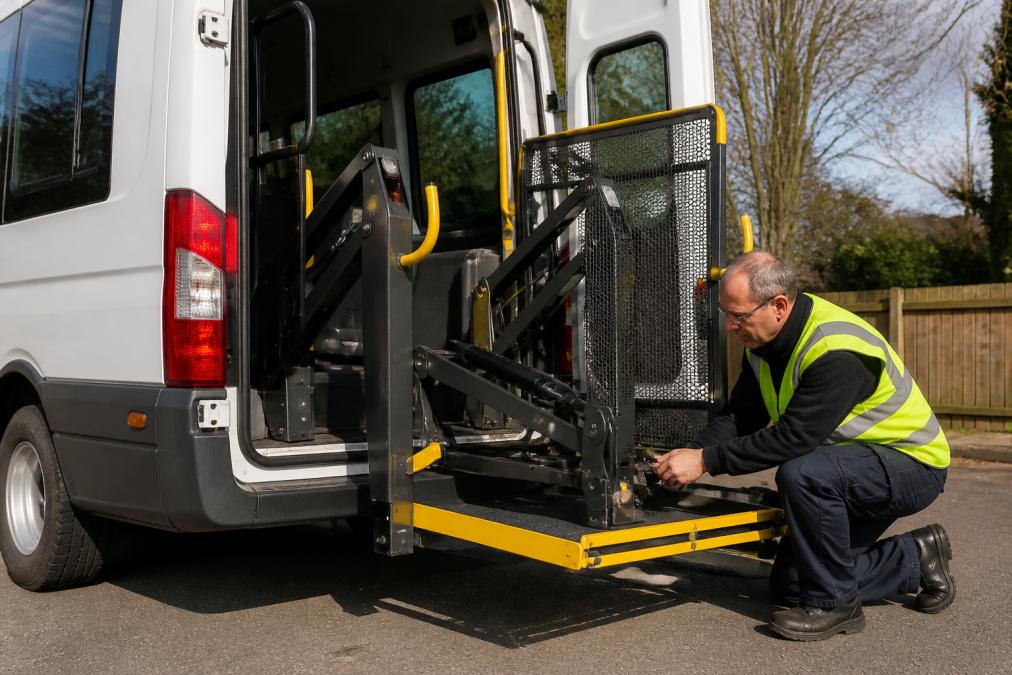
Lifts operate under extreme mechanical stress. Every deployment cycles the hydraulic system, extends the platform, and supports the full weight of a wheelchair user plus the wheelchair. Over time, seals wear, hydraulic fluid degrades, and mechanical linkages loosen.
Preventive maintenance schedules are your first line of defence. Lifts should be inspected and serviced every 6 months or 10,000 kilometres, whichever comes first. This is a legal requirement under the Lifting Operations and Lifting Equipment Regulations 1998 (LOLER). Each inspection should include checks of hydraulic pressure, platform alignment, safety latch engagement, and electrical controls. Documentation of every service must be kept and made available to enforcement officers.
Operators should establish a daily pre-use check routine. Before the minibus begins its day, the driver or designated staff member should deploy and retract the lift empty, listen for unusual sounds, and verify that all safety interlocks engage properly. This takes five minutes and catches most developing faults before they become dangerous.
Lift platform condition is often overlooked. The surface should have slip-resistant texture and be checked for cracks, corrosion, or loose fasteners. Rubber seals around the platform edges should be intact; gaps allow water ingress and accelerate internal corrosion.
Wheelchair users experience forces differently during vehicle movement than ambulatory passengers. They're sitting lower, their centre of gravity is offset by the wheelchair structure, and they cannot brace themselves using handholds or by adjusting their posture.
Electronic stability control (ESC) is now standard on most new minibuses. This system uses wheel-speed sensors and an accelerometer to detect when the vehicle is beginning to skid or roll, and automatically applies individual wheel brakes to correct the trajectory. For wheelchair users, ESC reduces the severity of sudden lateral movements that could destabilise a wheelchair.
Anti-lock braking systems (ABS) prevent wheel lockup during emergency braking. For wheelchair users, this matters because locked wheels can cause the vehicle to skid sideways, creating lateral forces that restraint systems weren't designed to handle. ABS maintains directional control and allows the restraint system to work as intended.
Suspension systems designed for wheelchair transport are tuned to minimise pitch and roll, the forward/backward and side-to-side movements that wheelchair users feel most acutely. Purpose-built accessible minibuses use suspension geometry and damping that balance comfort with stability.
Interior grab handles and handholds must be positioned for wheelchair users, not standing passengers. Handles should be at a height and distance that allow a carer to steady themselves during movement without blocking the wheelchair's position.
Crash protection for wheelchair users is an emerging area of safety design. Some modern accessible minibuses include reinforced side panels or energy-absorbing materials that reduce injury severity in a side-impact collision. Wheelchair users cannot wear seatbelts; they're restrained by the wheelchair restraint system alone. This means crash protection design must differ from standard minibuses.
Modern minibuses include driver assistance systems that reduce operator error and improve safety margins. For drivers operating accessible minibuses, who are often managing the vehicle, monitoring passengers, and coordinating lift operation simultaneously, these systems provide genuine safety benefit.
Reversing cameras and parking sensors are standard on new vehicles. Many accessible minibus operations involve frequent stops in tight spaces. A camera showing the area behind the vehicle and sensors alerting the driver to obstacles reduce the risk of striking pedestrians or property during manoeuvres.
Lane-keeping assist systems monitor road markings and alert the driver if the vehicle drifts out of lane without signalling. For long-distance runs, this system catches inattention before it becomes dangerous.
Blind-spot monitoring uses radar or cameras to detect vehicles in the driver's blind spot and alerts them before a lane change. For a minibus with larger blind spots than a car, this system prevents collisions with other traffic.
Traction control prevents wheel spin during acceleration on slippery surfaces. For a vehicle carrying vulnerable passengers, maintaining traction and directional stability is more important than achieving maximum acceleration.
Adaptive cruise control maintains a set speed and automatically adjusts it to maintain safe distance from vehicles ahead. This reduces driver workload on motorways and prevents gradual speed creep.
Accessibility controls, such as power-operated doors, lowered entry steps, and electronic ramps, should be intuitive and fail-safe. Controls should have manual overrides so that a mechanical failure doesn't trap passengers on board or prevent boarding in an emergency.
A risk assessment is your systematic way of identifying hazards, evaluating the likelihood and severity of harm, and deciding what controls are needed. For wheelchair accessible minibus operations, this assessment should be documented and reviewed at least annually, or whenever the vehicle or operation changes.
Start by listing all hazards specific to your operation: wheelchair restraint failure, lift malfunction, vehicle collision, sharp edges or protrusions inside the minibus, inadequate ventilation, and driver fatigue. For each hazard, estimate the likelihood and potential severity. A restraint system failure is low-likelihood but very high-severity. A minor cut from a sharp edge is low-severity but might occur more frequently if the hazard isn't removed.
Next, identify the existing controls already in place to manage each hazard: regular maintenance, driver training, vehicle design features, or supervision practices. Evaluate whether each control is effective. If maintenance is scheduled every 6 months but records show it's only happening annually, the control isn't working as intended.
Identify gaps and decide what additional measures are needed, whether that's more frequent maintenance, staff training, vehicle modifications, or operational changes.
Document your assessment in writing. Include the date, the people involved, the hazards identified, the controls evaluated, and the actions decided. Keep records of when actions are completed. This documentation demonstrates to regulators that safety is being managed systematically.
Involve your staff in the assessment. Drivers, carers, and maintenance technicians see hazards that managers miss and understand what's realistic to implement.
The best wheelchair accessible minibus for your organisation depends on your specific operation. A minibus suitable for a school's short daily runs differs significantly from one needed for a care home's longer journeys or a charity's variable transport demands.
Start by defining your actual requirements. How many wheelchair users will you transport? How many ambulatory passengers? What distances do you typically travel? How frequently does the minibus operate? What weather and road conditions will it encounter? These specifics determine which vehicle specification is appropriate.
Vehicle size matters. A minibus with capacity for 8-12 passengers differs from one designed for 16+. Smaller vehicles are more manoeuvrable in urban environments and use less fuel, but offer less passenger space. Larger vehicles provide more flexibility but are harder to park and navigate in tight spaces.
Lift type, platform, ramp, or hybrid, affects both safety and usability. Platform lifts are strong and suitable for most wheelchairs, but require more floor space. Ramps are faster to deploy but require a wheelchair user to have sufficient grip strength and balance. Some wheelchair users cannot use ramps safely. Hybrid systems offer flexibility but add mechanical complexity and maintenance burden.
Flooring material affects both safety and maintenance. Non-slip flooring reduces the risk of wheelchairs rolling during acceleration or braking, but is harder to clean. Most accessible minibuses use a textured vinyl or rubber composite that balances both concerns.
Heating and ventilation systems should maintain comfortable temperatures with a full passenger load and multiple wheelchairs. Poor ventilation creates discomfort and increases fatigue in drivers and carers.
At Minibus Leasing UK, we work with operators to specify vehicles that match their actual needs. Our account managers understand the regulatory requirements, the operational realities, and the safety trade-offs involved in each decision. We've supported schools, care homes, and charities across the country in selecting minibuses that are safe, compliant, and cost-effective over their full operational life. When you're ready to explore options that fit your budget and operational needs, our Minibus Leasing Special Offers can help you find competitive terms on vehicles that meet your safety standards.
A minibus with better suspension, more robust restraint systems, and modern driver assistance systems may cost more upfront but often costs less to maintain and operate over time. Better safety features also reduce the risk of incidents that could lead to regulatory action, liability claims, or reputational damage.
Wheelchair accessible minibus safety isn't a single feature, it's a system of design choices, maintenance practices, and operational discipline working together. The best safety outcomes come from vehicles built to current UK standards, maintained rigorously according to legal requirements, and operated by teams who understand the specific hazards of transporting wheelchair users.
Choosing the right minibus and maintaining it properly protects your passengers, reduces your liability, and ensures your operation remains compliant with UK regulations. The DVSA's guidance on wheelchair accessible vehicles provides detailed technical requirements, and BS 6109-1 standard for wheelchair securing devices sets the engineering specifications that safe restraint systems must meet.
At Minibus Leasing UK, we specialise in helping educational institutions, care homes, and charities select and manage accessible minibus fleets that prioritise safety and compliance. Our team understands Section 19 permits, D1 licensing requirements, and the specific operational demands of accessible transport. We provide bespoke vehicle specifications, whole-life cost analysis, and dedicated account management to ensure your fleet remains safe, legal, and cost-effective.
Get a bespoke quote or speak to a sector specialist at Minibus Leasing UK to discuss your accessible transport requirements. We'll help you select a minibus that meets your safety standards and operational needs.
Safety Feature | Purpose | UK Standard |
|---|---|---|
Four-point wheelchair restraint | Prevents wheelchair movement during braking or collision | BS 6109-1 |
Electronic stability control | Reduces skidding and rollover risk in corners | Road Vehicles Regulations 1986 |
Wheelchair lift with safety interlocks | Enables safe boarding for wheelchair users | LOLER 1998 |
Anti-lock braking system | Maintains directional control during emergency stops | Road Vehicles Regulations 1986 |
Reversing camera and sensors | Reduces collision risk during manoeuvres | Modern safety standard |
Accessible interior handholds | Provides stability for carers and ambulatory passengers | Design best practice |
Wheelchair accessible minibuses must comply with the Equality Act 2010 and meet specific accessibility standards. Vehicles carrying more than eight passengers require D1 licensing, which mandates safety features including wheelchair restraint systems, accessible entrances, and emergency exits. All wheelchair restraints must meet BS 6854 standards, and lifts must be regularly inspected and maintained. Your minibus operator should ensure compliance with these regulations to avoid penalties and protect passenger safety.
Wheelchair lifts should be inspected and serviced according to the manufacturer's recommendations, typically every 6-12 months, with safety checks before each use. Wheelchair restraint systems must be visually inspected before every journey and undergo formal testing annually. These maintenance schedules ensure equipment functions correctly and keeps passengers safe. Operators should keep detailed maintenance records to demonstrate compliance with regulatory requirements and identify any wear or damage that needs addressing.
Mandatory safety equipment includes certified wheelchair restraint systems meeting BS 6854 standards, accessible emergency exits, first aid kits, and fire extinguishers. Minibuses must have working wheelchair lifts with safety features, grab rails, and clear emergency communication systems. Additional features like anti-lock braking systems, electronic stability control, and driver assistance technology enhance safety further. All equipment must be regularly maintained and inspected to ensure it functions correctly during transport.
Conduct a comprehensive accessible minibus risk assessment covering vehicle design, equipment maintenance, driver training, and emergency procedures. Verify that all vehicles hold appropriate D1 licensing and that restraint systems meet BS 6854 standards. Establish regular inspection schedules for lifts and restraints, maintain detailed service records, and ensure staff receive training in safe wheelchair handling. Partner with a specialist fleet provider who understands UK compliance requirements and can guide you through regulatory obligations for your sector.

