Jun 25, 2026
Last Updated: June 25, 2026
Selecting the best minibus for care homes requires balancing accessibility, safety, capacity, and long-term operational costs. According to Department for Transport accessibility guidance, properly equipped minibuses are essential for compliance with disability access requirements in the UK. This guide covers the top minibus models, accessibility features, leasing versus buying decisions, and the regulatory framework you need to understand before making a purchase.
The minibus market offers several strong platforms designed for passenger transport and accessibility conversion.
Ford Transit Minibus supports up to 18-seat configurations with extensive customization options for wheelchair access. The Ford Co-Pilot360 driver assistance system includes blind-spot monitoring and lane-keeping assist. Conversion specialists widely support the Transit, making it straightforward to add ramps, lifts, or securement systems.
Mercedes-Benz Sprinter Minibus commands a premium but delivers superior ride quality and advanced safety features including Brake Assist, Crosswind Assist, and Pre-Safe systems. The Sprinter accommodates 16+ passengers comfortably, and resale value remains strong.
Renault Master Minibus represents a practical middle ground with strong accessibility conversion support and low-floor options that reduce boarding height. It supports up to 17 seats and includes modern safety connectivity features.
Fiat Ducato Minibus excels in modularity, allowing quick reconfiguration between passenger-only and wheelchair-heavy layouts. Its flexible floor space makes it ideal for care homes with changing resident needs.
Peugeot Boxer Minibus offers cost-effective operation with efficient Euro 6 diesel engines and supports various wheelchair lift and ramp systems.
Citroen Relay Minibus suits larger care facilities, supporting 17-seat configurations with cost-effective operation and multiple wheelchair restraint system compatibility.
| Model | Capacity | Key Strength | Best For |
|---|---|---|---|
| Ford Transit | Up to 18 | Versatility & service network | Mixed passenger/wheelchair needs |
| Mercedes Sprinter | 16+ | Premium comfort & safety | Premium care homes prioritizing ride quality |
| Renault Master | Up to 17 | Accessibility conversion support | Wheelchair-heavy transport requirements |
| Fiat Ducato | 14-16 | Modularity & flexibility | Facilities needing layout reconfiguration |
| Peugeot Boxer | 14-16 | Cost-effective operation | Budget-conscious operators |
| Citroen Relay | Up to 17 | High capacity | Large care groups with frequent transport |
This comparison prioritizes vehicles with proven track records in care sector conversions, strong specialist support networks, and realistic accessibility options. Each vehicle was evaluated on reliability data, service network density, conversion flexibility, and total cost of ownership.
Wheelchair accessibility is the foundation of safe, compliant care home transport. The difference between a properly configured minibus and a poorly adapted one can mean the difference between dignified resident independence and safety incidents.
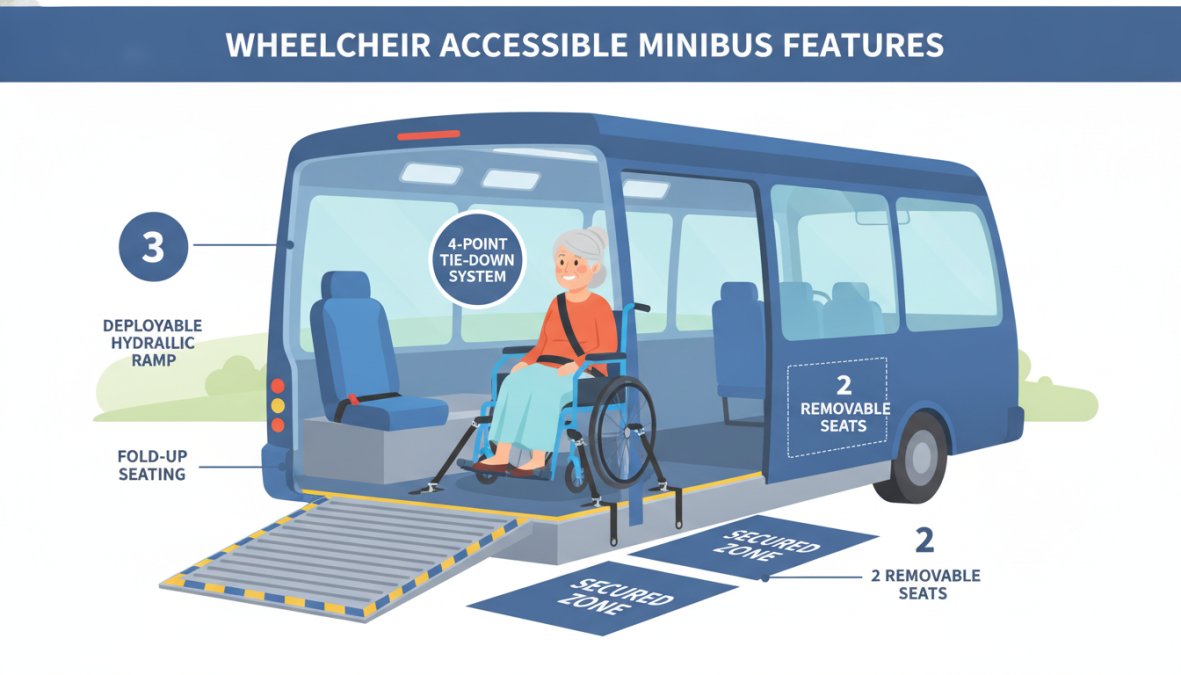
Low-floor entry points reduce boarding height to 300-400mm, making entry feasible for most residents. Powered hydraulic ramps are essential for high-frequency transport, reducing staff injury risk and speeding up boarding procedures. Research from Health and Safety Executive guidance on passenger transport emphasizes that ramp gradient should not exceed 1:12 to prevent safety hazards.
Modern securement systems use four-point tie-down systems that anchor the wheelchair frame to the vehicle floor via quick-release mechanisms. Quality systems deploy in under 30 seconds. Wheelchair users should face forward during transport, as sideways positioning creates spinal injury risk during braking.
The UK's Equality Act 2010 sets accessibility requirements for passenger transport vehicles. Care home minibuses carrying residents are legally required to meet these standards. Flexible seating configurations allow you to adjust passenger capacity based on resident needs, accommodating both ambulatory passengers and wheelchair users.
Leasing transfers vehicle risk to the leasing company. You pay a fixed monthly fee, and the lessor handles maintenance, repairs, insurance, and disposal. This predictability makes budgeting straightforward and works well for care homes with unpredictable transport needs. Leasing typically includes scheduled maintenance and breakdown recovery, reducing operational disruption.
Outright purchase makes sense if you operate consistently high transport volumes and plan to keep the vehicle for 5+ years. Once paid off, your only ongoing costs are fuel, maintenance, and insurance. The downside is capital requirement and depreciation risk. A quality minibus conversion costs between £40,000 and £80,000.
Fuel consumption for a 16-seat minibus averages 6-8 miles per gallon. Maintenance costs vary by vehicle age: a new minibus averages £1,500-2,000 annually; at 10 years old, annual maintenance can exceed £4,000. Insurance typically costs £1,500-3,000 annually. Breakdown recovery adds £400-600 annually.
A realistic five-year ownership scenario for a £50,000 minibus purchase totals approximately £84,500 including fuel, maintenance, insurance, and breakdown cover. A five-year lease for a comparable vehicle might cost £24,000-30,000 with maintenance and breakdown recovery included.
Operating a care home minibus without proper regulatory compliance creates liability exposure and immediate risk to residents.
D1 minibus licensing applies to vehicles carrying 9-16 passengers. Drivers must hold a PCV (Passenger Carrying Vehicle) license in addition to their standard car license. Section 19 permits allow vehicles to carry passengers for hire or reward. Without a Section 19 permit, you cannot legally operate the vehicle for passenger transport.
Obtaining a Section 19 permit requires:
The permit application process typically takes 4-6 weeks.
Driver training must include passenger assistance for mobility-impaired residents, wheelchair securement procedures, emergency evacuation protocols, and defensive driving techniques. Care home minibus drivers should complete care sector-specific training beyond the standard PCV qualification.
Occupant safety protocols should be documented in your care home's transport policy, including pre-journey vehicle safety checks, maximum occupancy limits, boarding procedures, and incident reporting.
The Ford Transit dominates the care sector because it balances versatility with proven reliability. Its modular design accommodates everything from basic passenger transport to fully wheelchair-accessible configurations. Ford's extensive service network ensures parts availability and repair support across the UK. Conversion specialists offer extensive Transit options, allowing you to specify exactly what your care home needs.
Pros: Excellent service network, versatile conversion options, proven reliability, good driver ergonomics Cons: Requires specialist conversion for full accessibility, lead times can extend 8-12 weeks
The Sprinter delivers measurable benefits in ride quality, safety systems, and long-term reliability. Advanced suspension reduces jolting during acceleration and braking, meaningful for elderly residents. Pre-Safe systems detect potential collisions and prepare the vehicle before impact. Sprinter resale value remains strong even at 5-7 years old, and the interior finish is noticeably higher quality than competitors.
Pros: Superior ride quality, advanced safety systems, strong resale value, premium interior finish Cons: Higher initial cost (£65,000-75,000 before conversion), specialist repair costs are premium
The Renault Master occupies the sweet spot for many care operators, offering strong accessibility support without premium pricing. Specialist converters favor the Master because its floor design accommodates wheelchair lifts and ramps naturally. Low-floor options reduce boarding height significantly. The vehicle's reputation for reliability is solid, with low unexpected failure rates.
Pros: Strong accessibility conversion support, low-floor options available, good value proposition, reliable performance Cons: Interior finish is more utilitarian than premium brands, smaller resale market
The Ducato's defining strength is modularity, allowing rapid reconfiguration between different seating and wheelchair layouts. This flexibility matters operationally when your facility's resident needs change. Mobility converters strongly support the Ducato platform with proven configurations.
Pros: Excellent modularity, strong specialist support, operational flexibility, reasonable value Cons: Ride quality less refined than premium brands, resale value varies by conversion type
Matching your facility's needs to the right vehicle requires honest assessment of your operational requirements.
Small facilities often operate minibuses that are partially empty. A smaller minibus (8-10 seat capacity) is more efficient than a 16-seater. A Fiat Ducato or Peugeot Boxer works well, with easier maneuverability in tight spaces and lower fuel consumption. Leasing often makes sense for small facilities, providing predictable monthly costs without capital outlay.
Medium facilities need genuine capacity flexibility. A 14-16 seat configuration with 2-4 wheelchair spaces provides realistic capacity. The Renault Master or Ford Transit work well at this scale. Standardizing on one platform simplifies maintenance and driver training. At this scale, buying often makes financial sense if you operate consistently.
Large facilities need maximum capacity. A 16-17 seat configuration with flexible wheelchair spaces matches your operational needs. Consider whether you need one large vehicle or multiple smaller ones. Two 12-seat minibuses sometimes work better operationally than one 16-seater, providing redundancy and flexibility. At this scale, buying is typically more cost-effective than leasing.
Prioritizing seating capacity over accessibility: A 14-seat minibus with proper wheelchair securement is more operationally useful than a 16-seater that can't accommodate wheelchairs safely.
Underestimating conversion costs: Wheelchair lifts, ramps, securement systems, and interior modifications add £10,000-20,000 to the base price.
Neglecting regulatory compliance: Many care homes operate minibuses without proper Section 19 permits or driver PCV licensing, creating criminal liability.
Choosing based on purchase price alone: Poor reliability and high repair costs quickly offset initial savings. Evaluate total cost of ownership over five years.
Ignoring specialist converter reputation: Research specialist converters, check references from other care homes, and verify safety certifications before committing.
Failing to match vehicle size to actual needs: Large minibuses are harder to maneuver and consume more fuel. Honest assessment of your typical transport volume prevents costly oversizing.
Overlooking driver training requirements: Factor driver training time and cost into your implementation timeline.
Selecting the best minibus for care homes requires balancing accessibility, safety, capacity, and long-term costs. The right vehicle depends on your specific resident population, transport volumes, and operational model. Whether you require a small accessible van for occasional transport or a full-size minibus for daily operations, matching your exact requirements ensures your fleet remains compliant, safe, and cost-effective.
Essential features include low-floor or ramp access, secure wheelchair securement systems, adequate interior space for mobility aids, and ADA-compliant seating configurations. Lift-equipped options provide easier entry for residents with severe mobility impairment. Safety restraints and non-slip flooring protect occupants during transit. Modern minibuses should include advanced driver-assistance systems and clear signage for emergency procedures. Proper ventilation and temperature control ensure resident comfort during transportation services.
Leasing typically offers lower upfront costs, predictable monthly payments, and included maintenance, ideal for care homes prioritizing cash flow flexibility. Buying suits facilities with long-term, stable transport needs and sufficient capital. Total Cost of Ownership (TCO) analysis reveals that leasing minimizes vehicle maintenance expenses and compliance risks, while purchasing builds equity over time. Consider your facility's growth plans, budget constraints, and fleet management capacity. Many care providers prefer leasing through specialist providers like Minibus Leasing UK for hassle-free fleet management and regulatory compliance.
Care home drivers transporting passengers require a Category D1 driving license (or PCV entitlement for vehicles over 16 seats). Operators need Section 19 permits for non-commercial passenger services. Facilities must ensure drivers complete specialized training in resident comfort protocols, emergency procedures, and wheelchair securement. Type-approved minibuses meet safety standards for occupant protection. Regular vehicle maintenance, insurance compliance, and documented driver training records are mandatory. Working with specialist providers ensures your fleet meets all regulatory requirements and safety regulations for care homes.
The Ford Transit or Renault Master are ideal for small care homes, offering flexible seating configurations and ease of entry without excessive size. Both support wheelchair accessible conversions and provide good fuel efficiency. The Fiat Ducato excels for facilities needing modularity, switching between passenger and wheelchair layouts easily. Consider your residents' mobility needs: if most are ambulatory, a standard passenger van suffices; if several use wheelchairs, prioritize low-floor or ramp-equipped options. Leasing allows you to upgrade as your facility grows without capital commitment.
This article was written using GrandRanker

