
Jul 01, 2026
Last Updated: July 1, 2026
Commercial minibus lease deals offer flexible financing for businesses requiring passenger transport without ownership burdens. Leasing transfers maintenance responsibility to the leasing company, freeing your team to focus on core operations. Unlike purchasing, you gain predictability, compliance assurance, and operational simplicity.
Commercial operations face stricter regulatory standards than personal users. Whether transporting employees, clients, or service users, your vehicle must meet specific safety, insurance, and accessibility requirements. Research from the UK government's vehicle leasing guidance confirms that commercial operators face obligations shaping every decision from vehicle selection through contract negotiation.
A commercial minibus lease differs fundamentally from personal car leasing. The vehicle is registered for business use, operating under different tax treatments, insurance categories, and maintenance protocols. Your organisation must ensure drivers hold appropriate licences (Category D1 for passenger transport), and the vehicle must comply with safety standards outlined in the Department for Transport's minibus regulations.
Using a commercially leased minibus for private purposes creates compliance gaps that can invalidate insurance and attract regulatory penalties. Minibus Leasing UK structures every deal ensuring your lease agreement explicitly matches your intended use case.
Leasing means paying for depreciation over a fixed term (typically 2-5 years) rather than owning an asset. A lease transfers maintenance risk to the lessor, with repairs, servicing, and parts replacement falling under their responsibility. Purchasing places all maintenance costs and risks directly on your organisation.
Tax treatment also diverges. Lease payments are typically tax-deductible as operating expenses, whereas purchased vehicles require depreciation calculations and capital allowance claims. The financial advantage depends on your organisation's tax position and long-term fleet strategy.
Running a commercial minibus operation demands regulatory compliance. Gaps expose your organisation to enforcement action, insurance denial, and reputational damage.
Commercial minibuses carrying more than eight passengers (excluding the driver) require a Public Service Vehicle (PSV) operator's licence from the Traffic Commissioner. Non-profit organisations may operate under Section 19 permits instead, which allow services to members or beneficiaries without full PSV licensing, though specific restrictions apply.
Driver licensing is critical. Drivers transporting more than eight passengers must hold a Category D1 driving licence (minibuses up to 16 seats) or Category D (larger vehicles). Standard Category B licences do not permit commercial passenger transport in minibuses.
Commercial minibuses must meet stringent safety standards. European Whole Vehicle Type Approval (ECWVTA) certification ensures the vehicle meets crash safety, emissions, and structural requirements. All new minibuses supplied by Minibus Leasing UK carry this certification as standard.
Accessibility compliance increasingly shapes commercial minibus specifications. If your operation serves passengers with mobility impairments, the vehicle must feature appropriate accessibility equipment including certified tail-lifts or ramps, secure wheelchair securement systems, and interior layouts accommodating mobility devices safely.
Regular testing and maintenance ensure compliance throughout the lease term. Your leasing agreement should specify maintenance schedules and inspection requirements, protecting both safety and your lease obligations.
Understanding the financial mechanics of commercial minibus leasing helps align decisions with your organisation's broader financial strategy.
Lease payments for commercial minibuses are typically deductible against business income, reducing your organisation's taxable profit. This applies to monthly or quarterly lease rental payments. The tax advantage becomes particularly valuable when lease payments are predictable and fixed, allowing finance teams to forecast costs accurately across multiple years.
Organisations should work with their accountant to confirm tax treatment specific to their circumstances. While lease payments are generally deductible, the detail matters, particularly for charities or non-profits where different tax rules may apply.
Whole life cost analysis compares the true cost of leasing versus purchasing over a defined period, including insurance, maintenance, fuel, and depreciation. Leasing typically offers cost advantages for organisations that cannot absorb unexpected repair bills or prefer predictable monthly expenses. A lease transfers repair risk to the lessor, protecting your budget.
When evaluating lease options, consider exploring Minibus Leasing Special Offers to identify deals that enhance cost-effectiveness. Minibus Leasing UK conducts whole-life cost analysis with each client, comparing lease versus purchase scenarios using your actual operational data.
Two primary financing models exist: operating leases and hire purchase agreements. Each offers distinct advantages depending on your organisation's circumstances and long-term strategy.
An operating lease transfers the vehicle to you for a fixed term (typically 2-5 years), after which it returns to the lessor. You pay only for the vehicle's depreciation during your lease period, not its full value.
Lease agreements typically include maintenance as standard, removing maintenance management from your operational burden and providing cost certainty. Leasing also provides flexibility, when your lease ends, you can upgrade to a newer vehicle incorporating the latest safety features and efficiency improvements. For organisations managing multiple vehicles, leasing simplifies fleet management, with Minibus Leasing UK handling registration, licensing support, and maintenance coordination.
Hire purchase represents a middle ground between leasing and outright purchase. You make monthly payments toward ownership, and after the final payment, the vehicle becomes your asset. This appeals to organisations wanting eventual ownership without paying the full purchase price upfront.
Hire purchase requires larger monthly payments than leasing because you're building equity. However, once ownership transfers, those payments cease. For organisations planning long-term operation (beyond 5-7 years), hire purchase can prove more economical than perpetual leasing. Ownership also allows customisation, if your operation requires specific adaptations or specialised equipment, ownership gives you freedom to modify the vehicle.
Selecting the right minibus starts with understanding your actual passenger requirements. Capacity and layout decisions ripple through every aspect of your operation.
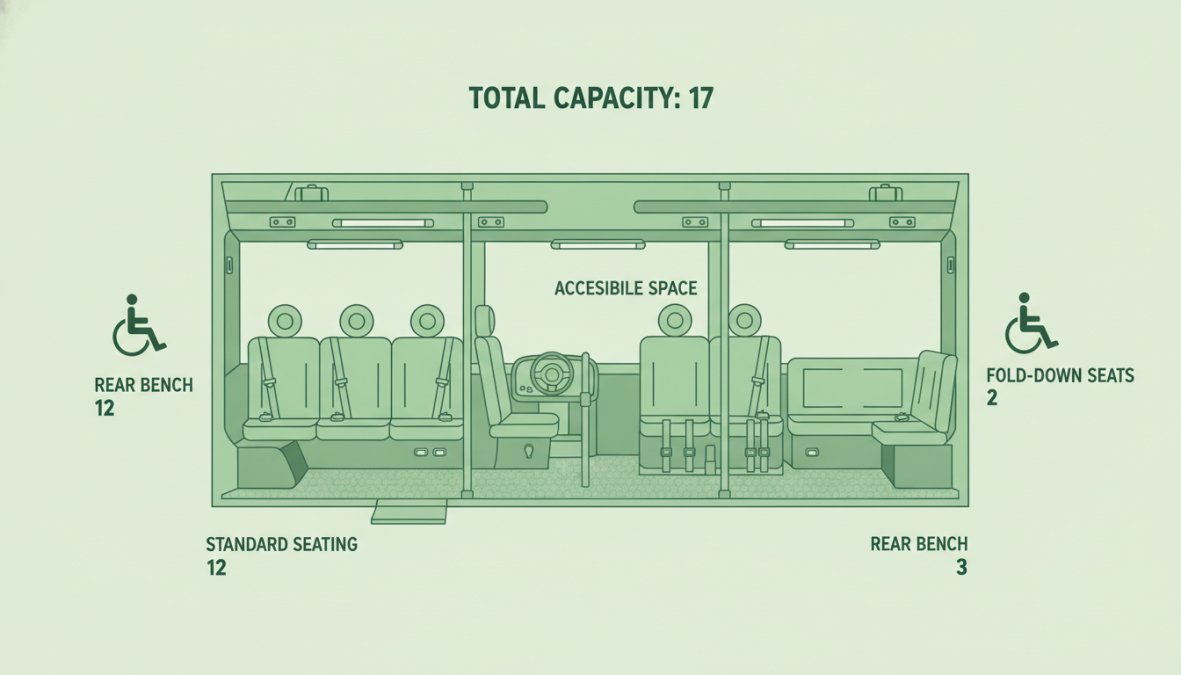
Commercial minibuses range from eight-seat vehicles to 16-seat configurations. Selecting the right capacity requires honest assessment of your typical passenger numbers, not your maximum capacity. Many organisations overestimate required capacity, selecting larger vehicles than they actually need, which increases lease costs, fuel consumption, and maintenance expenses.
Consider your passenger profile carefully. If you regularly transport elderly users, passengers with mobility impairments, or parents with pushchairs, a layout prioritising accessibility and comfort serves you better than maximising raw seat count. Minibus Leasing UK works with clients to model different configurations against actual demand.
Accessibility equipment transforms a standard minibus into an inclusive transport solution. Tail-lifts (hydraulic platforms that lower to ground level) allow wheelchair users to board independently, while ramps provide an alternative for passengers unable to navigate steps.
Wheelchair securement systems anchor mobility devices safely during transit using certified restraint points and quick-release mechanisms. Interior modifications supporting accessibility include widened aisles, grab handles positioned for stability, and designated wheelchair spaces clearly marked.
Selecting appropriate accessibility equipment depends on your passenger profile and regulatory requirements. If your operation serves disabled passengers, accessibility features are essential for legal compliance and service quality.
A lease agreement defines maintenance responsibility. Understanding what's included prevents budget surprises and operational disruptions.
New minibuses supplied by Minibus Leasing UK carry manufacturer warranties covering defects in materials and workmanship, typically covering three years or 60,000 miles. Your lease agreement should clearly specify whether warranty claims fall to you or the lessor. Most commercial leasing arrangements place warranty responsibility with the lessor.
Reliability varies by manufacturer and model. European manufacturers (Mercedes, Iveco, Ford) generally offer strong reliability records, supported by extensive dealer networks and parts availability. Preventative maintenance, regular servicing, typically annual or every 10,000 miles, extends vehicle life and prevents costly failures.
Once your lease begins, effective fleet management ensures compliance, safety, and cost control throughout the lease term. Establish clear driver protocols for pre-drive checks, damage reporting, and lease responsibilities.
Assign one team member to manage service scheduling, track maintenance records, and coordinate with the lessor's maintenance provider. Monitor mileage against your lease allowance, most leases include annual mileage limits (typically 20,000-40,000 miles), with excess mileage charges triggered if you exceed them.
Selecting a lease deal involves comparing multiple providers, understanding contract terms, and assessing whether the vehicle genuinely matches your operational requirements.
Start by defining your non-negotiable requirements: passenger capacity, accessibility features, geographic area, and budget range. Compare lease providers on multiple dimensions, monthly cost, included services, mileage restrictions, and breakdown cover. Assess provider expertise in your sector. Minibus Leasing UK specialises in education, care, community, and commercial operations, understanding the specific regulatory requirements and operational challenges your sector faces.
| Evaluation Criterion | What to Assess | Why It Matters |
|---|---|---|
| Monthly Cost | Base lease payment plus included services | Determines budget impact and cost predictability |
| Maintenance Coverage | What repairs/servicing are included | Affects total cost of ownership and operational disruption |
| Mileage Allowance | Annual miles included in lease | Excess mileage charges can be substantial |
| Accessibility Features | Wheelchair lifts, ramps, securement systems | Essential for serving passengers with mobility needs |
| Warranty Coverage | Manufacturer defects covered | Protects against unexpected repair costs |
| Provider Support | Account manager availability, response times | Critical when issues arise during operations |
| Contract Flexibility | Early termination options, upgrade paths | Allows adjustment if your needs change |
Never sign a lease agreement without driving the minibus yourself. A test drive reveals how the vehicle handles, visibility, and whether the layout genuinely suits your operations. During your test drive, assess driver comfort, passenger visibility, and ease of operation. If possible, arrange a site visit where your team experiences the vehicle in your actual operational environment.
Minibus Leasing UK facilitates comprehensive test drives and site visits, ensuring you experience the vehicle in conditions matching your actual operation.
Years of guiding organisations through minibus procurement reveal patterns in what goes wrong.
Underestimating accessibility requirements. Many organisations lease a standard minibus, then discover their passenger profile requires wheelchair accessibility. Assess accessibility needs honestly before leasing.
Ignoring mileage limits. Organisations frequently underestimate annual mileage, then face substantial excess mileage charges. Calculate your expected mileage conservatively, accounting for seasonal variations.
Focusing solely on monthly cost. The cheapest lease payment isn't necessarily the best deal. A lease with limited maintenance coverage, high excess mileage charges, and minimal provider support becomes expensive quickly. Evaluate total cost of ownership.
Failing to clarify maintenance responsibility. Ensure your lease agreement explicitly defines what maintenance is included, what's excluded, and who bears responsibility.
Choosing the wrong vehicle size. Organisations often select the largest available minibus. Oversized vehicles increase costs, fuel consumption, and maintenance expenses. Select the smallest vehicle that genuinely meets your needs.
Not involving drivers in the selection process. Drivers understand operational realities that management may overlook. Involving drivers in test drives improves acceptance and prevents later complaints about vehicle suitability.
Selecting commercial minibus lease deals requires balancing cost, compliance, and operational fit. The right lease removes transport challenges, allowing your organisation to focus on core services. Minibus Leasing UK combines deep sector expertise with data-driven whole-life cost analysis, ensuring your fleet remains compliant, safe, and cost-effective. Our dedicated account managers work directly with your team to understand your specific requirements and deliver tailored solutions. Get a bespoke quote from Minibus Leasing UK and discover how the right minibus lease transforms your transport operations.
Leasing offers lower upfront costs, predictable monthly payments, and included maintenance, making it ideal for businesses wanting flexibility. Hire purchase suits organisations seeking long-term ownership and asset building. Commercial minibus lease deals typically work best for operations with variable fleet needs, whilst purchase is better for stable, long-term requirements. Consider your operational timeline, budget constraints, and growth plans.
Lease payments are generally fully tax-deductible as a business expense, reducing your overall tax liability. Unlike purchase, you avoid depreciation calculations and capital allowance complexity. Consult your accountant to understand how minibus lease tax deductions apply to your specific business structure and financial situation, as tax treatment varies by sector and company type.
Commercial operations must comply with D1 licensing if carrying passengers for hire or reward, and Section 19 permits for community transport. Drivers need appropriate categories on their driving licence (usually category D1). Vehicles must meet safety standards including seatbelts, emergency exits, and passenger safety features. Insurance, MOT, and maintenance schedules are mandatory. Requirements vary by operation type, so verify your specific obligations with relevant authorities.
Yes, many providers offer flexible lease terms from 12 months upwards, though standard commercial minibus lease deals typically run 24-60 months for better value. Short-term leases may carry higher monthly costs but suit seasonal operations or trial periods. Discuss your timeline with providers to find options matching your operational needs without committing to lengthy agreements you don't require.

