
Jul 17, 2026
Last Updated: July 17, 2026
Understanding D1 licence requirements for minibuses is essential if you operate or plan to drive passenger vehicles in the UK. The rules governing who can legally drive a minibus have become increasingly complex, particularly around grandfather rights, weight restrictions, and the distinction between commercial and voluntary use. Driving a minibus without the correct licence category exposes your organisation to prosecution, unlimited fines, and potential vehicle impoundment.
A D1 licence permits you to drive minibuses carrying between 9 and 16 passenger seats, excluding the driver's seat. The vehicle's maximum authorised mass (MAM) cannot exceed 5,000 kilograms, and it must be designed and constructed for carrying passengers.
What distinguishes a D1 licence from other categories is the "not for hire or reward" restriction that applies to most D1 licence holders. This means you can drive a minibus for voluntary purposes, transporting school groups, charity outings, community activities, but you cannot operate it as a commercial passenger service where you charge fares. If you want to operate commercially, you'll need either a D2 licence or a Section 19 permit (for non-profit organisations) or Section 22 permit (for commercial operators).
The D1 licence requires passing both a theory test and a practical driving test specifically designed for passenger vehicles, plus a Group 2 medical examination.
The simple answer is no, not legally. Your standard Category B car licence permits you to drive vehicles with up to 8 passenger seats (including the driver). The moment you exceed that threshold, you're operating outside your entitlement.
However, there's a critical exception: if you hold a full car licence issued before 19 January 1997, you may have automatic entitlement to drive minibuses under grandfather rights. This means you inherited a D1 licence qualification without ever passing a D1 test. The catch: this grandfather entitlement comes with the code 101 restriction, meaning you cannot drive for hire or reward.
If your driving licence was issued before 19 January 1997, you automatically hold a "grandfather right" to Category D1. When the DVLA reissued your licence in the new format, they automatically added the D1 entitlement without requiring a test or fee.
This entitlement has real limitations. The code 101 restriction applies automatically, meaning you cannot drive for hire or reward. You can transport a group to a community event, drive school children, or support a charity outing, but only on a voluntary, non-commercial basis.
If you want to remove the code 101 restriction and gain the right to operate commercially, you must pass a full D1 test. If your pre-1997 licence expires and you renew it, your D1 entitlement is preserved.
The code 101 restriction means you cannot accept payment for transporting passengers. This includes any financial benefit, direct or indirect. If you charge passengers to cover fuel costs, accept sponsorship from a local business, or operate the minibus as part of a commercial contract, you're receiving payment and need either a D1 licence without code 101 or a Section 19/22 permit.
The DVLA investigates complaints about code 101 breaches. If you operate a minibus commercially and only hold a D1 licence with code 101, you're exposed to prosecution, unlimited fines, and disqualification. Insurance is also void if you breach the code 101 restriction.
The process for obtaining a D1 licence involves four distinct stages: eligibility checking, provisional licence application, theory test, and practical driving test.
You must be at least 18 years old to hold a D1 licence and must hold a full Category B (car) licence. Your medical fitness is assessed through a Group 2 medical examination (form D4), which is more rigorous than the standard medical check. Declare any chronic health conditions, medications, or disabilities to the DVLA before applying.
Check whether you have any driving disqualifications, penalty points, or outstanding driving offences. Gather your documents: your full driving licence, passport or birth certificate for identity verification, and proof of address. You'll also need to book a Group 2 medical examination with an approved medical practitioner.
Submit form D1 to the DVLA along with your supporting documents. You can apply online through the DVLA website or by post; the online process is faster.
Include your completed Group 2 medical form (D4) signed by an approved medical practitioner. This form cannot be older than 12 months at the time of application. The DVLA will issue a provisional D1 licence once your application is processed. This provisional licence allows you to drive a minibus under supervision, you must be accompanied by a qualified instructor or a D1 licence holder during all driving practice.
The D1 theory test assesses your knowledge of traffic law, vehicle safety, hazard perception, and passenger safety. It's more demanding than the car theory test because it covers additional topics relevant to larger vehicles and passenger transport.
The test consists of 50 multiple-choice questions (you need 43 correct to pass) and a hazard perception video section (you need 67 out of 100 marks). Book your test through the DVSA website. Most candidates take 4-8 weeks of study before attempting the test. Your theory test pass certificate is valid for two years, so you must pass your practical test within that timeframe.
The D1 practical test lasts approximately 90 minutes and assesses your ability to drive a minibus safely and competently. You'll be tested on vehicle safety checks, manoeuvring skills, normal driving on various road types, and your response to hazards.
Book your practical test through the DVSA. You'll need to arrange a minibus for the test, either through a driving school or by hiring one. Most candidates undertake 20-40 hours of professional instruction before attempting the practical test.
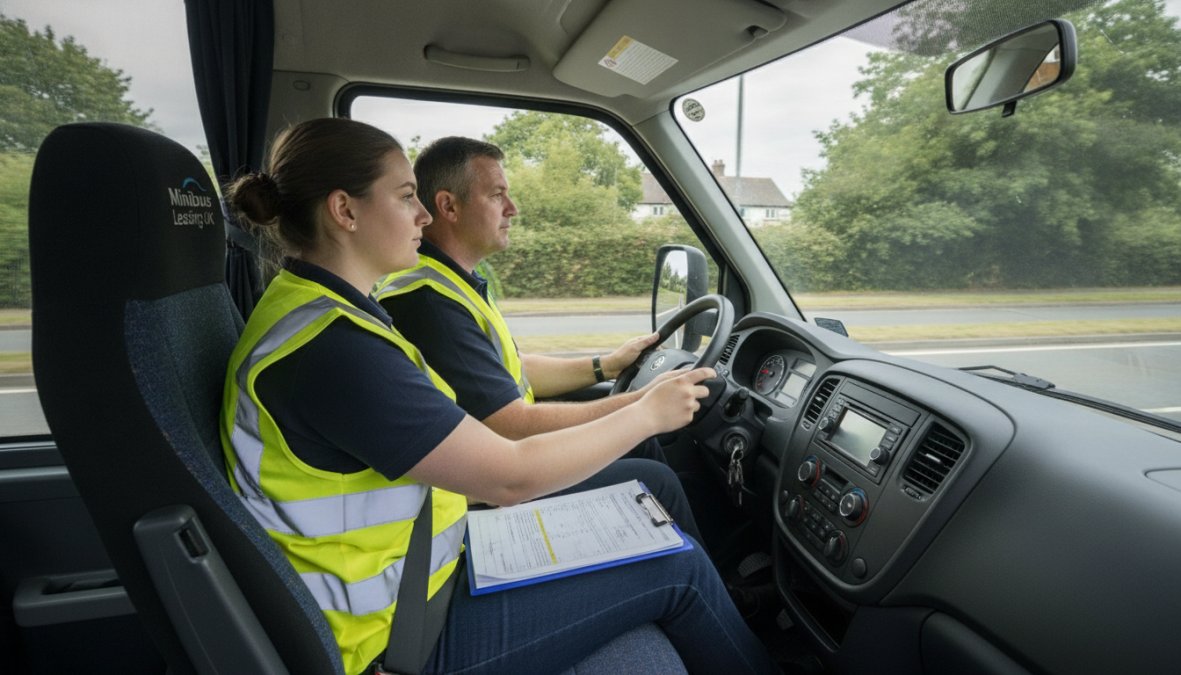
The Group 2 medical examination is a significant hurdle for some applicants. It's substantially more demanding than the standard medical check for car drivers because minibuses carry multiple passengers.
The D4 form is the official medical questionnaire you complete before your medical examination. You must answer every question honestly and completely. Failing to disclose relevant information is illegal and can result in prosecution or licence revocation.
The form covers cardiovascular health, neurological conditions, diabetes, mental health conditions, hearing and vision problems, and any medications you're taking. Once you complete the form, you attend an appointment with a Group 2 approved medical practitioner who will conduct a physical examination, test your vision and hearing, check your blood pressure, and review your medical history.
Group 2 standards are significantly stricter than car driver standards because minibus drivers carry multiple passengers.
Vision standards: You must have visual acuity of at least 6/7.5 in each eye (corrected if necessary), and a combined visual field of at least 120 degrees. Age-related macular degeneration or diabetic retinopathy will likely result in refusal.
Hearing standards: You must be able to perceive a whispered voice at one metre distance in at least one ear. If you don't meet this standard, you can be approved if you wear a hearing aid that brings you to the required standard.
Cardiovascular health: Any history of myocardial infarction, coronary angioplasty, or coronary artery bypass surgery requires specialist assessment and typically a period of time (usually 6 months) before you can be approved. Uncontrolled high blood pressure will result in refusal.
Diabetes: If you're insulin-dependent, you require annual medical reviews and must demonstrate good control. If you're managing diabetes through diet or oral medication, you may be approved if your blood sugar is well controlled.
Neurological conditions: Epilepsy requires a period of seizure-free time (usually 10 years) before approval. Parkinson's disease and multiple sclerosis are assessed individually, but many will result in refusal.
Mental health: Depression and anxiety are assessed based on severity and whether you're stable on medication. Psychosis and bipolar disorder are typically grounds for refusal unless you have a very long period of stability.
Your D1 licence comes with specific restrictions that define how you can legally operate a minibus.
Voluntary use means transporting passengers without receiving payment or financial benefit. This includes school transport provided by the school itself, charity minibuses run by volunteers, and community transport schemes. Under voluntary use, you can operate with a D1 licence carrying code 101 restriction.
Commercial use means operating the minibus as a business service where passengers pay fares or your organisation receives payment for the transport. Commercial operation requires either a D1 licence without code 101 restrictions or a Section 22 operator's licence.
Non-profit community transport allows registered charities or non-profit organisations to operate minibus transport under a Section 19 permit. This permit allows you to charge passengers (to cover costs) without requiring a full D1 licence from every driver.
Once you hold a D1 licence, you're required to complete Driver CPC (Certificate of Professional Competence) training if you drive the minibus for commercial purposes. This involves periodic training (35 hours every five years) covering safe driving, vehicle maintenance, passenger safety, and professional conduct.
If you're driving for voluntary purposes under code 101 restrictions, Driver CPC is not mandatory. A D1 licence permits you to tow a trailer if the combined maximum authorised mass of the vehicle and trailer doesn't exceed 12,000 kilograms.
Vehicles with 8 or fewer passenger seats (including the driver's seat) can be driven on a standard Category B car licence. Vehicles with a maximum authorised mass exceeding 5,000 kilograms require a D2 licence. The vehicle's technical specification determines the licence category, not its size or appearance. Check your vehicle's specification with the manufacturer or the DVLA.
If you hold a valid UK D1 licence, it's recognised throughout the European Union and most other countries that recognise the EU driving licence format. However, some countries have additional requirements including GB stickers, insurance green cards, headlight beam adjusters, and breathalyser kits.
The UK D1 licence is not recognised in countries outside the EU/EEA. If you're planning to drive in the United States, Australia, or other non-EU countries, you'll need an International Driving Permit obtained from the Post Office before departure. If you hold a D1 licence with code 101 restrictions, you cannot legally operate a minibus commercially in any country.
Scenario 1: School transport provider. A local authority runs a minibus transporting 12 school children to and from school daily. The driver holds a full car licence issued in 1995 (pre-1997). This driver can legally operate the minibus under grandfather rights without a D1 test, provided the minibus carries code 101 restrictions. This is compliant.
Scenario 2: Coach hire company. A commercial company operates three minibuses offering transport for hire, charging customers per journey. All three drivers must hold full D1 licences without code 101 restrictions. The company must hold a Section 22 operator's licence. This is a commercial operation requiring full professional licensing.
Scenario 3: Charity minibus. A registered charity operates a community minibus transporting elderly residents to day centres and charges passengers £2 per journey to cover fuel costs. The driver holds a post-1997 car licence. The charity can register for a Section 19 permit, which allows drivers with car licences to operate the minibus. This is compliant and avoids the need for a full D1 licence.
Scenario 4: Corporate shuttle service. A large employer operates a minibus providing free transport for employees between the office and a remote car park. The driver holds a full D1 licence with code 101 restrictions. This is compliant because the transport is not for hire or reward.
Scenario 5: Voluntary driver with car licence. A community organisation recruits a volunteer driver who holds only a post-1997 car licence. The organisation has not registered for a Section 19 permit. This scenario is non-compliant. The driver either needs a D1 licence or the organisation must register for Section 19.
| Scenario | Driver Licence Type | Vehicle Seats | Operational Purpose | Compliant Licensing |
|---|---|---|---|---|
| School transport | Pre-1997 car licence | 12 | Non-commercial | Grandfather rights (code 101) |
| Coach hire | Post-1997 car licence | 14 | Commercial | D1 licence + Section 22 permit |
| Charity day centre | Post-1997 car licence | 10 | Non-profit | Section 19 permit or D1 licence |
| Corporate shuttle | Post-1997 car licence | 12 | Non-commercial | D1 licence (code 101) or Section 19 |
| Voluntary driver | Post-1997 car licence | 15 | Voluntary | D1 licence or Section 19 permit |
Understanding D1 licence requirements for minibuses protects your organisation from prosecution, insurance voidance, and operational disruption. If your organisation operates minibuses, the first step is confirming which licensing category applies to your specific situation. Consult the DVLA directly if you're uncertain. For organisations managing minibus fleets, exploring Minibus Leasing Special Offers can provide cost-effective solutions while ensuring your vehicles and drivers meet all regulatory standards. Speak to a sector specialist to discuss your operational requirements and ensure full compliance.
A D1 licence (Passenger Carrying Vehicle category) permits you to drive minibuses with 9-16 passenger seats. It covers vehicles with a maximum authorised mass (MAM) up to 7,500 kg and is subject to the 'not for hire or reward' restriction unless you hold additional permits. The D1 licence requires passing theory and practical tests, plus Group 2 medical standards. It differs from a standard Category B car licence, which limits you to eight-seater vehicles maximum.
Yes, you need a D1 licence to drive any minibus with 9-16 passenger seats, regardless of whether it's for personal, voluntary, or community use. However, the 'not for hire or reward' restriction (code 101) applies, meaning you cannot charge passengers unless operating under a Section 19 permit (community transport) or Section 22 permit (larger operators). Pre-1997 licence holders may have grandfather rights allowing them to drive minibuses under certain conditions without a D1 licence.
The D4 medical form assesses Group 2 medical standards, which are stricter than standard driving requirements. You'll be evaluated on eyesight, hearing, cardiovascular health, diabetes management, neurological conditions, and medication effects. The medical examination is conducted by your GP, who completes the D4 form and submits it to the DVLA. You must meet these standards before receiving your D1 licence and renew your medical certificate every five years (or annually if you're over 70).
Code 101 ('not for hire or reward') is a standard restriction on D1 licences that prohibits you from charging passengers for transport. This applies to personal, voluntary, and community use. To operate a minibus commercially and charge passengers, you must obtain a Section 19 permit (for non-profit organisations) or a Section 22 operator's licence (for commercial services). These permits require compliance with additional regulations, including Driver CPC qualifications and safety standards.

