
Sep 10, 2026
Last Updated: September 10, 2026
D1 licence requirements for schools are the rules that decide who may legally drive a minibus carrying pupils, and under what conditions. The answer hinges on three things: the vehicle's weight, the number of passengers, and whether the service is run for profit. Get any of those wrong and your transport operation is running outside the law.
The core principle is simple. A minibus is a passenger-carrying vehicle, not a large car, and the licence category that covers it is D1. Most school staff who drive a minibus assume their standard car licence is sufficient. It often is, but only inside a narrow set of exemptions that many schools misread. Below, we break down exactly when a D1 licence is needed, how the medical and DVLA process works, and where MiDAS training fits in.
A D1 licence is legally required whenever a driver is paid to transport passengers, or when the vehicle exceeds the weight and seat limits that the car-licence exemption allows. The exemption covers minibuses under 3.5 tonnes with no more than 16 passenger seats, driven by someone over 21 who has held a full car licence for at least two years, and who is not driving for hire or reward (gov.uk).
The phrase "hire or reward" is where schools come unstuck. If you charge pupils or parents a fare, even to cover fuel, you have crossed into hire or reward territory and the exemption no longer applies. A voluntary driver receiving no payment, in a qualifying vehicle, can drive on a car licence.
A Section 19 permit allows certain organisations to operate minibuses without a full PSV operator licence, provided the transport is not run for profit. Schools, charities, and community groups commonly hold one.
Crucially, a Section 19 permit does not remove the driver licensing requirement. It changes the operator licensing rules, not who may drive. Drivers still need the correct licence category for the vehicle and use. DVLA guidance on minibus driving entitlements sets out the weight and seat thresholds in full, and it is worth reading alongside your permit conditions before you roster any driver.
Driving a minibus on a car licence is permitted for school staff only within the exemption limits: a vehicle under 3.5 tonnes, a maximum of 16 passenger seats, a driver aged 21 or over who has held a full car licence for two years, and no payment for the journey.
There is a second route that catches people out. Drivers who passed their car test before 1 January 1997 usually have D1 automatically included on their licence. Those who passed after that date do not. This single date divides your staff into two groups, and it is the first thing to check when building a driver roster.
D1 licence medical requirements centre on proving you meet the higher medical standard for passenger-carrying vehicles. Applicants complete a D4 medical examination with a doctor, then submit the completed form to the DVLA along with the licence application.
The medical standard is stricter than for a car licence because you are carrying passengers. Age matters here: once a D1 holder reaches 70, the licence must be renewed, and medical declarations become a regular requirement rather than a one-off. Schools running a minibus roster should track renewal dates for every driver, because an expired medical entitlement quietly invalidates your insurance.
The D4 medical examination covers vision, including eyesight and field of vision tests, plus a review of your medical history for conditions that affect safe driving. The doctor assesses cardiovascular health, diabetes, neurological conditions, and any dependency on alcohol or drugs.
The DVLA may request further information or a specialist report before granting entitlement. DVLA medical standards for drivers details the specific conditions and thresholds, and it is the definitive reference if a driver's GP raises a concern. Build in lead time: a D4 medical and DVLA processing can take several weeks, so do not leave it until the week before a trip.
MiDAS training requirements for schools are not a legal obligation, but they are widely treated as best practice for anyone driving pupils. MiDAS, the Minibus Driver Awareness Scheme, is a nationally recognised standard that assesses a driver's competence in a minibus rather than a car.
Get a Bespoke Quote or Speak to a Sector Specialist →
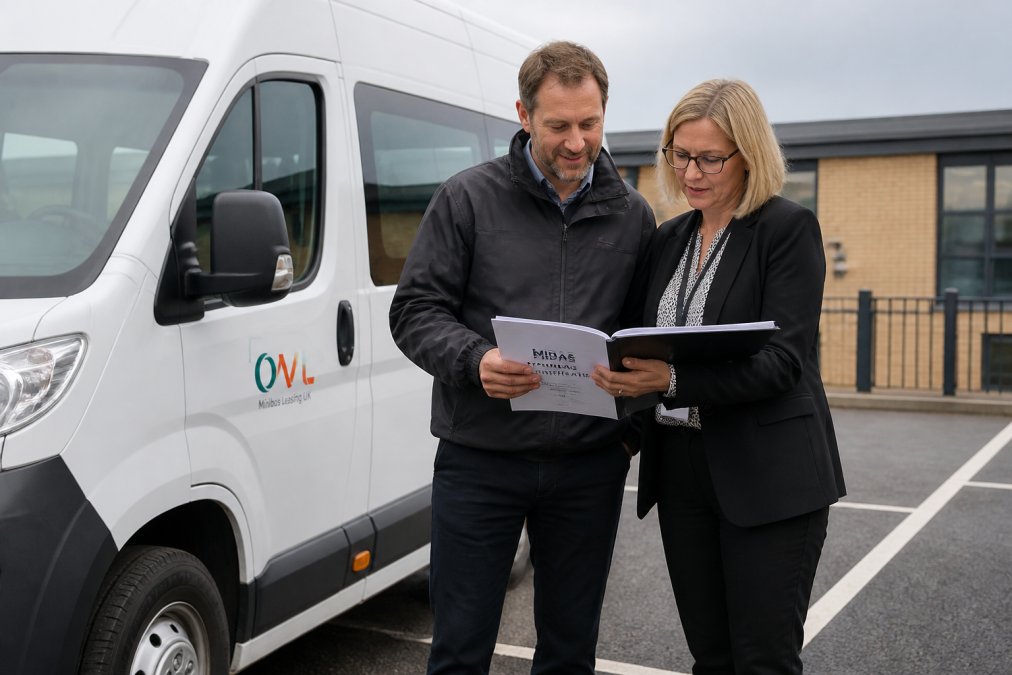
The scheme combines a classroom element on legal responsibilities and safety with a practical on-road assessment. It covers passenger safety, emergency procedures, and the specific handling differences between a minibus and a car. For schools, the value is twofold: it evidences due diligence if something goes wrong, and it catches the drivers whose confidence outstrips their competence. Many insurers look favourably on operators who put every driver through MiDAS, which matters when you are renewing cover.
Obtaining a D1 licence follows a defined sequence, and the order matters because you cannot book the practical test without the medical and theory stages complete. The table below maps the process.
| Step | What Happens | Typical Lead Time |
|---|---|---|
| 1. Check entitlement | Confirm whether D1 is already on the licence | Same day |
| 2. D4 medical | Complete examination with a doctor | 1-2 weeks |
| 3. Submit application | Send forms to the DVLA | 2-4 weeks |
| 4. Theory and hazard perception | Book and pass both tests | 2-6 weeks |
| 5. Practical test | Pass the D1 driving assessment | 2-8 weeks |
| 6. Licence issued | Entitlement added to the licence | 1-2 weeks |
The single biggest delay is usually the DVLA application itself, so start early. Once entitlement is granted, pair the licence with MiDAS training before putting the driver on a pupil route. For schools reviewing their wider fleet position, our Minibus Leasing Special Offers explain how vehicle procurement and compliance planning fit together.
Compliance failures at schools cluster around a handful of recurring errors, and most trace back to a single root cause: nobody owns the driver roster. When responsibility is diffuse, entitlements lapse and exemptions get misapplied.
A second recurring issue is vehicle specification. The car-licence exemption depends on the minibus being under 3.5 tonnes, and a vehicle loaded with a lift, a wheelchair, and passengers can edge toward that limit. If your operation needs accessible vehicles, the specification and the licensing position must be checked together, not separately.
For schools, the practical answer is to build a simple compliance file: one page per driver, listing licence entitlements, medical renewal dates, and training records. It takes an afternoon to set up and saves an enormous amount of stress when an insurer or a local authority asks questions.
Managing minibus compliance is a moving target: drivers age, medicals lapse, and entitlements quietly expire. Minibus Leasing UK helps schools stay ahead of it with tailored minibus procurement and fleet management built around your regulatory obligations, including Section 19 permits and D1 licensing. Our dedicated account managers provide whole life cost analysis, so your fleet stays compliant, safe, and cost-effective, and we supply brand-new vehicles specified to your exact operational requirements, whether that means standard pupil transport or wheelchair-accessible provision. Get a bespoke quote or speak to a sector specialist, and put your school transport on a firmer footing.
It depends on your licence date and the vehicle. If you passed your car test before 1 January 1997, you usually have D1 (not for hire or reward) entitlement already. If you passed after that date, you can only drive a minibus under specific conditions, such as volunteering or if the vehicle is not used for profit. Schools should check each driver's licence before allowing them to drive.
You can drive a minibus on a standard car licence if you passed your test before 1 January 1997, or if you meet the conditions for driving under a Section 19 permit. These rules cover driving a minibus on a car licence, including weight limits and the requirement that you are not driving for hire or reward. Always verify your entitlement with the DVLA.
A D1 licence covers minibuses with up to 16 passenger seats, while a D licence is for larger buses with more than 16 seats. For school transport, a D1 licence is usually sufficient. The D1 licence requirements include a medical examination and a practical driving test. If your school operates larger buses, you will need a full D licence.
Yes. To drive a minibus professionally or for hire or reward, you must be at least 21 and have held a full car licence for at least two years. Some insurers also set minimum age limits. For volunteers driving under a Section 19 permit, the age requirement may be lower, but you must still meet the D1 licence medical requirements and any MiDAS training requirements for schools.
MiDAS (Minibus Driver Awareness Scheme) is not a legal requirement, but many schools and local authorities require it. The MiDAS training requirements for schools typically include a classroom session and a practical driving assessment. It covers safety, passenger care, and emergency procedures. Refresher training is usually needed every four years to keep certification valid.
Volunteers can drive a school minibus without a D1 licence if they meet the conditions of a Section 19 permit. This includes driving for a non-profit organisation and not for hire or reward. However, volunteers must still meet the D1 licence medical requirements if they hold a D1 licence, and schools should ensure they have the correct insurance and training.

