Aug 14, 2026
Last Updated: August 14, 2026
Most well-maintained minibuses remain roadworthy for 10-15 years or 200,000-300,000 miles, though some exceed this significantly with prioritised preventative maintenance.
Mileage is often a better indicator than age alone. A minibus driven intensively on urban routes may accumulate 40,000 miles annually, reaching practical end-of-life in 5-7 years. Conversely, one used for occasional school trips might clock only 15,000 miles per year and remain serviceable for 15+ years despite calendar age.
Minibus longevity is determined by the operator's commitment to service history documentation, adherence to recommended maintenance schedules, and attention to early warning signs of wear.
Several interconnected variables shape vehicle longevity and inform maintenance investment decisions.
Stop-start urban driving creates more wear on transmission, brakes, and engine than steady motorway cruising. Each cold start generates friction; frequent braking accelerates pad and rotor degradation; low-speed manoeuvring stresses the drivetrain more than highway miles.
Commercial operators running long-distance routes often see better longevity per mile because vehicles operate at consistent engine speeds and temperatures. A minibus covering 60,000 miles on motorway work may experience less mechanical stress than one covering 40,000 miles in urban conditions.
Load capacity utilisation also matters. Vehicles regularly operating at maximum payload experience accelerated suspension wear, tyre degradation, and brake stress. Those operating well below capacity see extended component life.
Idle time is critical. A minibus that idles frequently, waiting for passengers or sitting unused, accumulates engine hours without generating mileage that would justify wear, leading to premature failure of seals, gaskets, and internal components.
Diesel engines, standard in commercial minibuses, typically deliver superior longevity compared to petrol equivalents when properly maintained. Diesel combustion operates at higher temperatures and pressures, driving stronger engineering in block construction, bearing tolerances, and fuel injection systems. Well-maintained diesel minibuses routinely exceed 300,000 miles; petrol equivalents often struggle past 200,000.
Smaller-capacity engines working harder experience accelerated wear. Larger-capacity engines operating at lower RPM for the same work generate less internal stress and typically last longer.
Manual transmissions are inherently more durable than automatics due to fewer components and lower parasitic losses, though driver skill and maintenance discipline are critical. Automatic transmissions require meticulous servicing; transmission fluid degradation is a silent killer that often goes undetected until catastrophic failure.
A structured maintenance schedule is the single most effective tool for extending minibus lifespan. The difference between a vehicle lasting 8 years and one lasting 14 years is often simply whether maintenance was performed on time or deferred.
Manufacturers specify service intervals, typically every 10,000-15,000 miles or 12 months, whichever comes first. These intervals are calculated based on component degradation rates, fluid breakdown patterns, and wear thresholds.
Oil changes are foundational. Engine oil lubricates, cools, and suspends contaminants. Interval adherence directly correlates with engine longevity. Delayed oil changes allow sludge accumulation, bearing wear, and corrosion. A single missed service can shorten engine life by 12-18 months.
Fluid checks beyond oil are equally critical: coolant protects against corrosion and maintains thermal efficiency; brake fluid absorbs moisture and degrades over time; transmission fluid carries heat and wear particles. Neglecting these creates cascading failures.
Filter replacements (engine, cabin, fuel) prevent contaminants from reaching sensitive components. A clogged fuel filter starves injectors of clean fuel; a degraded engine filter allows abrasive particles into the oil; a saturated cabin filter forces the HVAC system to work harder.
For organisations managing multiple minibuses, centralised maintenance logging transforms fleet reliability. Digital records create accountability, prevent duplicate work, and flag vehicles requiring attention before failures occur.
Effective logging captures: date, mileage, work performed, parts replaced, labour hours, and cost. This data reveals patterns allowing predictive intervention. Service history is also a compliance requirement; DVSA inspection standards require documented evidence of maintenance. Beyond compliance, complete service history improves resale value.
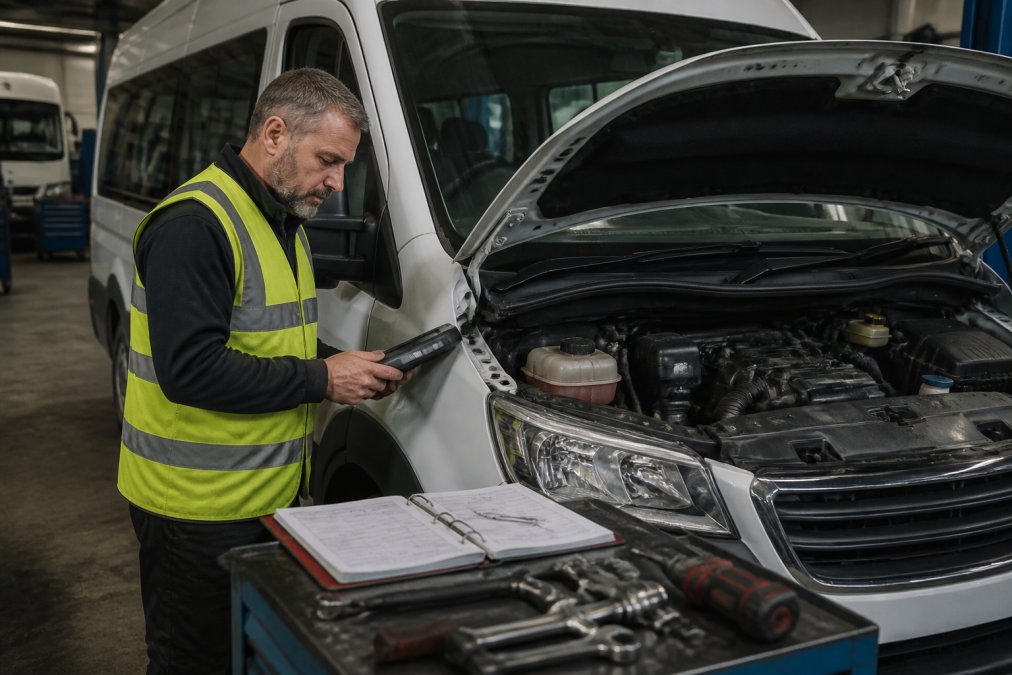
The Driver and Vehicle Standards Agency (DVSA) sets the regulatory framework for minibus safety and roadworthiness. A minibus that fails inspection cannot be operated legally, regardless of how well it runs.
DVSA inspection standards cover structural integrity, braking systems, steering, lighting, tyres, and emissions. Chassis integrity is assessed visually and through test procedures. Rust and corrosion that compromises structural strength results in failure. Welded repairs must meet specific standards; chassis beyond safe thresholds cannot be remedied by repair alone.
Braking systems must demonstrate adequate stopping power and balance. Brake pad thickness, fluid condition, and system responsiveness are tested. Worn brakes represent both a compliance issue and a safety liability.
Tyre condition is non-negotiable. Minimum tread depth is 1.6mm across the central three-quarters of the tyre, but safety improves significantly with deeper tread. Tyres with less than 3mm tread should be replaced. Uneven wear patterns indicate alignment or suspension issues requiring attention.
Emissions standards for diesel minibuses have tightened progressively. Older vehicles may fail modern emissions tests, restricting operational geography. Ultra-Low Emission Zones (ULEZs) in major cities exclude vehicles not meeting specific emissions thresholds, effectively shortening useful life.

The decision to replace a minibus should not be based on age or mileage alone. A comprehensive cost-of-ownership analysis reveals when replacement becomes economically rational.
The rule of thumb, replace when annual repair costs exceed 50% of replacement value, provides a starting point but oversimplifies the decision. A more nuanced approach considers:
Frequency and severity of failures. Repeated failures indicate systemic degradation; a single major repair might be a one-off event.
Component age and remaining life. If a major repair addresses one issue but other critical components are nearing end-of-life, replacement becomes more attractive.
Operational disruption. Breakdowns during school runs or care home transport create liability and service disruption. The cost of repairs must be weighed against downtime and reputational impact.
Regulatory compliance risk. A vehicle requiring increasingly frequent repairs to pass DVSA inspection is approaching end-of-life. The cost of repeated inspection failures often exceeds replacement cost.
Total cost of ownership (TCO) extends beyond purchase price and repair costs to include fuel consumption, insurance, maintenance, licensing, and depreciation.
Fuel efficiency declines with vehicle age. An older minibus with a worn engine and degraded injectors consumes 10-15% more fuel than a well-maintained equivalent. Over 50,000 annual miles, this difference translates to hundreds of pounds in unnecessary fuel costs.
Insurance premiums often increase for older vehicles. A newer minibus may have lower insurance costs offsetting higher financing costs.
Get a Bespoke Quote or Speak to a Sector Specialist →
Maintenance costs accelerate non-linearly with age. In years 1-3, maintenance is predictable and budgeted. By year 8-10, major component failures become increasingly likely, creating budget uncertainty.
A comprehensive TCO analysis compares the cost of running your current minibus for another 3-5 years against replacement cost, often revealing that replacement becomes economically rational earlier than intuition suggests. For organisations seeking to avoid the uncertainty of ownership costs, Minibus Leasing Special Offers provide access to modern, compliant vehicles with predictable monthly costs and built-in maintenance support.
Extending minibus longevity requires discipline, planning, and attention to early warning signs.
Adhere to service intervals without exception. Scheduled maintenance costs a fraction of emergency repairs. Document every service and retain records.
Monitor fluid levels and condition. Check engine oil, coolant, brake fluid, and transmission fluid monthly. Discoloured or low fluid levels signal problems requiring investigation.
Inspect tyres weekly. Check tread depth and pressure. Uneven wear indicates alignment issues; bulges or cracks require immediate replacement.
Listen for unusual noises. Grinding, knocking, whining, or clunking sounds indicate developing problems requiring prompt attention.
Test brakes regularly. Soft pedal feel, longer stopping distances, or brake warning lights demand immediate attention.
Manage payload carefully. Don't consistently operate at maximum capacity. Overloading accelerates suspension wear and drivetrain stress.
Minimise idle time. Extended idling generates engine hours without productive mileage, accelerating wear of seals and gaskets.
Maintain battery health. Corroded terminals, low charge, or slow cranking indicate battery degradation stressing the charging system.
High-mileage minibuses require heightened attention. Increase inspection frequency from annual to semi-annual. Check suspension bushings, brake hoses, fuel lines, and electrical connectors for degradation. Early detection allows planned replacement rather than emergency breakdown.
Use high-quality lubricants and fluids. Synthetic oils provide superior protection at high mileage; premium coolants resist corrosion better. The marginal cost is recovered through extended component life.
Address small leaks immediately. A slow oil leak becomes a major leak starving the engine of lubrication. A small coolant weep becomes a blown head gasket.
Consider preventative component replacement. Timing belts, water pumps, and fuel pumps are often replaced before failure at high mileage because their failure is catastrophic and expensive. Replacing them proactively during planned maintenance is cost-effective insurance.
Rust is the silent killer of minibus longevity. Salt from winter roads, moisture from washing, and poor drainage create corrosion conditions. Structural rust that compromises chassis integrity cannot be repaired safely.
Undercarriage protection is essential. After winter, wash the undercarriage thoroughly to remove salt. Apply protective coatings to vulnerable areas. Store vehicles in dry conditions when possible.
Inspect door seals, window frames, and panel gaps for water ingress. Water trapped in cavities accelerates corrosion from inside. Ensure drainage holes are clear and functional.
Address surface rust immediately. Small rust spots can be treated with rust converter and protective paint. Allowing rust to progress to pitting makes repair becomes uneconomical.
Commercial minibuses experience different wear patterns than private-use vehicles, influencing longevity expectations and maintenance strategies.
Commercial minibuses typically accumulate 40,000-60,000 miles annually. This accelerates component wear but also means maintenance is performed more frequently, catching problems earlier.
Commercial operators are more disciplined with maintenance because downtime directly impacts revenue or service delivery. A school cannot operate without transport; a care home cannot manage without accessible vehicles. This operational pressure drives compliance with maintenance schedules.
Private-use minibuses often accumulate lower annual mileage but face greater risk of deferred maintenance. If used only occasionally, maintenance discipline lapses. Fluids degrade even without mileage accumulation; seals deteriorate; batteries discharge.
Commercial operators must maintain DVSA compliance for continuous operation. Private owners may delay inspections, allowing defects to progress unchecked.
A well-maintained commercial minibus often outlasts a neglected private-use equivalent despite higher mileage, because the operational framework enforces maintenance discipline.
The longevity of your minibus ultimately rests on the maintenance decisions you make today. A minibus receiving consistent, documented care can reliably serve 12-15 years or more. One receiving reactive, deferred maintenance often fails prematurely, forcing expensive replacement.
At Minibus Leasing UK, we work with organisations across education, care, and commercial sectors to optimise fleet longevity through structured maintenance planning, compliance management, and cost-of-ownership analysis. Our dedicated account managers help you understand how long your minibus will last and what investment in maintenance delivers measurable returns through extended vehicle life and reduced downtime.
If you're evaluating whether to maintain, repair, or replace your current minibus, or exploring how leasing can provide access to reliable, compliant vehicles without the uncertainty of ownership, speak to our team about a bespoke assessment tailored to your operational requirements.
Most minibuses reach 150,000 to 200,000 miles before major mechanical issues arise, though well-maintained vehicles can exceed 250,000 miles. Longevity depends heavily on maintenance history, driving patterns, and whether the vehicle operates in commercial or private use. Regular servicing and preventative maintenance significantly extend this threshold. Beyond 200,000 miles, operating costs often climb steeply, making replacement more economical than continued repair.
Regular maintenance schedules, driving patterns, load capacity usage, and environmental conditions (rust and corrosion exposure) are the primary factors. Engine type, diesel engines typically outlast petrol, also plays a crucial role. Commercial vehicles subjected to stop-start driving and heavy loads wear faster than those in lighter duty cycles. Service history documentation is critical; vehicles with complete maintenance records retain better mechanical reliability and resale value.
Replace when repair costs exceed 50% of the vehicle's current market value, or when the minibus fails DVSA inspection standards. Consider Total Cost of Ownership: factor in fuel efficiency decline, insurance increases, and downtime frequency alongside repair expenses. High-mileage vehicles (over 200,000 miles) with transmission failure or chassis integrity issues are typically uneconomical to repair. Leasing new vehicles often provides better cost certainty than maintaining ageing fleets.
Preventative maintenance prevents wear and tear from escalating into major failures. Following manufacturer service intervals keeps the drivetrain, engine, and transmission functioning optimally. Regular fluid changes, filter replacements, and brake inspections catch problems early. Fleet-specific maintenance logs ensure nothing is missed and provide evidence of compliance with safety standards. Vehicles with documented, consistent service histories typically last 30-40% longer than those serviced irregularly.

