Aug 02, 2026
Last Updated: August 2, 2026
Managing minibus weight limits is essential for anyone responsible for passenger transport in the United Kingdom. Exceeding weight restrictions isn't just a legal risk, it fundamentally changes how your vehicle handles, brakes, and performs. Overloaded minibuses experience longer stopping distances, reduced steering control, and accelerated wear on tyres, suspension, and braking systems. Weight management directly affects your insurance validity, your duty of care to passengers, and your operational costs. A single overloading incident can invalidate your comprehensive coverage, expose you to prosecution, and damage your fleet's reliability.
The UK's minibus weight regulations are governed by the Vehicle and Operator Services Agency (VOSA) and enforced through the Road Traffic Act 1988. Every minibus has a maximum authorised mass, the absolute heaviest the vehicle can legally weigh when fully loaded with passengers, fuel, luggage, and equipment. Exceeding this figure is an offence that can result in fines, prosecution, and vehicle impoundment.
Maximum authorised mass (MAM) is the maximum weight at which a minibus is legally permitted to operate on UK roads. This figure is set by the vehicle manufacturer and recorded on the chassis plate and registration documents (V5C). The MAM includes the vehicle itself plus everything inside it: passengers, luggage, fuel, and specialist equipment like wheelchair lifts.
If your minibus has a MAM of 3,500 kg, that is the absolute ceiling. Exceeding MAM by up to 10% can result in a fine of up to £300 per vehicle. Exceeding it by more than 10% attracts much heavier penalties, including prosecution and potential disqualification of the operator's licence. If you're involved in an accident while overloaded, your insurer may refuse to pay claims, leaving you personally liable for damages.
Your ability to drive a minibus legally depends on your driving licence category, which restricts both passenger numbers and vehicle weight.
Category B (standard car licence) permits you to drive vehicles up to 3,500 kg MAM with up to 8 passenger seats (excluding the driver). Category D1 (minibus licence) allows you to drive minibuses between 3,500 kg and 4,250 kg with up to 16 passenger seats. Category D (full bus licence) covers vehicles over 4,250 kg with more than 16 seats.
Driving outside your licence category is a criminal offence: six penalty points, a fine of up to £1,000, and potential disqualification. Your insurance is also invalidated if you drive a vehicle your licence doesn't permit.
Payload capacity is the maximum weight your minibus can carry in passengers, luggage, and equipment. It is calculated by subtracting the unladen weight from the maximum authorised mass.
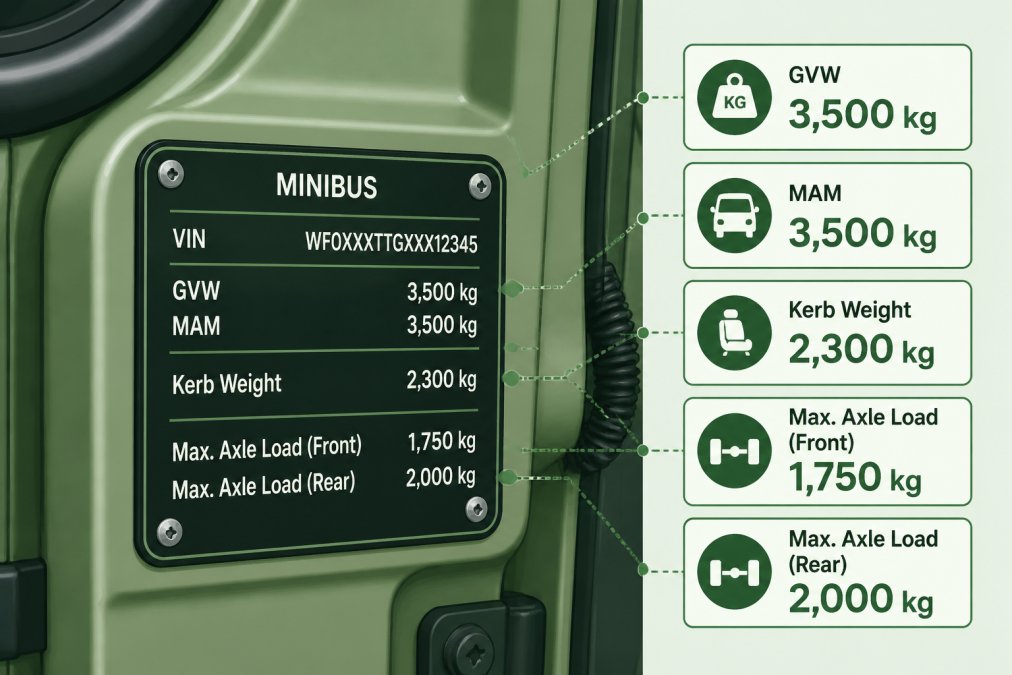
Step 1: Find the unladen weight. The unladen weight is stamped on the chassis plate (usually on the driver's side door pillar or under the bonnet) and listed in your vehicle's registration document (V5C). For example, 2,100 kg.
Step 2: Locate the maximum authorised mass (MAM). This is also on the chassis plate and V5C. For example, 3,500 kg.
Step 3: Calculate payload capacity. Subtract unladen weight from MAM: 3,500 kg (MAM) - 2,100 kg (unladen weight) = 1,400 kg (payload capacity).
Step 4: Account for fuel weight. Fuel weighs approximately 0.8 kg per litre. A full tank of 60 litres weighs roughly 48 kg. Subtract this from your payload capacity: 1,400 kg (payload) - 48 kg (fuel) = 1,352 kg (available for passengers and luggage).
Step 5: Calculate average passenger weight. The standard assumption is 75 kg per adult and 45 kg per child. For example, 12 school children (average 45 kg each) and 2 adults (75 kg each): (12 × 45 kg) + (2 × 75 kg) = 690 kg.
Step 6: Calculate remaining luggage allowance. Subtract passenger weight from available payload: 1,352 kg - 690 kg = 662 kg (available for luggage and equipment).
Passenger weights vary significantly. A minibus carrying 16 elderly care home residents (average 85 kg each) will weigh substantially more than one carrying 16 school children (average 45 kg each). A simple headcount is never sufficient for weight management.
Specialist equipment adds complexity. Wheelchair lifts typically weigh 150-250 kg. If your minibus is fitted with a wheelchair lift, account for this in your payload calculations from the start. For care home transport, create a weight profile for your typical passenger groups, including mobility aids. For school transport, establish a standard passenger weight assumption based on the age group.
The only way to know with certainty whether your minibus is overloaded is to weigh it. Estimating weight by feel or appearance is unreliable and dangerous.
A weighbridge is an industrial scale designed to weigh vehicles. Most are located at waste disposal sites, agricultural suppliers, or commercial transport companies. A single weighing costs between £15 and £30 and takes about 10 minutes.
Step 1: Find a local weighbridge. Search online for "weighbridge near me" or contact your local waste disposal facility. Step 2: Prepare your minibus. Fill the fuel tank to normal operating level and include all passengers (or use weights to simulate them), luggage, and equipment you plan to carry. Step 3: Drive onto the weighbridge. Follow the operator's instructions. Step 4: Record the figure. Write down the total weight. Subtract your unladen weight to determine your actual payload. Step 5: Compare to MAM. If the total weight exceeds your MAM, you are overloaded and must remove weight before driving.
Weigh your minibus at least twice per year, once in summer when you're likely carrying more luggage, and once in winter.
The chassis plate is a metal plate stamped with the vehicle's technical specifications, usually located on the driver's side door pillar, under the bonnet, or inside the engine bay.
Key figures on the chassis plate:
If you cannot find the chassis plate or it's illegible, contact the minibus manufacturer or your vehicle registration authority with your VIN.
Overloading is not a minor infringement. The UK enforcement system treats it as a serious breach of road safety law, with escalating penalties based on how much you exceed the limit.
According to UK government guidance on vehicle weight enforcement, the penalties for exceeding MAM are structured as follows:
Beyond financial penalties, overloading convictions damage your professional reputation. An overloading conviction can affect your operator's licence, insurance premiums, and ability to tender for contracts. For drivers, overloading is a criminal offence if they knowingly drive an overloaded vehicle, resulting in six penalty points, a fine, and potential disqualification.
If your minibus is involved in an accident while overloaded, your insurance policy is likely to be invalid. Insurers include weight compliance as a condition of cover. If you breach this condition, the insurer can refuse to pay claims, leaving you personally liable for third-party injuries and property damage. Overloading also accelerates wear and tear on your minibus, stressing the suspension, increasing tyre wear, and straining the braking system.
A strong pre-journey inspection routine catches weight and safety issues before they become problems.
Before every journey, the driver should complete a basic safety check:
Create a simple checklist card that drivers complete and sign before each journey. This creates accountability and provides a record if an incident occurs.
An overloaded minibus exhibits noticeable changes in handling. Drivers should be trained to recognise warning signs: longer braking distances, difficulty steering, swaying or instability when cornering, and suspension noise. If a driver notices any of these signs, they should stop immediately, check the load, and reduce weight if necessary. Regular driver training on weight management and vehicle handling is essential.
Modern minibus operators have access to technology that simplifies weight management. Onboard weighing systems use sensors on the suspension or axles to measure vehicle weight continuously. As passengers and luggage are loaded, the system updates the total weight in real time. Drivers can see on a display in the cab whether the minibus is within MAM limits before they depart.
Telematics systems track vehicle weight alongside other operational data, fuel consumption, braking patterns, and driver behaviour. This data reveals whether specific drivers or routes are associated with chronic overloading. For smaller operators, a simple practice of weighing the minibus before and after major route changes provides sufficient control.
Specialist equipment, wheelchair lifts, hoists, accessible seating, and mobility aids, adds significant weight to a minibus. Managing this equipment properly is essential for both compliance and passenger safety.
A wheelchair lift typically weighs 150-250 kg and is bolted to the floor and chassis of the minibus. This weight is permanent and reduces the available payload for passengers and luggage. Many operators underestimate the total weight of disabled passenger accommodation. Beyond the lift itself, you must account for wheelchair weight (15-25 kg for manual, 45-180 kg for powered), mobility aids (walking frames, crutches), hoists and slings (30-80 kg), and accessible seating.
Specialist equipment changes how you plan routes and passenger allocations. A minibus designed for wheelchair users cannot carry as many able-bodied passengers as one without specialist equipment, even if both have the same MAM.
When planning routes for care homes or schools with disabled students, calculate the weight of the typical passenger group (including wheelchairs and mobility aids) and subtract this from your payload capacity. If you need to transport luggage alongside disabled passengers, you may need to use a larger minibus (Category D1, up to 4,250 kg MAM) or split the journey into two trips.
Managing minibus weight limits is fundamental to safe, legal, and cost-effective fleet operation. Calculate your payload capacity, weigh your minibus under realistic operating conditions, and monitor compliance consistently. The consequences of neglect are severe: fines, prosecution, insurance invalidation, and safety risks to your passengers. If you're managing minibus transport and want certainty that your fleet remains compliant and safe, explore Minibus Leasing Special Offers to find vehicles specifically configured for your passenger profiles and routes, or speak to a sector specialist today.
| Factor | Calculation | Result |
|---|---|---|
| Maximum Authorised Mass | From chassis plate | 3,500 kg |
| Unladen Weight | From chassis plate | 2,100 kg |
| Payload Capacity | MAM - ULW | 1,400 kg |
| Fuel Weight | Tank capacity × 0.8 | ~48 kg |
| Available for Passengers & Luggage | Payload - Fuel | 1,352 kg |
| Adult Passenger Weight | Standard assumption | 75 kg |
| Child Passenger Weight | Standard assumption | 45 kg |
| Wheelchair Weight | Typical manual | 20 kg |
| Wheelchair Lift | Typical installation | 200 kg |
Maximum authorised mass (MAM) is the maximum weight at which a minibus can legally operate. For a standard minibus carrying up to 8 passengers, MAM typically ranges from 2,500 to 3,500 kilograms, depending on the vehicle specification. Larger minibuses carrying 9-16 passengers may have a MAM of 3,500 to 5,000 kilograms. You can find your specific vehicle's MAM on the chassis plate, usually located on the driver's door frame or inside the engine bay. Exceeding MAM is illegal and invalidates insurance cover.
Payload capacity is calculated by subtracting the unladen weight (ULW) from the maximum authorised mass (MAM). For example, if your minibus has an MAM of 3,500 kilograms and an unladen weight of 2,000 kilograms, your payload capacity is 1,500 kilograms. This payload must accommodate all passengers, luggage, fuel, and any specialist equipment such as wheelchair lifts. Divide the total payload by the number of passengers to understand how much luggage each person can bring. Always allow for fuel weight (approximately 6-8 kilograms per 100 litres) when calculating available capacity.
Overloading a minibus can result in fines up to £300 per offence under the Road Vehicles (Construction and Use) Regulations 1986. Drivers and operators can both be prosecuted. More seriously, overloading compromises braking distance, steering control and tyre performance, increasing accident risk. Your insurance may be invalidated if you're involved in a collision whilst overloaded, leaving you personally liable for damages. Fleet operators face reputational damage and potential loss of operating licences, particularly if you hold a Section 19 permit for passenger services.
Conduct pre-journey checks to verify your vehicle is within safe weight limits. Check tyre pressure and condition, as overloaded minibuses wear tyres faster and increase blowout risk. Test brakes thoroughly, as overloaded vehicles require longer stopping distances. Inspect suspension and springs for signs of sagging or damage. Ensure luggage and passenger loads are distributed evenly across the vehicle to maintain stability. Keep a record of these checks and maintain documentation of passenger and cargo weights to demonstrate compliance with weight management procedures.
[EXTERNAL_LINK: VOSA vehicle and operator services guidance | gov.uk]
[EXTERNAL_LINK: Road Traffic Act 1988 vehicle weight regulations | legislation.gov.uk]
[EXTERNAL_LINK: Health and Safety Executive guidance on safe manual handling in minibuses | hse.gov.uk]

