Aug 06, 2026
Last Updated: August 6, 2026
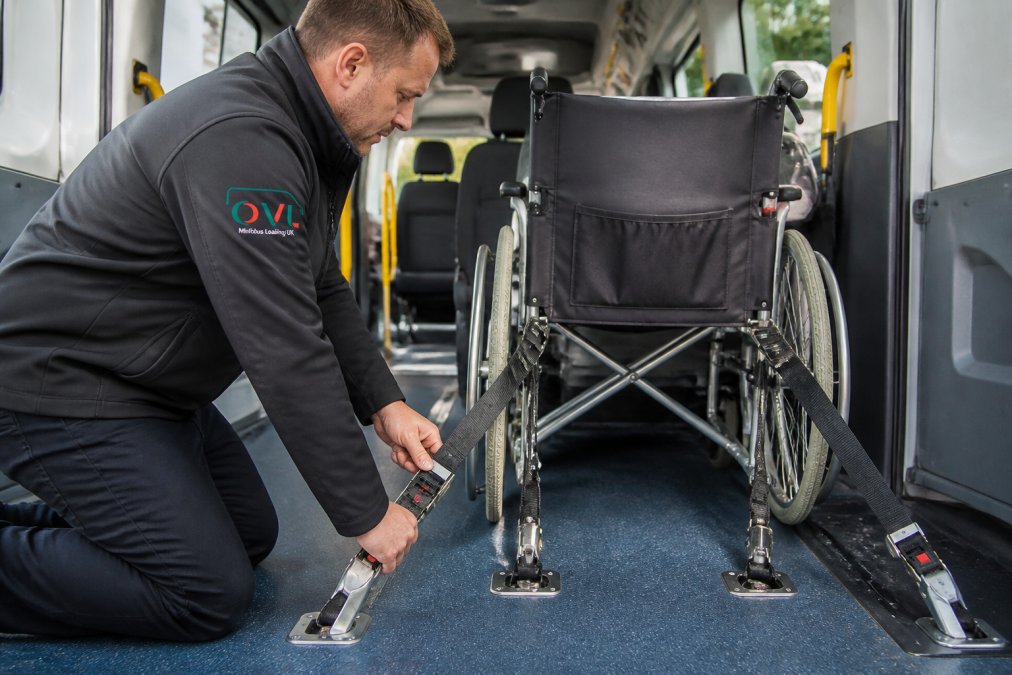
Securing a wheelchair safely in a minibus protects lives. When a vehicle brakes suddenly or turns sharply, an unsecured wheelchair becomes a projectile, risking serious injury to the occupant and other passengers. Proper securement prevents this entirely.
At Minibus Leasing UK, we work with schools, care homes, and charities to ensure their transport meets safety standards. This guide walks you through exactly how to secure a wheelchair in a minibus, covering the equipment, the step-by-step process, and how to troubleshoot common problems.
A wheelchair restraint system is a set of straps, anchors, and locking mechanisms designed to hold a wheelchair and its occupant securely during transit. The system must meet specific UK standards to be legal and safe.
Floor tracking systems are rails or channels built into the minibus floor that allow you to position restraint anchors exactly where needed. This flexibility matters because wheelchairs vary in size and configuration. A manual wheelchair takes up different space than a power chair, and a child's wheelchair differs from an adult's.
Anchor points must be rated to handle crash forces. UK regulations specify minimum load capacities. When selecting a minibus or installing a restraint system, verify that anchor points meet these requirements.
The four-point tie-down system uses four restraint straps to secure the wheelchair: two at the front and two at the rear. This configuration prevents forward, backward, and lateral movement.
Front straps angle downward from the wheelchair frame to anchor points ahead of the front wheels. Rear straps angle upward from the wheelchair frame to anchor points behind the rear wheels. This geometry distributes force so that when the vehicle brakes, the angled straps pull the wheelchair down into the floor, locking it in place.
UK law requires that any minibus carrying wheelchair users must have appropriate restraint systems installed. Regulations fall under the Road Traffic Act, the Equality Act 2010, and Department for Transport guidance.
According to Department for Transport guidance on accessible transport, wheelchair users must be transported with the same level of safety as seated passengers. You cannot simply park a wheelchair in an aisle; it must be secured.
For minibuses carrying passengers for hire or reward (including school transport and care home shuttles), compliance is mandatory. If you operate a Section 19 permit or hold D1 licensing, your vehicles must have certified restraint systems. Minibus Leasing UK ensures all vehicles in our fleet meet these requirements.
Restraint systems must be regularly inspected and maintained. Worn straps, corroded anchor points, or damaged retractors compromise safety. A visual check before each journey is essential. If you spot damage, the vehicle shouldn't be used until repairs are completed. If you're looking to upgrade your fleet or need vehicles with fully compliant restraint systems already installed, Minibus Leasing Special Offers can help you find cost-effective solutions tailored to your organisation's needs.
Follow these seven steps every time you transport a wheelchair passenger.
Inspect the restraint system for visible damage: torn webbing, bent anchor points, corroded metal, or cracked plastic. Test each retractor by pulling the strap and releasing it; it should lock and release smoothly.
Check the wheelchair itself. Ensure the brakes work and look for loose components or damage. If the wheelchair has quick-release wheels, they should be properly secured. Verify that the minibus floor is clear of obstacles.
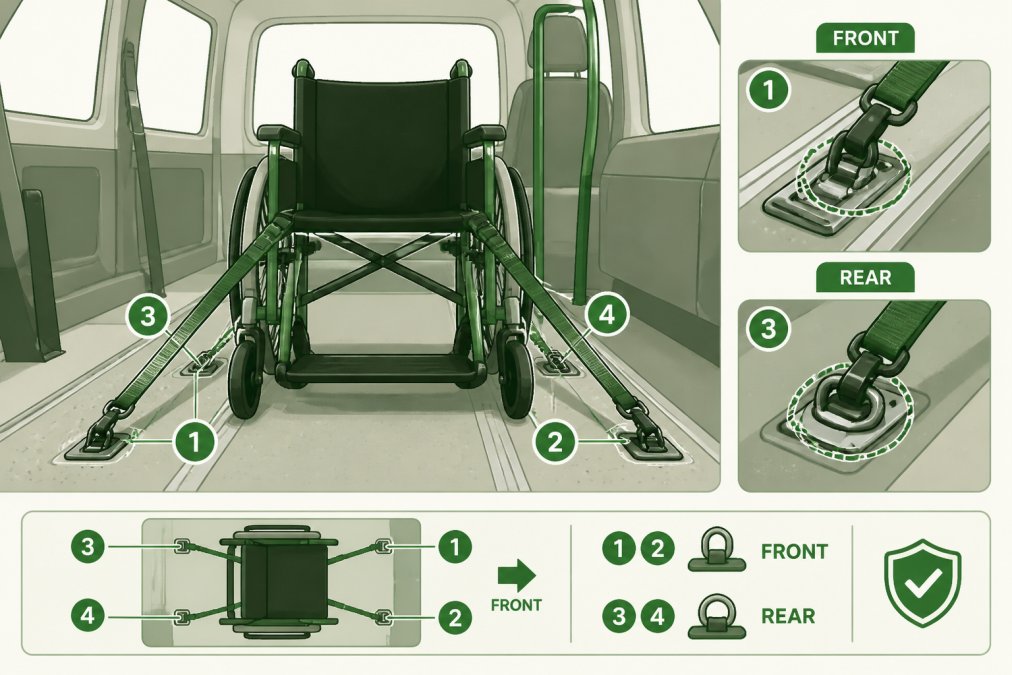
Drive the wheelchair into the designated wheelchair space, typically near the side or rear of the minibus. The wheelchair should face forward, aligned with the direction of travel, with wheels sitting firmly on the floor.
Position the wheelchair as centred as possible in the space, not tilted or at an angle. Leave enough clearance around the wheelchair to access both sides for attaching restraint straps.
Locate the anchor points ahead of the wheelchair's front wheels. Attach the first front restraint strap to an anchor point on one side of the wheelchair frame, usually the frame tube below the seat.
Pull the strap forward and connect it to the floor anchor point. The strap should angle downward from the wheelchair to the floor. Repeat on the other side with the second front restraint strap.
Locate the anchor points behind the wheelchair's rear wheels. Attach the first rear restraint strap to the wheelchair frame on one side, usually at a point behind the seat.
Pull the strap backward and connect it to the floor anchor point. The rear restraint should angle upward slightly from the wheelchair to the anchor point. Repeat on the other side.
Fasten a lap belt across the passenger's thighs, low and snug. The lap belt should be tight enough that you can't slip more than one finger under it.
If the system includes a shoulder harness, position it across the chest and secure it. The shoulder harness should sit on the shoulders and upper chest, not the neck. Adjust so it's snug but not restrictive.
Some systems use a five-point harness (lap belt plus two shoulder straps plus a crotch strap). Secure all attachment points and verify that the occupant can breathe comfortably.
Engage both wheelchair brakes fully. If the wheelchair has manual brakes, push them down or pull them firmly. If it has electronic brakes, activate them. Listen or feel for the click that indicates they're locked.
Locked brakes prevent the wheelchair from rolling slightly within the restraint system, keeping the occupant stable and reducing stress on the restraint straps.
Get a Bespoke Quote or Speak to a Sector Specialist →
Pull on each restraint strap; it should not move. There should be no slack. Verify that the occupant is comfortable and can move slightly but not significantly. They should breathe normally and reach an emergency release if needed.
Verify that the wheelchair brakes are locked. Ensure that restraint straps don't block emergency exits. If anything feels wrong, stop and adjust before driving.
The occupant restraint system is separate from the wheelchair restraint system. The wheelchair is secured to the floor; the occupant is secured to the wheelchair or the vehicle.
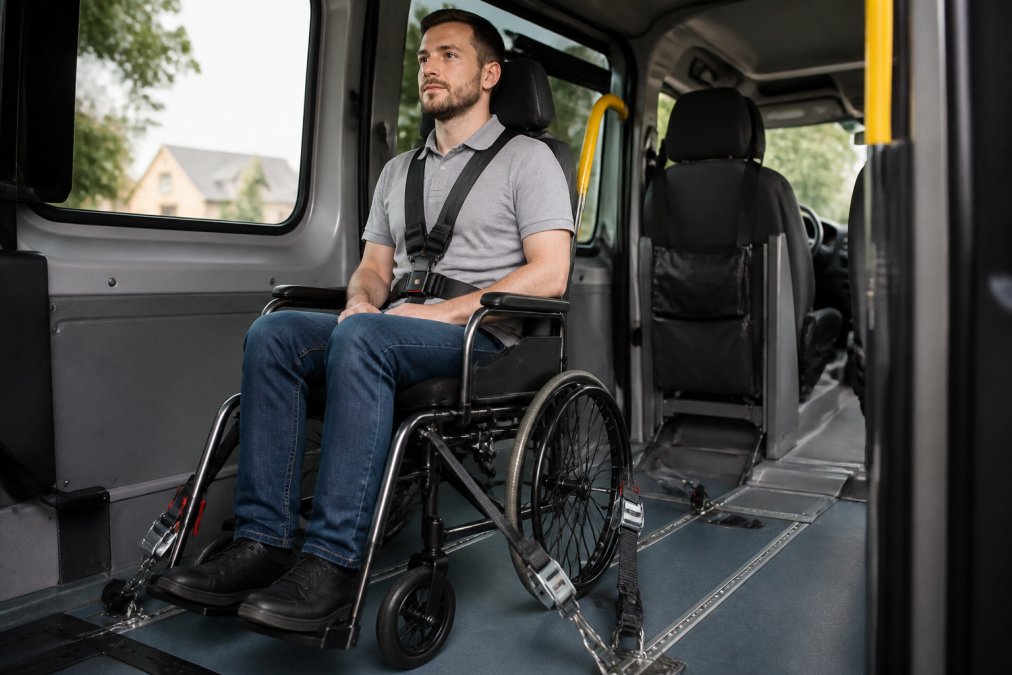
Most occupant restraint systems use a lap belt similar to a standard vehicle seatbelt, running across the thighs and attaching at two points on either side of the wheelchair or vehicle floor.
Shoulder harnesses provide additional protection by preventing forward movement of the upper body in a crash. These attach at shoulder height and cross the chest. A properly fitted shoulder harness sits on the shoulders, not the neck.
Some systems include a five-point harness: lap belt, two shoulder straps, and a crotch strap. The crotch strap prevents the occupant from sliding under the lap belt during hard braking. Five-point systems offer maximum protection but can feel restrictive.
All occupant restraint components must be regularly inspected. Check for fraying webbing, damaged attachment points, and worn retractors. If a component is damaged, replace it before using the system.
Not all wheelchairs are identical, and the securement process varies slightly depending on the type.
Manual wheelchairs are lighter with a simpler frame structure. Restraint straps attach to the frame tubes, typically below and behind the seat.
Ensure that the wheels sit flat on the floor and the chair does not tilt or rock. If the wheelchair has quick-release wheels, ensure these are locked in place. Verify that the brakes are accessible and functional.
Power chairs are heavier and have batteries, motors, and electronic controls. The restraint system must account for this additional weight.
Before securing a power chair, verify that the battery is charged and secure. A loose battery can shift during transit. Ensure that power chair controls are not damaged and that the chair operates normally.
Some power chairs have footrests that extend outward. Ensure these don't interfere with restraint straps or other passengers. Verify that the occupant can reach emergency controls or alert systems if needed.
Restraint straps won't tighten properly. The retractor mechanism may be stuck or worn. Try pulling the strap sharply to reset the locking mechanism. If the strap still won't hold tension, replace it or use an alternative anchor point.
The wheelchair rocks side to side even when restrained. Check that all four wheels sit flat on the floor. If the floor is uneven, position the wheelchair in a different spot if possible. If the wheelchair itself is damaged, it may need repair before transport.
The occupant reports discomfort from the restraint system. Adjust the lap belt so it's snug but not cutting into the skin. Check that the shoulder harness is positioned correctly on the shoulders, not the neck.
Restraint anchor points are corroded or damaged. Do not use damaged anchor points. If the damage is minor (surface rust), clean it with a wire brush. If the anchor is bent, cracked, or severely corroded, it must be replaced.
The wheelchair won't fit in the designated space. Measure the wheelchair and the available space. If the wheelchair is too large, you may need a different vehicle or positioning strategy. Never force a wheelchair into a space where it doesn't fit.
The occupant needs to exit during the journey. Release the occupant restraint first (lap belt and shoulder harness). Then release the wheelchair restraint straps. Always release occupant restraints before wheelchair restraints to prevent the occupant from being trapped.
Securing a wheelchair in a minibus is a straightforward process when you follow the steps systematically. Proper securement protects the occupant, other passengers, and staff. It's also a legal requirement for any minibus carrying wheelchair users in the UK.
At Minibus Leasing UK, every vehicle in our fleet comes equipped with certified restraint systems that meet UK safety standards. Get a bespoke quote or speak to a sector specialist to learn how we can support your accessible transport requirements.
UK regulations require that wheelchairs in minibuses be secured with a restraint system that meets applicable safety standards. All restraint systems must include both wheelchair tie-downs and occupant restraints (lap belts and shoulder harnesses). Your minibus must comply with D1 licensing requirements if carrying passengers for hire, and all securing equipment must be properly maintained and regularly inspected. Consult your vehicle's documentation and local transport authority guidance to confirm your specific obligations.
A four-point tie-down system uses four straps to anchor the wheelchair: two front straps attach to the wheelchair frame near the footrest area, and two rear straps attach higher on the frame. Each strap connects to anchor points on the vehicle floor using hook-and-loop fasteners, pins, or lever mechanisms. Tighten each strap in sequence (front-left, front-right, rear-left, rear-right) to ensure even tension. The wheelchair should not shift more than 5 centimetres in any direction when properly secured. Always follow the manufacturer's instructions for your specific restraint system.
Yes. Wheelchair passengers require both wheelchair tie-downs and occupant restraints. The occupant restraint system typically consists of a lap belt and shoulder harness that secure the person to the vehicle, separate from the wheelchair restraints. This dual approach protects both the wheelchair and the occupant. The lap belt should sit low across the hips, and the shoulder harness should cross the chest diagonally. Never rely on wheelchair restraints alone to protect the passenger.
Stop using the minibus for wheelchair transport immediately. Inspect the entire restraint system, including straps, anchor points, retractors, and locking mechanisms. Check for frayed webbing, bent pins, broken hooks, or damaged floor tracking. If any component is worn or non-functional, replace it before the vehicle returns to service. Document the fault and repair in your vehicle maintenance records. Never attempt to improvise repairs or use damaged equipment. Contact your minibus leasing provider or equipment supplier for replacement parts and guidance on compliance.

