Sep 06, 2026
Last Updated: September 6, 2026
Deciding between leasing vs buying a minibus for elderly transport is one of the most significant financial and operational choices your organisation will make. For care homes, charities, and community groups across Northampton and the wider United Kingdom, the decision shapes your budget for years to come and determines how reliably you can serve vulnerable passengers. At Minibus Leasing UK, we guide education, care, and community sector clients through this exact decision daily, using whole life cost analysis rather than simply comparing a purchase price against a monthly figure.
The core distinction is straightforward: buying means paying a large capital sum to own a vehicle outright, while leasing spreads the cost into predictable monthly payments for a fixed term, typically three to five years. However, the right answer depends on your charity's cash flow, how many miles you cover each year, and whether you have the reserves to handle an unexpected engine failure. Below, we'll break down the financial mechanics, the compliance landscape including D1 licensing and Section 19 permits, and the practical realities of maintenance so you can choose with confidence.
The most immediate difference between leasing and buying a minibus lies in ownership and upfront capital. When you buy, you take full ownership immediately. Leasing, by contrast, transfers depreciation risk to the finance provider, and you pay only for the vehicle's use during your contract term.
| Consideration | Buying Outright | Leasing |
|---|---|---|
| Upfront capital | Full purchase price required | Small initial rental, then fixed monthly payments |
| Ownership | You own the asset | No ownership unless you opt for a final purchase |
| Monthly budgeting | No regular payments, but repair costs vary | Fixed, predictable monthly costs |
| Depreciation risk | Yours to absorb | Held by the leasing provider |
| Vehicle age | You choose when to replace | Brand-new vehicle every 3-5 years |
| Maintenance | Your responsibility throughout | Often included in the lease agreement |
For an organisation transporting elderly passengers, the predictability of leasing often matters more than outright ownership. A fixed monthly cost makes budgeting straightforward for trustees and finance committees, whereas an older owned vehicle can present sudden, unbudgeted repair bills that disrupt care services.
Cash flow is the deciding factor for most charities and care providers weighing leasing vs buying a minibus for elderly transport. Buying requires access to significant capital reserves, which many non-profits simply do not hold. Leasing preserves that capital for other priorities, such as staff training, passenger care, or facility improvements, while delivering a reliable, brand-new vehicle.
Tax treatment under HMRC rules is another layer worth understanding. For VAT-registered organisations, leasing payments typically allow you to reclaim the VAT on the rental element, which can improve your effective cost position. Capital allowances on purchased vehicles are more restrictive for cars and some dual-purpose vehicles, so it is wise to review the current HMRC guidance on capital allowances for businesses before committing to a purchase. Charities should also confirm their VAT position with a specialist, as the rules differ depending on whether your transport services are charged or provided free of charge. We always recommend that clients in Northampton discuss their specific structure with an accountant who understands the sector.
Before any financial decision makes sense, you must confirm your drivers can legally operate the vehicle. Driving a minibus for elderly transport is not covered by a standard car licence in most cases. Drivers need a D1 licence category, which permits them to drive vehicles with between 9 and 16 passenger seats, or they must meet the specific criteria for driving under a Section 19 permit (gov.uk).
The key distinction is that a D1 entitlement allows paid driving, whereas a Section 19 permit, issued by the traffic commissioner, permits non-profit organisations to operate transport without a full PCV licence, provided no profit is made and drivers are over 25 with at least two years of car driving experience. The official D1 and Section 19 guidance from GOV.UK clarifies that drivers using the Section 19 basis must not receive payment for driving, which is a common stumbling block for care homes that want to use staff members.
When you lease through Minibus Leasing UK, we verify that your planned usage matches the correct licensing basis before you commit. Getting this wrong can invalidate your insurance and leave you unable to transport residents at short notice.
For elderly transport, accessibility is rarely optional. Accessible minibus leasing requirements typically centre on wheelchair lifts or ramps, internal headroom, and secure restraint systems that meet the Public Service Vehicle Accessibility Regulations. A vehicle that cannot accommodate a wheelchair user safely is not fit for purpose, regardless of how attractively it is priced.
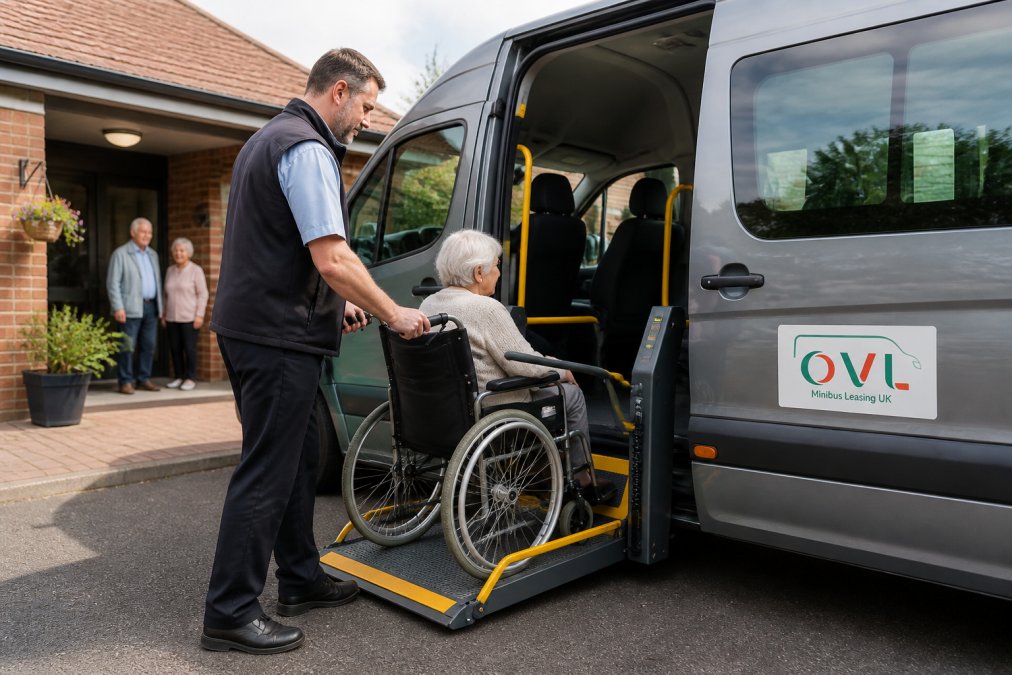
When leasing, you specify the accessibility configuration at the outset, which means the vehicle arrives ready for service rather than requiring expensive aftermarket conversions. Key decisions include whether you need a rear or side-mounted lift, the number of wheelchair positions required, and whether your passengers typically remain in wheelchairs during transit or transfer to seats. A common mistake is underestimating the space needed to manoeuvre a wheelchair inside the cabin, so we always recommend a physical demonstration before finalising a lease specification.
A whole life cost analysis for minibuses goes far beyond comparing a monthly lease payment with a purchase price. The true cost of ownership includes fuel consumption, insurance premiums, road tax, tyre replacement, scheduled servicing, and the depreciation you absorb when you eventually sell the vehicle. Many organisations that own older minibuses underestimate how quickly maintenance costs can escalate.
Get a Bespoke Quote or Speak to a Sector Specialist →
Leasing typically includes a manufacturer's warranty for the full contract term. When you buy, that warranty expires, and you become responsible for repairs. For a care home running daily resident transport, an unexpected gearbox failure on an owned vehicle means hiring a replacement at short notice.
The practical burden of keeping a minibus roadworthy and compliant falls differently depending on whether you lease or buy. Leased vehicles are almost always brand new and covered by a comprehensive manufacturer warranty, so your team simply books the vehicle into an approved service centre when required. Breakdown cover is frequently bundled into the agreement, giving your drivers a single number to call if the vehicle fails to start on a cold Northampton morning.
Owned vehicles, particularly those beyond their warranty period, place the full maintenance burden on your organisation. You must track service intervals, manage tyre replacements, and budget for the inevitable wear items such as brakes and clutches. For organisations without a dedicated transport manager, this administrative load often proves more demanding than expected. Leasing effectively outsources the vehicle replacement cycle, ensuring your fleet can remain modern, safe, and comfortable.
The right choice depends entirely on your organisation's financial position, usage patterns, and risk tolerance. Leasing suits organisations that value predictable budgeting, want to avoid depreciation risk, and prefer to drive brand-new vehicles with full warranty protection. Buying suits organisations with strong capital reserves, very high annual mileage where ownership costs are spread thinner, and the internal capacity to manage maintenance and eventual resale.
A key advantage of leasing is that it can remove the temptation to run an ageing vehicle beyond its safe and economical life. When the lease term ends, you simply return the vehicle and take delivery of a new one, which can be a significant safety benefit for elderly passengers who may have limited mobility and higher vulnerability in a collision.
Leasing can be a strong option for many care homes, charities, and community transport providers because it can deliver compliant, accessible, and reliable vehicles without tying up scarce capital. The fixed monthly cost can make financial planning straightforward, and the inclusion of warranty and maintenance provisions can help manage the risk of unbudgeted repair bills. For organisations across the UK seeking a dependable solution for elderly transport, Minibus Leasing UK provides tailored procurement with whole life cost analysis, D1 licensing verification, and dedicated account management to help ensure your fleet remains safe, compliant, and cost-effective. Be sure to review our Minibus Leasing Special Offers to see current deals on accessible vehicles that could fit your service. Contact our team to discuss your requirements and receive a bespoke quote for accessible minibus leasing.
Choosing between leasing and buying a minibus for elderly transport ultimately comes down to whether you value capital preservation and predictable costs over long-term asset ownership. For many care and community organisations, leasing can deliver compliance, safety, and budgetary certainty. Minibus Leasing UK supports this decision with whole life cost analysis, regulatory expertise in D1 licensing and Section 19 permits, and a consultative approach backed by dedicated account managers. Get a bespoke quote or speak to a sector specialist to explore the right solution for your organisation.
Leasing payments are generally deductible against your organisation's corporation tax as an operating expense, which can smooth your cash flow. When buying, you may claim capital allowances on the vehicle's value, but these are spread over several years. HMRC rules on business mileage and private use also apply differently. A specialist leasing provider can outline how each structure affects your specific tax position before you commit.
Many minibus leasing agreements offer optional maintenance packages that bundle routine servicing, tyre replacement, and breakdown cover into your monthly payment. This shifts the risk of unexpected repair bills onto the leasing company, which helps with budgeting. It is essential to check the terms of your contract, as not all leases include these services by default.
Yes. Vehicles used for elderly transport must meet the accessibility standards set out in the Public Service Vehicles Accessibility Regulations 2000 (PSVAR), unless a permit exemption applies. This typically includes a wheelchair ramp or lift, priority seating, and appropriate restraints. When leasing, confirm the vehicle is PSVAR-compliant and that any accessible minibus leasing requirements are met to keep your service legal and safe.
Whole life cost analysis looks beyond the purchase price or monthly lease payment. It factors in depreciation, fuel efficiency, maintenance, insurance, and vehicle excise duty over the time you plan to run the minibus. This gives a truer picture of affordability, because an older owned vehicle with frequent breakdowns can cost more per mile than a newer leased one with predictable payments.

