
Aug 04, 2026
Last Updated: August 4, 2026
Understanding minibus licence rules for over 70s is essential as organisations increasingly rely on experienced drivers. At Minibus Leasing UK, we've seen fleet managers struggle with DVLA regulations when drivers reach 70. The rules change significantly at this age, and getting them wrong exposes your organisation to legal liability, insurance issues, and operational disruption.
This guide breaks down what happens to your D1 entitlement at 70, what medical assessments you'll need, how to apply for retention, and what happens if you don't renew on time.
The single most significant change at 70 is automatic loss of your D1 entitlement, the category that permits you to drive minibuses carrying 9 to 16 passengers. This automatic revocation occurs on your 70th birthday unless you've already secured D1 retention approval. Your standard B licence remains valid, but your ability to operate a minibus stops immediately.
Many organisations discover this rule too late. A school transport manager or care home operations lead might assume their driver can simply renew their licence as normal. In reality, the driver cannot legally drive a minibus on the day they turn 70 unless they've already secured D1 retention approval. The window to apply is tight: you can submit your retention application up to 90 days before your 70th birthday, but not after.
You have two paths at 70: proactive retention or automatic loss.
Automatic loss occurs on your 70th birthday if you take no action. Your DVLA licence will show that your D1 entitlement has expired. You cannot drive a minibus from that moment forward.
Voluntary retention is your alternative. You can apply to the DVLA to retain your D1 entitlement after 70. This requires a D4 medical examination report from your GP, submission of a specific application form, and payment of a renewal fee. If approved, your D1 entitlement continues and you can legally operate a minibus. You must reapply every three years after age 70, and each renewal requires another D4 medical assessment.
Your D1 entitlement permits operation of minibuses carrying between 9 and 16 passengers plus the driver. It sits between standard B (car) licences and larger D (bus) categories.
D1 entitlement permits you to drive a minibus with a maximum passenger capacity of 16 seats (including the driver). The vehicle must have a gross vehicle weight rating (GVWR) of no more than 7,500kg. This covers most conventional minibuses used in education, care, community transport, and small commercial operations.
D1 is specifically for passenger carrying. When you hold D1, you're also permitted to drive any vehicle you could drive on a standard B licence (cars, vans up to 3,500kg).
The D1 category has two hard limits: passenger capacity and vehicle weight.
Passenger capacity limit: 16 seats (including driver). If your minibus is designed to carry 17 or more passengers, it falls into the D2 category. Adding an unauthorised extra seat creates a compliance breach and invalidates your insurance.
Gross vehicle weight rating (GVWR): 7,500kg maximum. Check your vehicle registration document (V5C) to confirm the GVWR. If your minibus exceeds this, it falls into a larger category with different licensing requirements.
If the vehicle is designed to carry 9-16 passengers, you need D1. If it carries 8 or fewer passengers, a standard B licence is sufficient. Vehicle design, not the number of seats currently occupied, determines the category.

If you're over 70 and want to retain your D1 entitlement, a D4 medical examination report from your GP is mandatory. The DVLA uses this report to assess whether you meet the medical standards for passenger carrying.
Any driver aged 70 or over who wants to retain D1 entitlement must provide a D4 medical examination report. This applies regardless of your health status, driving history, or years of experience. You must book an appointment with your GP well in advance of your 70th birthday, ideally 3-4 months before, to allow time for the examination and report to be completed before your application deadline.
The D4 medical examination assesses your fitness to drive a minibus by reference to the DVLA's medical standards. Your GP will evaluate vision, cardiovascular health, neurological function, musculoskeletal fitness, and any notifiable medical conditions.
Vision standards require uncorrected or corrected visual acuity of at least 6/7.5 in each eye, with a combined visual field of at least 120 degrees.
Cardiovascular assessment involves evaluation of your blood pressure, heart rhythm, and any history of heart attack, stroke, or arrhythmia.
Notifiable medical conditions are specific diagnoses that must be declared to the DVLA. These include epilepsy, diabetes managed by insulin, certain neurological conditions (Parkinson's, multiple sclerosis, motor neurone disease), severe mental health conditions, sleep disorders (sleep apnoea), and certain eye conditions. Failure to declare a notifiable condition is a criminal offence and will result in licence revocation if discovered later.
Book an appointment with your registered GP practice and ask for a "D4 medical examination for DVLA licence renewal." Your GP will complete a standardised DVLA form during your appointment, typically taking 20-30 minutes. Once completed, they'll give you a copy to submit with your DVLA application. You should receive the form within 2-3 weeks of your appointment. Submit your D4 form alongside your completed DVLA application form and payment. The DVLA processes these applications within 4-6 weeks under normal circumstances. You can continue to drive on your existing licence while your application is being processed, provided you're still within the validity period.
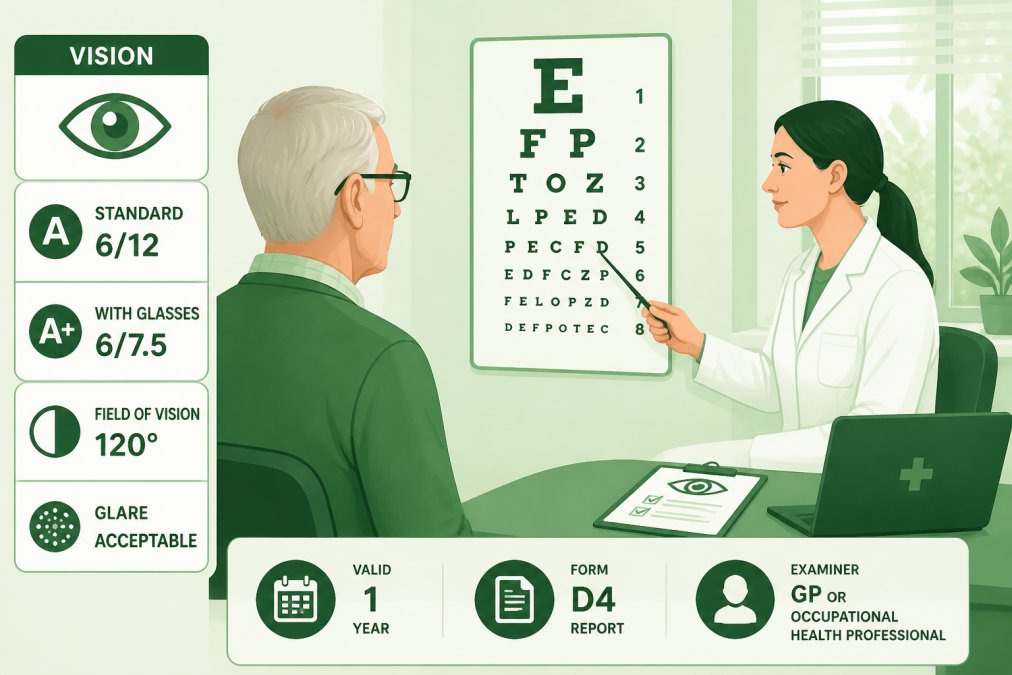
Renewing your licence at 70 is more complex than a standard renewal. The process involves a D4 medical report, specific DVLA forms, and tighter deadlines. Missing a deadline or submitting incomplete paperwork results in automatic licence expiry.
The window for application is 90 days before your 70th birthday. You can submit your application no earlier than 90 days before and no later than your actual birthday. If you miss this window, your D1 entitlement expires automatically on your 70th birthday.
Recommended timeline:
The DVLA's standard processing time is 4-6 weeks. In most cases, you'll receive your renewed licence before your birthday or shortly after.
The application form you need is the D2 (Application for a Driving Licence), specifically the section for renewal of a licence after 70. When you complete the D2 form, you must clearly indicate that you're applying to retain D1 entitlement after 70.
On the same form, you'll declare any notifiable medical conditions. The DVLA cross-checks your declarations against GP records. You'll also need to provide updated proof of identity and proof of address (utility bill, council tax bill, or similar), typically dated within the last 3 months.
Submit the following to the DVLA:
Send all documents to the DVLA address provided on the D2 form, or submit online if you're using the DVLA's digital service. Processing typically takes 4-6 weeks from receipt. Your new licence will show your D1 entitlement and a new expiry date (typically 3 years after renewal for drivers over 70).
Age-related insurance is a significant consideration for drivers and fleet operators. Understanding how age affects your premiums, what you must disclose, and how to maintain valid coverage is critical for compliance.
Most minibus insurance providers increase premiums for drivers over 70. The increase varies by insurer, but age alone does not determine your premium. Your driving history, the type of minibus you're operating, annual mileage, routes, and claims history all influence the final price.
For fleet operators, retaining an experienced over-70 driver may incur a modest insurance cost increase, but it's often offset by the driver's experience, reliability, and reduced accident risk compared to younger, less experienced drivers.
Your insurance policy is valid only if all material facts have been disclosed to the insurer. For a driver over 70, material facts include:
If you fail to disclose any of these facts, the insurer may void your policy. This means that if an accident occurs, the insurer can refuse to pay the claim, leaving your organisation liable for the full cost of any damage, injury, or third-party claims.
When your driver reaches 70 and undergoes their D4 medical examination, inform your insurance provider immediately. If the D4 report identifies a new medical condition, declare it to your insurer. Your insurance policy should remain valid as long as the driver's licence is valid and all material facts are disclosed.
The rules for driving a minibus differ depending on whether you're engaged in commercial operation or voluntary, non-profit transport.
A Section 19 permit allows a voluntary organisation (a charity, not-for-profit, or community group) to operate a minibus for passenger transport without holding a public service vehicle (PSV) operator's licence. To hold a Section 19 permit, your organisation must be a registered charity or a not-for-profit body. The minibus must be used exclusively for the organisation's charitable or community purposes, not for commercial hire or profit.
For drivers operating under a Section 19 permit, the age rules are the same as for any other minibus driver: D1 entitlement is required, and automatic loss occurs at 70 unless retention has been approved. The key responsibility is ensuring that every driver operating the minibus holds valid D1 entitlement and has passed the required medical assessments.
Commercial minibus operators (those charging passengers a fare or operating for profit) must hold a PSV operator's licence and comply with stricter regulations. For commercial operators, the age rules for drivers are identical: D1 entitlement is required, and retention after 70 requires a D4 medical report and DVLA approval.
However, commercial operators often face additional restrictions from their insurance providers. Some commercial operators impose internal age limits on drivers (for example, mandatory retirement at 75). These are the operator's choice and are not legally mandated, but they reflect insurance and risk management considerations.
Understanding what not to do is as important as understanding what you must do.
Driving a minibus after your D1 entitlement has expired is a criminal offence. The penalties are severe: prosecution, unlimited fines, a driving ban, and immediate invalidation of your insurance. Your D1 entitlement expires on your 70th birthday if you haven't already secured retention approval.
For fleet operators, track driver ages, plan licence renewals well in advance, and ensure that every driver has valid D1 entitlement before they operate a minibus. A simple spreadsheet listing each driver's date of birth and licence expiry date, updated quarterly, prevents this mistake entirely.
The 90-day window before your 70th birthday is tight. If you miss it, your entitlement expires automatically and you cannot legally drive a minibus until you've reapplied and received approval.
This mistake occurs when drivers or organisations delay booking their GP appointment, assuming there's plenty of time. GP appointments for medical examinations can be difficult to secure, particularly in busy practices. Identify your 70th birthday at least 6 months in advance. Book your GP appointment immediately.
| Mistake | Consequence | Prevention |
|---|---|---|
| Continuing to drive after D1 expires | Criminal prosecution, unlimited fines, driving ban, insurance void | Track licence expiry dates; plan retention 6 months in advance |
| Missing the 90-day renewal window | Automatic loss of D1; 4-6 week gap before reapplication approved | Book GP appointment 6 months before 70th birthday |
| Non-disclosure of medical conditions | Insurance void; claims refused; criminal liability | Declare all notifiable conditions on D4 form and to insurer |
| Operating minibus without valid insurance | Unlimited fines, prosecution, third-party liability uncovered | Inform insurer of age, medical conditions, and D4 result immediately |
| Using wrong DVLA form | Application rejected; deadline missed; entitlement expires | Use D2 form specifically for over-70s renewal; confirm with DVLA |
Managing minibus licensing and compliance across a fleet is complex, particularly when drivers are approaching or over 70. Minibus Leasing UK works with schools, care homes, charities, and commercial operators to ensure their fleets remain fully compliant with DVLA regulations, insurance requirements, and operational standards.
Our approach combines whole-life cost analysis with deep expertise in D1 licensing, medical standards, and Section 19 permits. Rather than simply leasing vehicles, we support our clients in understanding their regulatory obligations, managing driver transitions, and optimising fleet composition to meet their specific needs.
For organisations with drivers over 70, we provide guidance on D4 medical assessments, retention applications, and insurance disclosure. We help fleet managers track licence expiry dates, plan renewals in advance, and ensure that no vehicle operates without a fully compliant driver. Our dedicated account managers work with your team to understand your operational requirements and deliver solutions that are both legally sound and cost-effective.
Whether you're a school transport manager concerned about a driver reaching 70, a care home director managing a fleet of accessible minibuses, or a charity running community transport, Minibus Leasing UK combines consultative expertise with reliable, brand-new vehicle solutions. We also offer Minibus Leasing Special Offers to help organisations optimise their fleet investment whilst maintaining full compliance with licensing and safety standards.
Navigating minibus licence rules for over 70s requires careful planning, accurate medical assessment, and timely DVLA applications. The consequences of getting it wrong, prosecution, invalidated insurance, operational disruption, are severe. Minibus Leasing UK's sector specialists understand these regulations inside out and work with you to ensure your fleet remains compliant, safe, and cost-effective. Get a bespoke quote or speak to a sector specialist today to discuss your specific requirements and how we can support your compliant operations.
Yes, but your minibus licence rules for over 70s change significantly. Your D1 entitlement (which allows you to drive minibuses with 9-16 passenger seats) expires at 70 unless you apply to retain it. You must pass a DVLA D4 medical examination and meet strict fitness-to-drive standards. If approved, you can continue driving minibuses, but your licence will be renewed annually rather than every three years. Commercial minibus operation is restricted for drivers over 70, though volunteering with Section 19 permits may still be permitted depending on the organisation's insurance.
A D4 medical examination report is a formal assessment completed by your GP or occupational health professional to confirm you meet DVLA medical standards for minibus driving. You must obtain one if you wish to retain your D1 entitlement after 70. The report covers visual acuity, hearing, cardiovascular fitness, and any notifiable medical conditions (such as diabetes, epilepsy, or certain neurological conditions). The assessment costs vary by provider; contact your GP practice for current fees. You then submit the completed D4 form to the DVLA along with your licence renewal application.
A standard B car licence allows you to drive vehicles up to 3,500kg gross vehicle weight with up to 8 passenger seats (excluding the driver). A D1 entitlement permits you to drive medium-sized minibuses with 9-16 passenger seats and a gross vehicle weight up to 7,500kg. D1 is essential if you operate minibuses for schools, care homes, or community organisations. After 70, your D1 entitlement is automatically removed unless you apply for retention with medical evidence. Standard B licences continue indefinitely, though they remain subject to the same medical fitness requirements as all drivers.
Contact your GP or occupational health provider to arrange a D4 medical examination (typically 4-6 weeks before your 70th birthday). Once completed, submit the D4 form, your current driving licence, and the DVLA application form (available on the DVLA website) to the DVLA. Processing usually takes 6-8 weeks. If approved, your renewed licence will show D1 entitlement valid for one year, after which you must renew annually. Failure to renew on time means automatic loss of D1 entitlement. Many organisations leasing minibuses to over-70s drivers ensure all documentation is in order before deployment.
[EXTERNAL_LINK: DVLA guidance on driving licence categories and age restrictions | dvla.gov.uk]
[EXTERNAL_LINK: UK legislation on passenger carrying entitlements and medical standards | legislation.gov.uk]
[EXTERNAL_LINK: Traffic Commissioner guidance on Section 19 permits and voluntary organisations | gov.uk]

