
Aug 05, 2026
Last Updated: August 5, 2026
A Section 19 permit is a legal authorisation issued by a local authority in the United Kingdom that allows organisations to operate passenger transport services without requiring a full Public Service Vehicle (PSV) operator's licence. The permit is named after Section 19 of the Transport Act 1985, which established the framework for this exemption.
Section 19 permits are designed for not-for-profit organisations, charities, educational institutions, and community groups that need to provide transport to their members or beneficiaries. The permit applies to vehicles with more than eight passenger seats but no more than 16 seats (including the driver), making it particularly relevant for schools organising student trips, care homes arranging resident outings, and charities operating community transport. At Minibus Leasing UK, we work regularly with educational institutions and care providers who rely on Section 19 permits to ensure their transport operations remain compliant and cost-effective.
A Section 19 permit operates under a lighter regulatory framework than a full PSV operator's licence, though organisations must still demonstrate they meet safety standards, driver eligibility requirements, and maintenance obligations.
Yes, a Section 19 permit is transferable between vehicles, provided the replacement vehicle meets the same regulatory standards. The authorisation belongs to the organisation, not to a specific vehicle. If your school needs to replace an ageing minibus with a newer model, you can transfer the permit to the new minibus without reapplying.
Notify your local authority of the vehicle change, provide the new vehicle's registration details, and confirm it meets required safety and specification standards. The replacement minibus must have a seating capacity between 9 and 16 passengers, meet current vehicle safety standards and emissions regulations, hold a valid MOT certificate, be properly insured for passenger transport, and have documentation confirming roadworthiness.
Many schools and care homes find that leasing new vehicles through a specialist provider like Minibus Leasing UK offers better value than owning ageing minibuses, because you can transition vehicles without losing your Section 19 permit status. The permit simply moves with you to the new minibus. Exploring Minibus Leasing Special Offers can help you identify cost-effective options when planning a vehicle replacement.
No, a Section 19 permit is not transferable between organisations. The permit is issued to a specific named organisation and cannot be transferred to a different school, care home, charity, or any other entity. The local authority issues a Section 19 permit based on the applying organisation's governance, insurance, safety procedures, and operational management, conditions specific to that organisation.
This non-transferability creates practical challenges for schools considering shared minibus arrangements. If two schools want to pool resources and share a single minibus, each school would need to apply for their own Section 19 permit for that vehicle. The vehicle cannot legally operate under one school's permit whilst being used by another, even temporarily.
For educational institutions, this restriction means you cannot lend your minibus to a partner school for a day trip, nor can you hire out your vehicle to generate revenue. The minibus must be operated exclusively under your organisation's Section 19 permit.
However, multiple organisations can jointly apply for a single Section 19 permit if they operate as a formal partnership or consortium. This requires a shared governance structure, joint insurance arrangements, and agreed operational procedures.
Operating a minibus under a Section 19 permit requires compliance with several mandatory requirements. Schools must demonstrate that they meet safety standards, driver eligibility criteria, vehicle maintenance obligations, and insurance requirements before the local authority will issue the permit.
Driver Eligibility and Licensing
Drivers operating minibuses under a Section 19 permit must hold a D1 driving licence (or the older PCV category if they passed their test before 1997). A standard car licence (category B) is insufficient for operating a minibus with more than eight passenger seats. The D1 licence permits the holder to drive vehicles with between 9 and 16 passenger seats. Drivers must be at least 21 years old and pass a medical examination.
Many schools discover they need to arrange driver training and licence upgrades as part of their Section 19 permit application. The cost and time involved in upgrading existing staff to D1 status should be factored into your transport budget and planning timeline.
Vehicle Safety and Maintenance Standards
Your minibus must meet strict safety and maintenance standards, including a valid MOT certificate, proper seating with safety restraints for all passengers, working emergency exits, functioning safety equipment including first aid kits and fire extinguishers, regular mechanical inspections and maintenance records, and compliance with current emissions standards.
Schools must maintain detailed maintenance records and be prepared to demonstrate vehicle compliance to the local authority. Many schools find it easier to lease new vehicles through specialist providers, as the lessor manages ongoing maintenance and compliance obligations.
Insurance Requirements
Your minibus must be insured for passenger transport. Standard vehicle insurance policies often exclude passenger-carrying use. You need a specialist minibus insurance policy that covers passenger liability, bodily injury, and the specific risks associated with transporting students or vulnerable passengers. Your insurance provider should be aware of your Section 19 permit status, as this affects the premium and coverage terms.
Operational Procedures and Safeguarding
Schools must establish documented operational procedures covering route planning and risk assessments, driver conduct and supervision standards, passenger safety briefings and emergency procedures, record-keeping for trips and passenger numbers, and safeguarding protocols (particularly important for schools transporting young people).
Applying for a Section 19 permit involves several stages and requires careful attention to documentation and procedural requirements.

Step 1: Prepare Your Documentation
Gather the required evidence: details of your organisation (name, registration number, charity status if applicable), information about the minibus (registration number, seating capacity, age, condition), driver details (names, dates of birth, driving licence categories, medical fitness evidence), insurance quotation or policy for passenger transport, operational procedures document, and risk assessment for your proposed transport operations.
Step 2: Contact Your Local Authority
Identify the correct local authority for your area. Section 19 permits are issued by the local council's transport or licensing department. Search your council's website for "Section 19 permit" or "minibus permit" to find the right department and contact details. Request an application pack or guidance notes.
Step 3: Complete the Application Form
The application form requires detailed information about your organisation, the proposed minibus operation, drivers, vehicles, and safety procedures. Complete the form accurately and thoroughly, as incomplete or unclear applications are likely to be rejected.
Step 4: Submit Supporting Evidence
Alongside your application form, submit photocopies of all driver driving licences (both sides), medical fitness certificates for drivers (if required by your local authority), insurance quotation or policy document, your operational procedures document, risk assessment documentation, and vehicle safety inspection report (if required by your council).
Step 5: Pay the Application Fee
Most local authorities charge a fee for processing Section 19 permit applications. Contact your local authority for the current fee and payment method.
Step 6: Await Assessment and Approval
The local authority will assess your application against the statutory requirements. This typically takes 4-8 weeks, though some councils may take longer during busy periods. The authority may request clarification on specific points, ask for additional documentation, conduct a vehicle inspection, or interview key staff members. Once approved, you'll receive formal notification and your Section 19 permit documentation. The permit is usually valid for three years, after which you'll need to apply for renewal.
Section 19 permits are issued exclusively by local authorities. Each local authority operates independently, so requirements, timescales, and processes vary slightly between councils. However, the fundamental legal framework is the same across the UK.
England: Each local authority (county council or unitary authority) in your area handles Section 19 permits. Contact your local council's transport or licensing team directly.
Get a Bespoke Quote or Speak to a Sector Specialist →
Scotland: Local authorities in Scotland administer Section 19 permits under the same Transport Act 1985 framework.
Wales: Welsh local authorities issue Section 19 permits under comparable processes.
Northern Ireland: The Department for Infrastructure in Northern Ireland administers minibus permits under equivalent legislation.
For most schools, your local authority is the single point of contact. There are no private bodies or intermediaries that can issue Section 19 permits, the local authority is the only designated body with legal authority to do so.
When multiple organisations share a minibus, liability and compliance become significantly more complex.
Insurance and Liability Coverage
If your school's minibus is used by another organisation, your insurance policy may not cover the vehicle during that use. Most minibus insurance policies are issued on the basis that the vehicle will be operated exclusively by the named organisation under their Section 19 permit. If a second organisation uses your minibus and an accident occurs, your insurance may deny a claim on the grounds that the vehicle was being used outside the scope of your permit.
Additionally, liability for passenger injuries becomes ambiguous. If a passenger is injured whilst the minibus is being operated by a different organisation, which organisation is liable? This question becomes particularly serious if the accident results from negligence by the borrowing organisation's staff or procedures.
Regulatory Compliance and Enforcement
Operating a minibus under a Section 19 permit that doesn't cover the actual user is a breach of transport legislation. The local authority can take enforcement action against both the permit holder and the organisation actually operating the vehicle. Penalties may include suspension or revocation of your Section 19 permit, fixed penalty notices, prosecution if the breach is serious or persistent, and liability for passenger safety incidents.
Shared Permit Arrangements
If two or more organisations genuinely need to share minibus capacity, the proper approach is to establish a joint Section 19 permit. This requires a formal partnership agreement between the organisations, joint governance arrangements and decision-making procedures, shared insurance policy covering all partner organisations, agreed operational procedures and safety standards, and joint responsibility for compliance and maintenance.
Understanding the distinction between Section 19 and Section 22 permits is important, as they serve different purposes and have different regulatory requirements.
Section 19 Permit (Passenger Transport Exemption)
A Section 19 permit allows not-for-profit organisations to operate passenger transport services without a full PSV operator's licence. It's designed for organisations transporting their own members or beneficiaries (such as students, service users, staff, or volunteers). The permit applies to minibuses with 9-16 passenger seats, permits transport of the organisation's own members or beneficiaries, operates under a lighter regulatory framework than a full PSV operator's licence, is valid for three years then requires renewal, and requires no traffic commissioner or PSV operator's licence.
Section 22 Permit (Minibus Registration)
A Section 22 permit is a registration scheme for minibuses operated by not-for-profit organisations that don't meet the criteria for a Section 19 exemption. Organisations holding a Section 22 permit must comply with additional regulatory requirements similar to (but somewhat lighter than) a full PSV operator's licence.
When to Use Section 19 vs Section 22
Most schools, care homes, and charities use Section 19 permits because they meet the exemption criteria. You qualify for Section 19 if your organisation is not-for-profit, you're transporting your own members or beneficiaries, you're not operating a commercial minibus service, and you're not charging passengers (except to cover actual operating costs). For most educational institutions, Section 19 is the appropriate and simpler option.
Maintaining compliance with Section 19 permit requirements is an ongoing responsibility. Regular self-audits help identify and address potential issues before they become regulatory problems.
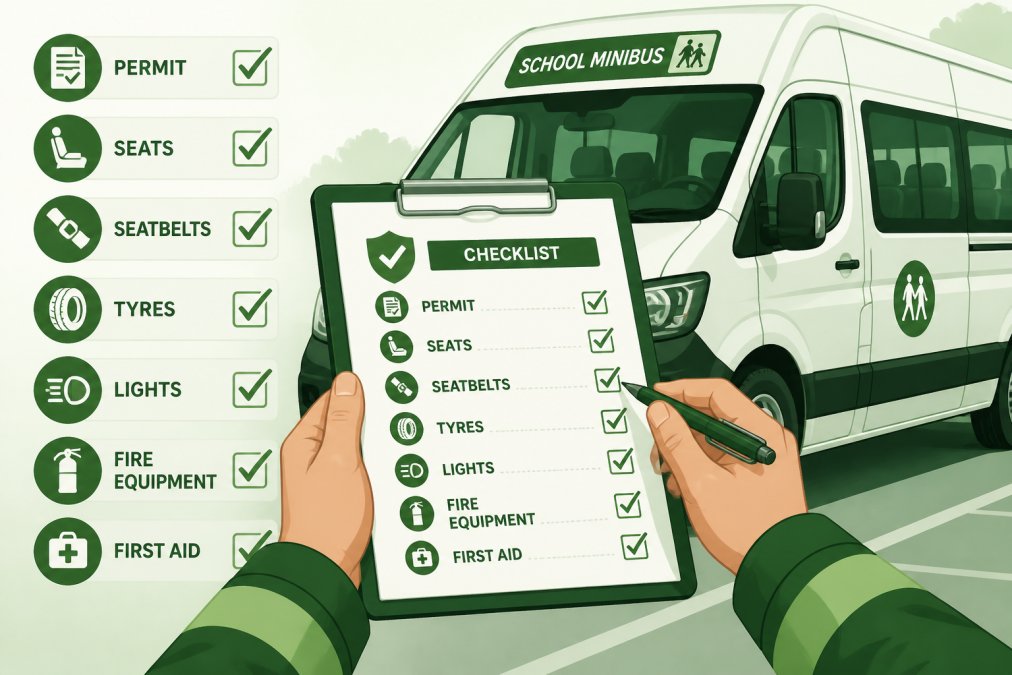
Use this checklist quarterly or before major trips to verify your operation remains compliant:
| Compliance Area | Requirement | Status | Action Required |
|---|---|---|---|
| Permit Documentation | Section 19 permit certificate current and valid | ☐ | Renew if expiring within 6 months |
| Driver Licensing | All drivers hold valid D1 driving licence | ☐ | Arrange licence upgrades if needed |
| Medical Fitness | Drivers have current medical fitness certificates | ☐ | Schedule medical examinations |
| Vehicle Registration | Minibus registered and matches permit details | ☐ | Notify local authority of changes |
| MOT Certificate | Valid MOT (if vehicle over 3 years old) | ☐ | Schedule MOT before expiry |
| Insurance Policy | Valid passenger transport insurance | ☐ | Renew or upgrade cover |
| Safety Equipment | Emergency exits, first aid kit, fire extinguisher present | ☐ | Replace or repair damaged items |
| Seating and Restraints | All seats secure, safety belts functional | ☐ | Repair or replace faulty restraints |
| Maintenance Records | Current maintenance log with service dates | ☐ | Update records after each service |
| Operational Procedures | Written procedures for safety, supervision, emergencies | ☐ | Review and update annually |
| Risk Assessments | Current risk assessments for routes and operations | ☐ | Revise if routes or procedures change |
| Safeguarding | Staff trained in safeguarding and child protection | ☐ | Arrange refresher training if needed |
| Trip Records | Documentation of trips, passengers, routes | ☐ | Establish record-keeping system |
| Vehicle Condition | Minibus clean, safe, and fit for purpose | ☐ | Schedule deep clean or repairs |
Annual Compliance Review
Conduct a comprehensive compliance review annually: review your Section 19 permit conditions and any special requirements, audit all driver documentation and licensing status, verify insurance cover remains adequate for your operations, assess whether operational procedures need updating, review incident reports and near-misses to identify improvement areas, check that safeguarding training is current for all staff, confirm vehicle maintenance schedule is being followed, and evaluate whether your minibus specification still meets your transport needs.
Many schools find it helpful to assign compliance responsibility to a specific staff member (often the school business manager or operations manager) and schedule an annual compliance meeting to review the checklist and address any issues.
Working with a specialist provider like Minibus Leasing UK can simplify compliance management. Our team provides guidance on Section 19 permit requirements and help ensure your leased vehicles meet all regulatory standards.
Maintaining compliance protects your students, safeguards your organisation from regulatory action, and ensures your minibus transport operation remains safe and legally authorised.
Challenge: Managing minibus compliance can feel overwhelming when you're balancing multiple regulatory requirements, driver documentation, vehicle maintenance, and insurance obligations. Many schools discover gaps in their compliance only when facing a local authority audit or incident investigation.
Solution: Minibus Leasing UK provides comprehensive fleet management support designed specifically for educational institutions and care providers. Our dedicated account managers handle vehicle compliance, maintenance scheduling, and regulatory coordination, ensuring your transport operation remains legally authorised and operationally efficient. We combine deep expertise in Section 19 permits and D1 licensing requirements with whole life cost analysis, so you know exactly what your transport solution delivers.
Transport Act 1985 legislation
UK government guidance on minibus permits and passenger transport
Driving and Vehicle Standards Agency (DVSA) information on D1 driving licences and minibus operation
No. A Section 19 permit is tied to a specific vehicle registration. If you change vehicles, you must apply for a new permit for the replacement minibus. The permit does not transfer between vehicles, each vehicle requiring passenger transport under Section 19 rules needs its own individual permit from the local authority.
Schools operating minibuses for passenger transport must hold a valid Section 19 permit, employ drivers with the correct D1 driving licence category, maintain vehicle safety standards, keep comprehensive records of passengers and journeys, and ensure the minibus meets accessibility and insurance requirements. The permit holder is responsible for all transport operations and cannot transfer these obligations to another organisation.
The local authority in your area is the designated body responsible for issuing Section 19 permits. You submit your application to the local authority's transport or licensing department where the minibus will primarily operate. Some councils have specific application forms and fees; contact your local authority transport team for current procedures and requirements.
Yes. Even within a multi-academy trust, each school location typically requires its own Section 19 permit if that school operates its own minibus. Permits are issued to specific organisations and tied to specific vehicles and locations. A single permit cannot cover multiple schools, so each site needing passenger transport must hold separate permits.

