Jul 24, 2026
Last Updated: July 24, 2026
Modernising school transport fleet strategy has become essential for educational institutions across the UK. At Minibus Leasing UK, we understand that transport operators face mounting pressure to balance safety, compliance, cost control, and environmental responsibility. This guide covers the complete framework for modernizing school transport fleet strategy in 2026, from electric vehicle transitions to cybersecurity protocols, helping you make data-driven decisions that protect students, reduce operational costs, and future-proof your fleet.
The landscape for school transport has shifted dramatically. Compliance requirements have tightened, parent expectations around safety and transparency have risen, and fuel costs remain volatile. Technology now offers solutions that were unimaginable five years ago: real-time vehicle tracking, predictive maintenance, route optimisation powered by AI, and integration with parent communication apps.
Schools and local authorities that have adopted modern fleet management report significant improvements in operational visibility, reduced fuel consumption, and improved compliance audit outcomes. Many organisations still operate with outdated systems, paper-based records, and reactive maintenance cycles. The cost of inaction is substantial: unplanned breakdowns disrupt schedules, missed compliance deadlines attract regulatory penalties, and inefficient routing wastes thousands annually on fuel.
Electric vehicles (EVs) represent the most visible shift in modern school transport. The transition requires careful planning around vehicle range, charging infrastructure, and total cost of ownership.
Understanding EV range and charging infrastructure
Modern electric minibuses designed for school transport typically offer 150-250 miles of range per charge. For most UK school routes, which average 40-80 miles per day, a single overnight charge provides sufficient range. Range decreases in cold weather and with heavier passenger loads, so realistic planning must account for a 15-20% seasonal reduction.
Overnight charging at your depot is typically the most cost-effective option, requiring installation of 7-11 kW chargers. Fast-charging infrastructure (50 kW+) is more expensive and less essential for daily school routes but becomes relevant for extended services.
Grant funding and capital investment options
The UK government supports school transport electrification through several funding streams. The Department for Transport's zero-emission bus funding programme provides grants and concessional loans for eligible operators. Many local authorities have established dedicated sustainability funds for educational transport with favourable terms for schools meeting specific emission reduction targets.
Whole life cost analysis is essential. While the upfront purchase price of an electric minibus is typically 30-40% higher than diesel equivalents, operating costs (fuel, maintenance, and depreciation) are substantially lower over a seven-year lifecycle. Minibus Leasing UK can model these scenarios for your specific fleet size and routes, helping you access available grants and structure financing to maximise ROI.
School transport management software forms the operational backbone of modern fleet strategy, integrating routing, real-time tracking, telematics data, maintenance scheduling, and parent communication into a single system.
Route optimisation and real-time tracking capabilities
Route optimisation software uses geospatial analysis and historical traffic data to design efficient routes, reducing mileage by 10-20% compared to manually planned routes. Real-time GPS tracking provides operational visibility, allowing you to respond to delays or emergencies instantly.
Parent communication apps linked to your fleet management system send automated notifications about pickup and dropoff times, delays, and driver contact information. This transparency reduces parent anxiety whilst creating a record of all communications for safeguarding purposes.
Cheaper platforms often lack integration with telematics systems, limiting your ability to extract actionable data. Mid-tier solutions from established providers typically balance cost, functionality, and support quality.
Telematics and data-driven decision making
Telematics systems collect real-time data from your vehicles: fuel consumption, harsh braking events, acceleration patterns, idle time, and engine diagnostics. This data reveals driver behaviour, vehicle efficiency, and maintenance needs before they become problems.
Data-driven decision making means using telematics insights to improve safety and efficiency. If telematics shows a driver consistently brakes harshly, targeted coaching can reduce wear on braking systems. If a vehicle shows increasing fuel consumption, preventative maintenance can identify and resolve the issue before a breakdown occurs.
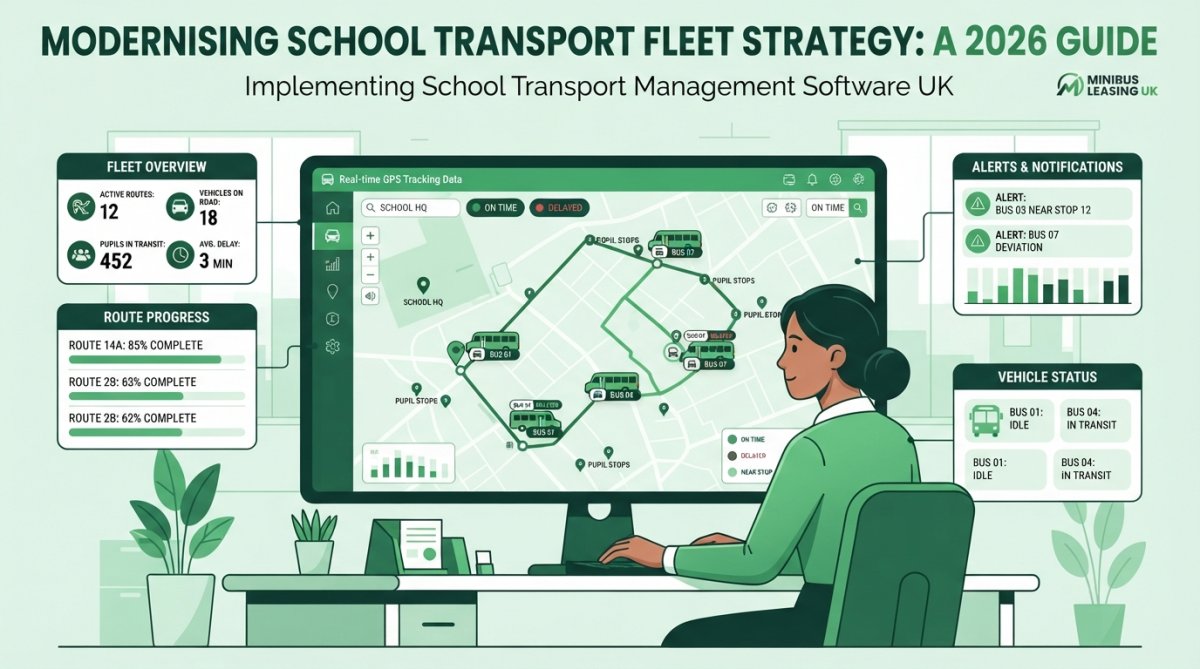
Assign clear ownership for reviewing weekly telematics reports and translating insights into specific actions: maintenance appointments, driver coaching, or route adjustments.
Sustainability has moved from a nice-to-have to a regulatory expectation. Most local authorities now require schools to demonstrate measurable progress toward emission reduction targets.
Reducing emissions and improving air quality
Emission reduction strategies operate at two levels: fleet-wide (switching to electric or advanced diesel vehicles, optimising routes) and individual (driver training, preventative maintenance, load balancing).
Load balancing, ensuring buses run at appropriate capacity rather than half-empty, is one of the quickest wins. If your fleet operates with an average 60% utilisation rate, consolidating routes to achieve 75% utilisation reduces emissions per student by 20%. This requires coordination with schools and parents but delivers immediate environmental and cost benefits.
Driver training focused on fuel-efficient techniques (smooth acceleration, avoiding idle time, maintaining steady speeds) typically reduces fuel consumption by 5-10%. Combined with route optimisation and preventative maintenance, these behaviours compound into substantial savings.
Measuring sustainability ROI and environmental impact
Calculate your baseline: current fuel consumption, emissions per student-mile, and maintenance costs. Track these metrics quarterly as you implement changes.
Many schools find that sustainability investments pay for themselves within 3-5 years through fuel and maintenance savings, even before accounting for grant funding. The environmental impact, measured in tonnes of CO₂ avoided annually, becomes a powerful communication tool for parents, governors, and local authority partners.
Modern fleet strategy requires understanding available funding mechanisms and structuring your business case to access them.
Local authority grants and capital programmes
Most local authorities administer dedicated transport funding programmes. Common funding streams include zero-emission vehicle grants (typically 20-40% of capital cost), school improvement grants with transport components, sustainability and air quality initiatives, and apprenticeship and training funding for driver development.
The application process typically requires a detailed business case demonstrating need, expected outcomes, and sustainability. Minibus Leasing UK can help structure these applications, providing independent cost analysis and implementation timelines that strengthen your case. Our team also assists with exploring Minibus Leasing Special Offers that can reduce your capital outlay whilst maintaining fleet quality and compliance standards.
Whole life cost analysis and operational budgeting
Whole life cost analysis extends beyond purchase price to encompass fuel, maintenance, insurance, driver training, and depreciation over the vehicle's operational life. A vehicle that costs 15% more upfront but delivers 25% lower operating costs over seven years is objectively the better investment.
Operational budgeting becomes more predictable with modern fleet management. Telematics data reveals actual fuel consumption patterns, maintenance scheduling becomes proactive (reducing emergency repairs), and route optimisation reduces mileage.
| Budget Component | Traditional Fleet | Modernised Fleet | Annual Saving |
|---|---|---|---|
| Fuel (per vehicle) | £3,200 | £2,560 | £640 |
| Maintenance | £1,800 | £1,200 | £600 |
| Emergency repairs | £900 | £300 | £600 |
| Driver training | £400 | £600 | (£200) |
| Total per vehicle | £6,300 | £4,660 | £1,640 |
UK school transport operates under a complex regulatory framework. Non-compliance carries financial penalties, reputational damage, and potential safeguarding risks.
Section 19 permits and D1 licensing requirements
Section 19 permits (issued by your local authority) authorise the operation of school transport services. Permit conditions specify vehicle specifications, driver qualifications, insurance requirements, and safety standards. Renewal typically occurs every three years, with increasingly stringent compliance expectations.
D1 licensing requirements apply to minibuses carrying 9-16 passengers. Drivers must hold a D1 category licence and complete periodic training. From 2026 onwards, digital tachographs are mandatory for most school transport vehicles, creating an audit trail of driving hours and rest periods.
Authorities now conduct unannounced inspections and cross-reference vehicle records with DVLA, insurance databases, and maintenance logs. A single compliance failure can result in permit suspension.
HMRC compliance and vehicle safety standards
HMRC compliance for school transport primarily concerns fuel duty relief (if applicable) and vehicle tax. Vehicle safety standards are governed by the DVSA vehicle standards guidance, which specifies maintenance requirements, inspection intervals, and roadworthiness criteria.
Annual MOT testing is mandatory, but proactive maintenance prevents failures and extends vehicle lifespan. Telematics systems flag maintenance needs before they escalate, reducing downtime and ensuring continuous compliance.
Technology adoption fails when staff resist it or lack the skills to use it effectively. Change management is often the overlooked critical success factor in fleet modernisation.
Upskilling teams for new fleet management systems
New software platforms require training, but training alone is insufficient. Staff need to understand why the system matters, how it improves safety, reduces their administrative burden, and supports better decision-making.
Effective upskilling follows this sequence: (1) executive briefing explaining strategic rationale, (2) hands-on training with the actual software, (3) peer mentoring pairing experienced staff with newer users, (4) ongoing support with a designated "super-user" answering questions.
Address common resistance points directly: clarify that systems enhance decision-making rather than replace people, explain data governance and privacy protections, and demonstrate time savings in administrative tasks.
Ensuring staff buy-in during digital transformation
Staff buy-in emerges when people see tangible benefits in their daily work. Drivers appreciate telematics-based coaching if it reduces harsh braking complaints. Maintenance staff appreciate predictive maintenance alerts if they reduce emergency callouts. Office staff appreciate automated reporting if it eliminates manual data entry.
Involve staff in system selection and configuration. A 30-minute conversation with three drivers about their pain points often generates better design decisions than external consultants can provide. This involvement also builds ownership.
As school transport becomes increasingly digital, cybersecurity emerges as a critical operational and safeguarding concern.
Protecting student data and vehicle systems
School transport systems hold sensitive data: student contact information, pickup/dropoff locations, driver contact details, and real-time location information. A data breach exposes students to safeguarding risks and schools to regulatory liability.
Modern minibuses contain networked telematics systems, GPS units, and communication devices. A compromised vehicle system could theoretically allow unauthorised tracking, disable safety features, or disrupt operational systems.
Protect both data and systems through: (1) strong access controls (multi-factor authentication, role-based permissions), (2) encryption of sensitive data in transit and at rest, (3) regular security updates for all systems, (4) staff training on phishing and social engineering, (5) incident response procedures.
Risk assessment and incident response planning
Conduct a cybersecurity risk assessment specific to your transport operations. Identify critical systems (fleet management software, parent communication apps, vehicle telematics), potential threats (data breaches, system outages, malicious access), and consequences (safeguarding risks, operational disruption, reputational damage).
Develop a written incident response plan specifying: (1) who to contact if a breach is suspected, (2) how to isolate affected systems, (3) communication protocols for parents, staff, and authorities, (4) forensic investigation procedures, (5) recovery and restoration steps.
Test your incident response plan annually through tabletop exercises where staff walk through their roles without triggering system changes. This identifies gaps and builds team confidence.
Modernising your school transport fleet strategy requires balancing safety, compliance, cost control, and environmental responsibility across multiple interconnected systems. Institutions leading this transformation are acting now, learning from implementation, and building competitive advantage through operational excellence.
Minibus Leasing UK specialises in helping schools and local authorities navigate this transition. We provide data-driven whole life cost analysis, ensure compliance with Section 19 permits and D1 licensing requirements, and source reliable, brand-new vehicles tailored to your specific operational needs. Our dedicated account managers work with you throughout the procurement and implementation process.
Ready to modernise your school transport fleet strategy? Explore our Minibus Leasing Special Offers or speak to one of our sector specialists today to discover how modern fleet management can transform your operations.
Modernising your school transport fleet strategy delivers improved student safety through real-time tracking and compliance systems, reduced operational costs via route optimisation and fuel efficiency, enhanced environmental sustainability, and better operational visibility. Data-driven decision making enables schools to allocate resources more effectively, whilst fleet management software streamlines administrative tasks and parent communication. These improvements also support regulatory compliance and create a more professional, reliable service.
Schools can explore multiple funding routes including local authority capital grants, Department for Education transport schemes, and sustainability-focused programmes. Whole life cost analysis demonstrates that leasing modern vehicles often costs less than maintaining ageing fleets when maintenance and fuel expenses are factored in. Some schools access funding through green transport initiatives or partnership programmes. Consulting with specialists who understand school transport funding mechanisms can identify grants and programmes aligned with your modernisation objectives.
School transport management software UK enables route optimisation, reducing fuel consumption and idle time through geospatial analysis and AI-driven logistics. Real-time GPS tracking improves student safety and provides transparency for parents. Telematics systems support preventative maintenance scheduling, extending vehicle lifecycle and reducing downtime. These platforms centralise data, enabling data-driven decision making on fleet utilisation, enrollment management, and operational efficiency. Integration with parent communication apps strengthens stakeholder engagement throughout the modernisation process.
Schools must ensure compliance with Section 19 permits (for passenger services), D1 licensing requirements, and HMRC vehicle standards. Modern fleet procurement should meet current emissions standards and safety regulations. Vehicle maintenance schedules must align with regulatory requirements, and driver training programmes must reflect legal obligations. Working with specialists experienced in school transport compliance ensures your modernised fleet meets all legal requirements, protecting students and supporting operational legitimacy throughout your digital transformation.

