Jul 14, 2026
Last Updated: July 14, 2026
Understanding how to maintain school minibus compliance is essential for any organisation operating school transport. This guide covers the core legal obligations that govern school minibus operations, the specific permits required, and the practical steps needed to keep your fleet compliant and safe.
School minibus compliance protects both your passengers and your organisation from serious liability. The regulations span multiple areas: operator licensing, driver qualifications, vehicle maintenance, safety equipment, and record-keeping. Missing even one element can result in enforcement action from the DVSA, fines, or operational suspension.
Your statutory obligations begin the moment a minibus carries school passengers. The primary regulations fall under the Public Service Vehicle (PSV) regime and the Road Transport (Working Time) Regulations.
The key statutory framework includes:
Even if you contract out your transport, your school retains ultimate liability for passenger safety and regulatory compliance. You must verify that your contractor meets all legal requirements and maintain oversight through regular audits.
Most schools use a Section 19 permit, which allows you to operate up to 10 vehicles for school transport without holding a full operator licence. The permit comes with specific conditions: you cannot operate commercially, you must maintain detailed records of all journeys, and all drivers must hold appropriate qualifications.
The application process typically takes 4-6 weeks. You'll need to provide evidence of insurance, driver qualifications, vehicle maintenance arrangements, and a transport manager appointment. The permit is valid for five years but requires annual review and renewal of insurance documentation.
Effective minibus compliance starts before the engine starts. Daily walkaround checks are your first line of defence against roadworthiness failures and safety incidents. These inspections take 10-15 minutes and should be performed by the driver before every journey.
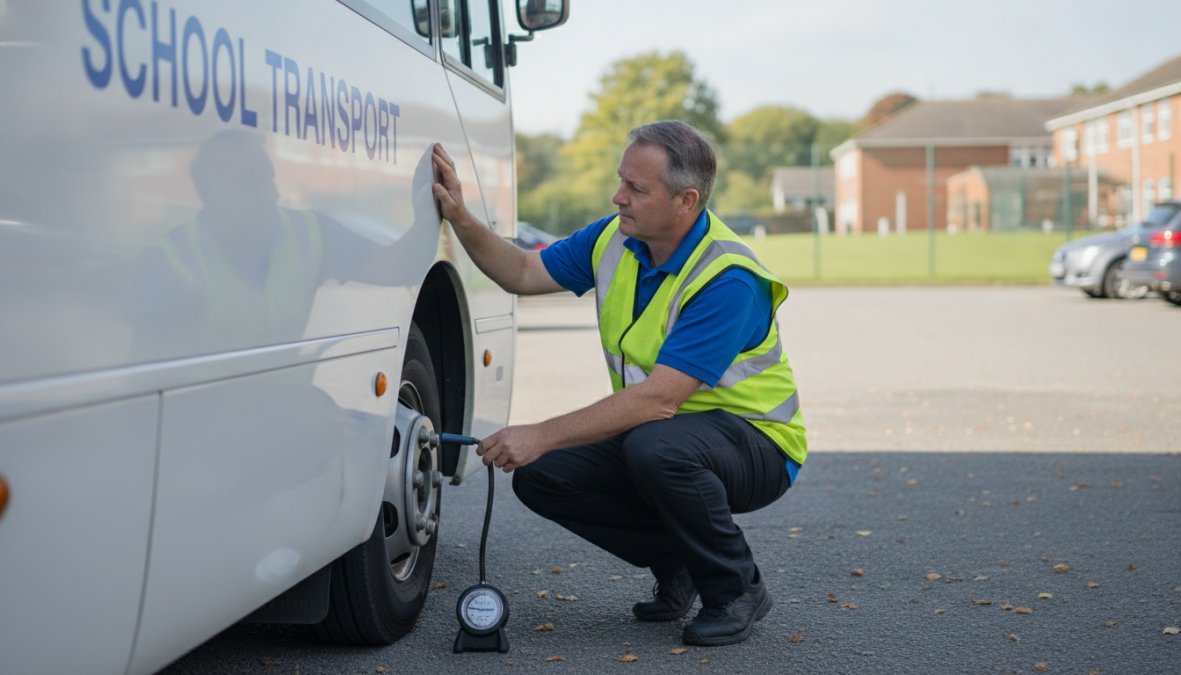
A structured pre-journey inspection follows a consistent pattern: exterior check, interior check, lights and visibility, and fluid levels.
Exterior Checks:
Interior Checks:
Lights and Visibility:
Fluid Levels:
Drivers should complete this checklist using a standardised form and sign off on each item. If any issue is identified, the vehicle should not be used until the problem is resolved.
Implement a formal defect reporting system: the driver reports the defect immediately, it's recorded in a vehicle defect register, the transport manager assesses safety, a repair is scheduled, and the defect is closed once repaired. Critical defects (brakes, steering, lights, seatbelts) should be resolved within 24-48 hours.
Use a simple spreadsheet, app, or transport management software to track defects. Every defect must be recorded, actioned, and documented.
The Section 19 permit application is submitted to the Traffic Commissioner for your region. The application requires operator details, vehicle schedule, insurance certificate, driver list with PCV qualifications, transport manager appointment, maintenance arrangements, and operating statement.
Once approved, the permit is valid for five years. Conditions typically include: no commercial operation, maintenance of journey records, continuous insurance, appropriate driver qualifications, regular vehicle safety inspections, and notification of any changes. Failure to comply with any condition can result in suspension or revocation of your permit.
Your Section 19 permit requires you to maintain detailed records. These records demonstrate compliance if audited by the DVSA and provide evidence of due diligence if an incident occurs.
Essential Records to Maintain:
Record Type | Frequency | Retention Period |
|---|---|---|
Vehicle maintenance logs | Ongoing | 3 years |
Driver training records | Annually | 3 years |
Defect reports | Ongoing | 3 years |
Journey logs | Per journey | 1 year |
Insurance certificates | Annually | Duration of permit |
Safety inspection reports | Quarterly | 3 years |
Records should be stored securely with digital backups and be easily retrievable if the DVSA conducts an inspection. Inadequate records may result in warnings, conditions on your permit, or revocation.
Your minibus must be maintained to a standard that ensures it's safe and roadworthy at all times.
Every minibus manufacturer specifies a service schedule based on mileage or time intervals. For most school minibuses, services are due every 10,000-15,000 miles or annually, whichever comes first.
Typical Service Intervals:
Your minibus must pass an MOT annually. For a minibus carrying more than 8 passengers, the MOT is more rigorous and includes checks on braking systems, emissions, lighting, seatbelts, and emergency equipment. An MOT failure means the vehicle cannot be used for passenger transport until defects are corrected and the vehicle passes a retest.
Three areas of minibus maintenance are critical for safety: brakes, tyres, and fluid levels.
Brakes: Brake pads should be inspected at every service and replaced when they reach the wear indicator (typically 3mm thickness remaining). Brake fluid should be changed every 2 years. If a driver reports soft brakes or a spongy brake pedal, the vehicle should be taken out of service immediately.
Tyres: Tyres should be replaced when the tread depth reaches 1.6mm (the legal minimum), but for safety-critical vehicles like minibuses, replacement at 3mm is recommended. Check tyre pressure weekly and rotate tyres every 20,000 miles to ensure even wear.
Fluid Levels: Engine oil, coolant, and brake fluid should be checked weekly by the transport manager or a designated mechanic. A log of fluid checks should be maintained as part of your compliance records.
Your drivers are the frontline of safety and compliance. A well-trained, qualified driver reduces accident risk and ensures regulatory compliance.
All minibus drivers must hold a valid driving licence with the appropriate category. For minibuses carrying more than 8 passengers, drivers must hold either:
A driver operating a minibus without the correct licence category is breaking the law, and your school is liable for allowing them to do so.
Holding the correct licence is the baseline. Beyond that, drivers need ongoing training to maintain competency and understand your school's specific safety procedures.
Recommended Driver Training Programme:
Training records should be maintained for every driver. Even experienced drivers benefit from refresher training, and it demonstrates to regulators that you take safety seriously.
Your minibus must be equipped with specific safety equipment to protect passengers in an emergency.
First Aid Kit: Your minibus must carry a first aid kit containing basic medical supplies. The kit should be easily accessible to the driver and checked quarterly to ensure supplies are current.
Fire Extinguisher: A fire extinguisher rated for vehicle fires (typically a 2kg dry powder or foam extinguisher) must be carried and mounted securely. Check the pressure gauge monthly.
Safety Hammers: Safety hammers allow passengers to break windows and escape in an emergency. Your minibus should carry at least two safety hammers, clearly marked and easily accessible.
Every passenger, including the driver, must be able to wear a seatbelt. Seatbelts should be checked during every walkaround inspection and replaced if damaged.
Children under 1.35 metres tall must use a child restraint system appropriate to their weight. Your school must have an adequate supply of booster seats to accommodate younger passengers.
Emergency exit procedures should be clearly communicated to all passengers. Your minibus should have at least two emergency exits with clearly marked emergency exit signs. Drivers should brief passengers on emergency procedures at the start of each journey.
Operating a minibus without proper insurance is illegal and exposes your school to catastrophic financial liability.
Your minibus insurance must cover:
The insurance policy should clearly state that the vehicle is used for school transport. Verify that your policy covers your actual operation. Your insurance certificate must be kept current and displayed in the vehicle.
A transport manager must be appointed and given clear responsibility for compliance. This person doesn't need to be full-time but must have adequate time and training.
Transport Manager Responsibilities:
A transport manager should conduct a risk assessment annually to identify potential risks and put controls in place to mitigate them.
Many schools still rely on paper-based logs and spreadsheets. While technically compliant, this approach is inefficient, error-prone, and difficult to audit.
Digital compliance software automates many manual tasks. A typical system includes:
These systems reduce administrative burden, eliminate manual errors, and provide real-time visibility of compliance status. When the DVSA conducts an audit, you can generate a complete compliance report in minutes.
When an accident or incident occurs, you must ensure all parties are safe, document the scene, report the incident in detail, obtain driver and witness statements, have the vehicle inspected, notify your insurance company and the DVSA, and conduct a thorough investigation. Digital systems help by creating a structured incident reporting process and ensuring that all relevant information is captured and retained.
Use this checklist to verify that your school minibus operation is compliant across all key areas:
Compliance Area | Action Required | Frequency |
|---|---|---|
Driver Licences | Verify all drivers hold D1/PCV licence | Quarterly |
Driver Training | Deliver refresher training and competency assessments | Annually |
Vehicle Insurance | Confirm insurance is current and covers school transport | Monthly |
Road Tax | Verify road tax is paid and displayed | Annually |
MOT Testing | Schedule and complete MOT test | Annually |
Planned Servicing | Complete scheduled service at manufacturer intervals | Per schedule |
Walkaround Checks | Driver completes pre-journey inspection | Per journey |
Defect Reporting | Log and action all reported defects | Ongoing |
Safety Equipment | Check first aid kit, fire extinguisher, safety hammers | Quarterly |
Maintenance Records | Maintain detailed logs of all maintenance and repairs | Ongoing |
Training Records | Document all driver training and assessments | Ongoing |
Compliance Audit | Conduct internal audit of compliance status | Annually |
Section 19 Permit | Renew permit and notify of any changes | Per permit term |
Completing this checklist quarterly ensures that no compliance area is neglected and that your operation maintains consistent standards.
Maintaining school minibus compliance is an ongoing commitment that requires clear processes, competent staff, and regular oversight. The alternative exposes your school to regulatory action, financial liability, and most importantly, puts children at risk.
If you're considering whether to operate your own minibus fleet or explore alternative options, [Minibus Leasing Special Offers](https://www.minibusleasinguk.co.uk/page/minibus-leasing-offers) from Minibus Leasing UK can help schools reduce the burden of fleet ownership while maintaining full compliance. Leasing removes the responsibility for maintenance scheduling, vehicle roadworthiness, and capital investment, allowing your school to focus on education rather than fleet management. DVSA guidance on operator licensing and vehicle safety standards outlines the regulatory framework, and whether you operate your own fleet or lease, understanding these requirements is essential.
If you're struggling to maintain compliance or want to simplify your fleet management processes, Minibus Leasing UK can help. Our team has deep expertise in school transport regulations and combines that knowledge with data-driven whole-life cost analysis to ensure your fleet remains safe, legal, and cost-effective.
School minibus drivers must hold a valid D1 or PCV (Passenger Carrying Vehicle) qualification, depending on passenger numbers and vehicle size. A standard car driving licence is insufficient. Drivers must also pass DVSA guidance compliance checks, maintain medical fitness standards, and complete appropriate training. Your transport manager must verify all driver credentials and maintain records as part of statutory obligations.
School minibuses require daily walkaround checks before each journey, scheduled servicing according to manufacturer intervals (typically annually or every 10,000–15,000 miles), and an annual MOT test for roadworthiness. Daily checks should cover brake fluid levels, coolant, tyre pressure, seatbelt safety, and emergency equipment. Defect reporting must be documented immediately to maintain compliance audit trails.
A Section 19 permit is a legal authorisation that allows schools to operate minibuses for passenger transport without holding a full operator licence. It's essential for school transport operations and requires documented compliance with safety, maintenance, and driver training standards. You must apply to your local traffic commissioner and maintain comprehensive records demonstrating ongoing compliance with statutory requirements.
School minibuses must carry a first aid kit, fire extinguisher, and safety hammers for emergency exit purposes. All seatbelts must be functional and regularly inspected. Emergency exit procedures must be clearly marked and communicated to passengers. Your transport manager is responsible for conducting risk assessments and ensuring all safety equipment meets current standards and is accessible during emergencies.

