
Nov 06, 2026
Last Updated: 6 November 2026
Quick Summary
Van leasing monthly cost for business is set by five inputs: the vehicle's list price, its residual value at contract end, the term length, the annual mileage allowance and the initial rental you pay upfront. Change any one of those and the monthly figure moves, so a quote built on your real mileage, term and use case beats a headline rate.
Van leasing monthly cost for business is set by five inputs: the vehicle's list price, the residual value at contract end, the term length, the annual mileage allowance, and the initial rental you pay upfront. Change any one of those and the monthly figure moves.
At Minibus Leasing UK, we build quotes around those inputs rather than around a headline rate. The real question is what your business will actually pay each month across the whole contract.
Below, we break down how each input works, what a good business van leasing deal includes, and how Northampton operators can match vehicles to real work. First, here is what most guides get wrong: they quote the rental and ignore the rest of the contract.
Every van leasing quote rests on five variables. Understand them and you can predict roughly where your monthly rental will land before you speak to anyone.
A common mistake is fixing on one input, usually the monthly figure, and ignoring the other four. The contract you sign is the combination of all five.
A like-for-like example. Take two businesses leasing the same model of panel van on the same term and mileage. Business A pays a three-month initial rental; Business B pays a nine-month initial rental. Business B's monthly rental will be lower, but Business B has tied up more cash upfront. Neither is automatically cheaper, the right choice depends on working capital.
How the inputs interact. Shorten the term and the monthly figure rises because the depreciation is spread over fewer months. Raise the mileage allowance and the monthly figure rises because the van is worth less at contract end. Increase the initial rental and the monthly figure falls. There is no single 'correct' combination; there is only the combination that matches your work.
Setting your inputs from real data. Before you request a quote, gather three things: your typical annual mileage from route or diary records, your expected replacement cycle, and the working capital you can commit upfront. With those three, a quote can be built around your operation rather than around a headline rate.
If mileage is the variable you are least sure about, our guide to calculating van leasing mileage limits for businesses walks through how to set an allowance you will not blow through.
A van lease is a funding arrangement, not a purchase. You pay for the van's depreciation over the term, plus a finance charge, spread across fixed monthly payments.
Business contract hire is a common structure for commercial fleets. You pay an initial rental, then fixed monthly payments for an agreed term, then hand the vehicle back. The van never appears on your balance sheet as an owned asset, which keeps capital expenditure down and preserves working capital.
Personal contract hire works the same way but suits sole traders and individuals rather than limited companies. The tax treatment differs, so take advice on which fits your structure.
What most guides miss is that the advertised rental is only one line of the contract. Delivery, processing fees, and the condition standards at return all sit alongside it. We will cover those shortly.
A good business van leasing deal is transparent about the whole contract, not just the monthly rental. Here is what to check before you sign anything.
What to check | Why it matters | Red flag |
|---|---|---|
Initial rental | Sets your upfront payment | Unusually high to shrink the headline rate |
Annual mileage allowance | Drives excess mileage charges | Allowance far below your real usage |
Contract length | Affects monthly rental and flexibility | Term longer than your work cycle |
Maintenance inclusion | Fixed cost versus variable bills | Unclear what is covered |
Lease-end condition standards | Determines return charges | Vague fair-wear guidance |
Processing fee | One-off cost on top of rental | Fee buried in small print |
Best for: businesses that want predictable fixed monthly payments. Skip if: you need to own the asset outright or change vehicles frequently.
If you are weighing up whether an offer stacks up, our piece on whether business van leasing offers are worth it in the UK sets out the maths. You can also view our current minibus leasing special offers to see what is available across the range we lease.
Contract length is the input most businesses get wrong. Each term length trades monthly cost against flexibility.
Shorter terms keep your monthly rental higher but let you refresh the fleet sooner. They suit businesses whose work is changing, or operators who want the latest electric van as technology moves.
Longer terms bring the monthly figure down. The trade-off is commitment: you are locked into the vehicle and the mileage allowance for longer. If your routes or payload needs shift, you live with the mismatch.
A useful rule: match the term to your replacement cycle, not to the cheapest quote. If you typically run vans for four years before maintenance costs climb, a four-year term fits. Signing a five-year deal to save a little each month rarely pays off.
New businesses can lease a van, but the process differs. Without trading history, funders rely more on the directors' credit profile, a larger initial rental, or a guarantor.
Get a Bespoke Quote or Speak to a Sector Specialist →
Business eligibility and documentation usually includes proof of address, director identification, and bank details. A limited company with no accounts may still be approved, but expect the funder to look harder at the people behind it.
The practical steps for a start-up:
If you are setting up in Northampton, our guide to business van leasing requirements in Northampton covers the local documentation and eligibility points in more detail.
The advertised rental is not the full cost.
Initial rental. This is quoted as a multiple of the monthly rental. A larger initial rental lowers the monthly figure but ties up cash.
Processing fee. Many funders charge a one-off documentation or processing fee. Ask for it in writing before you compare quotes, because it is frequently excluded from the advertised rental.
Delivery. Delivery to your Northampton premises may be included or charged separately depending on the funder and the dealer. Confirm the delivery point and cost before signing.
VAT. For VAT-registered businesses, VAT is charged on the monthly rental. Whether and how much VAT can be reclaimed depends on how the van is used, including any private use.
Excess mileage. If you exceed your agreed annual mileage, the funder charges per mile at the end of the contract. The rate varies by funder and vehicle, and excess mileage can cause a budget to slip.
Damage and fair wear. Vans are working vehicles, and funders apply fair-wear-and-tear standards at return. Damage beyond that standard is chargeable. Photograph the van before return and keep servicing records.
Servicing and maintenance. If maintenance is not included in the rental, budget for servicing, tyres and repairs separately. A maintained contract bundles these into a fixed monthly figure, which suits businesses that want predictable costs.
Total contract cost. The number that matters is the total you pay over the term: initial rental plus all monthly rentals plus fees plus any end-of-contract charges.
If you want to see how the whole-life picture compares across funding models, our guide to choosing the best fleet finance model sets out the comparison. To look at specific vehicles we lease, view our current minibus leasing special offers and ask us for a full-contract quote on the vans that fit your work.
Northampton sits at the heart of the Midlands logistics network, and the vans that suit local operators vary by sector. A crew van for a commercial firm is a different proposition from an accessible vehicle for a care home.
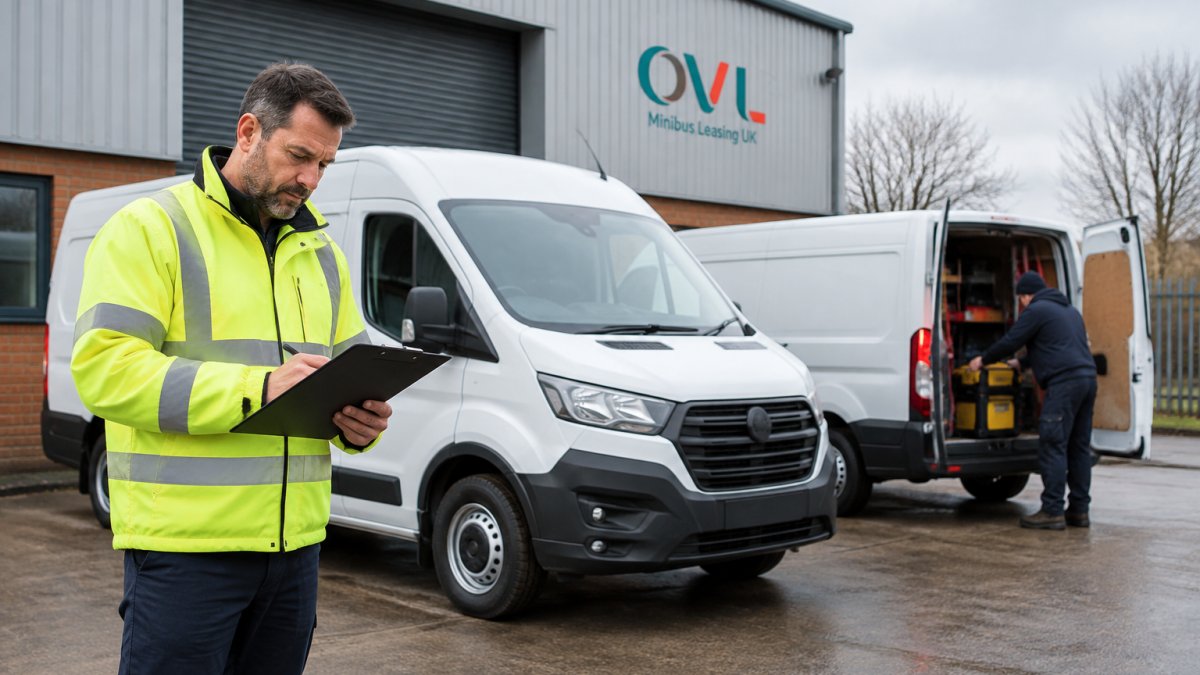
For operations managers moving staff and equipment, a crew van with a second row of seats covers both jobs. For care homes and community groups, an accessible conversion matters more than payload. For schools and charities, compliance and safety come first.
If you are ready to look at specific vehicles, you can view a Citroen e-Dispatch crew van available to lease as a starting point for commercial use. Tell us your routes and payload and we will match the spec to the work.
Working out the right van leasing monthly cost for business comes down to matching the five inputs to how you actually operate. A quote built on your mileage, term, and use case will always beat a headline rate built on assumptions.
At Minibus Leasing UK, we provide a consultative service with dedicated account managers, whole life cost analysis, and brand-new vehicles specified to your operational requirements. We work across education, care, community, and commercial sectors, and we understand the compliance that governs them.
Get started with Minibus Leasing UK and build a fleet quote around your real usage. Speak to a sector specialist or request a bespoke quote today.
There is no single figure. The van leasing monthly cost for business is built from the vehicle's list price, the contract length, your annual mileage allowance and the initial rental you pay upfront. A longer term and a higher upfront payment spread the depreciation over more months and lower the monthly rental; short terms and high mileage push it up. Ask for a written quote covering the full contract so you can compare like for like rather than headline rentals.
Yes, a newly formed limited company can usually apply. Lenders look at the directors' credit history and may ask for a personal guarantee or a larger initial rental when there is no trading record. Van leasing for new businesses works best when you have a clear mileage estimate and a realistic contract length from day one. Speak to a specialist who can explain what documentation the funder will ask for before you apply.
For VAT-registered businesses, VAT on the rental is generally recoverable where the van is used for business, subject to rules on private use. Rental payments are normally treated as a business expense for Corporation Tax or Income Tax purposes. Tax treatment depends on your structure and how the vehicle is used, so confirm your position with HMRC guidance or your accountant before you commit to a contract.
A contract hire agreement typically covers the use of a brand-new van for a fixed monthly rental over an agreed term and mileage. Check the quote line by line so you know exactly what the monthly figure covers.


