
Jun 30, 2026
Last Updated: June 30, 2026
When selecting a wheelchair accessible minibus for charity operations, the stakes are high. Your transport solution directly impacts the independence, dignity, and safety of the people you serve. This guide walks you through every critical consideration: assessing accessibility needs, understanding compliance requirements, evaluating financing options, and ensuring proper training.
Accessible transport is fundamental to your charity's mission. A properly specified wheelchair accessible minibus removes barriers that prevent people from accessing employment, education, healthcare, and social participation. The difference between a vehicle that merely fits wheelchairs and one that genuinely prioritizes safety and comfort is substantial.
Beyond the human impact, accessibility compliance protects your charity legally. The Equality Act 2010 establishes clear expectations for accessible transport provision. Vehicles must meet specific standards for boarding, securement, and emergency procedures. Non-compliance creates liability exposure and undermines trust with the communities you serve.
Your transport requirements depend on who you serve, where you operate, and how frequently you travel. Start by mapping your actual usage patterns. How many passengers typically travel together? What percentage use wheelchairs versus mobility aids like walkers or canes? Do you transport children, elderly passengers, or working-age adults?
Consider your routes and destinations. Urban services with frequent stops require different specifications than long-distance journeys. Rough terrain or rural access roads demand superior suspension and ground clearance. Calculate passenger capacity realistically. A minibus advertised as seating 16 passengers might accommodate only 8-10 when accounting for wheelchair spaces, mobility aid storage, and comfort.
The seating configuration determines how many passengers you can serve and which accessibility features work practically. A typical accessible minibus offers flexible arrangements with 4-6 dedicated wheelchair spaces with secure securement points, 4-6 forward-facing seats for ambulant passengers, and 2-3 folding jump seats for additional capacity when wheelchair spaces aren't needed.
The layout should allow wheelchair users to board and position themselves without requiring transfers. This means adequate aisle width (minimum 750mm), accessible doors, and floor-level or near-level boarding. Passengers using walkers or canes need grab rails positioned at comfortable heights and clear sightlines to seating areas.
Wheelchair securement and positioning:
Modern accessible minibuses use either manual or automated securement systems. Wheelchair positions should allow passengers to face forward during travel. The securement system must accommodate various wheelchair sizes and styles, preventing the frustration of "your wheelchair doesn't fit" scenarios.
| Configuration Type | Wheelchair Spaces | Ambulant Seats | Best For | Typical Capacity |
|---|---|---|---|---|
| High Accessibility | 4-6 | 4-6 | Mixed-ability groups, regular wheelchair users | 8-10 passengers |
| Balanced Layout | 3-4 | 8-10 | Occasional wheelchair users, flexible demand | 12-14 passengers |
| Minimal Accessibility | 1-2 | 12-14 | Primarily ambulant passengers, occasional wheelchair access | 14-16 passengers |
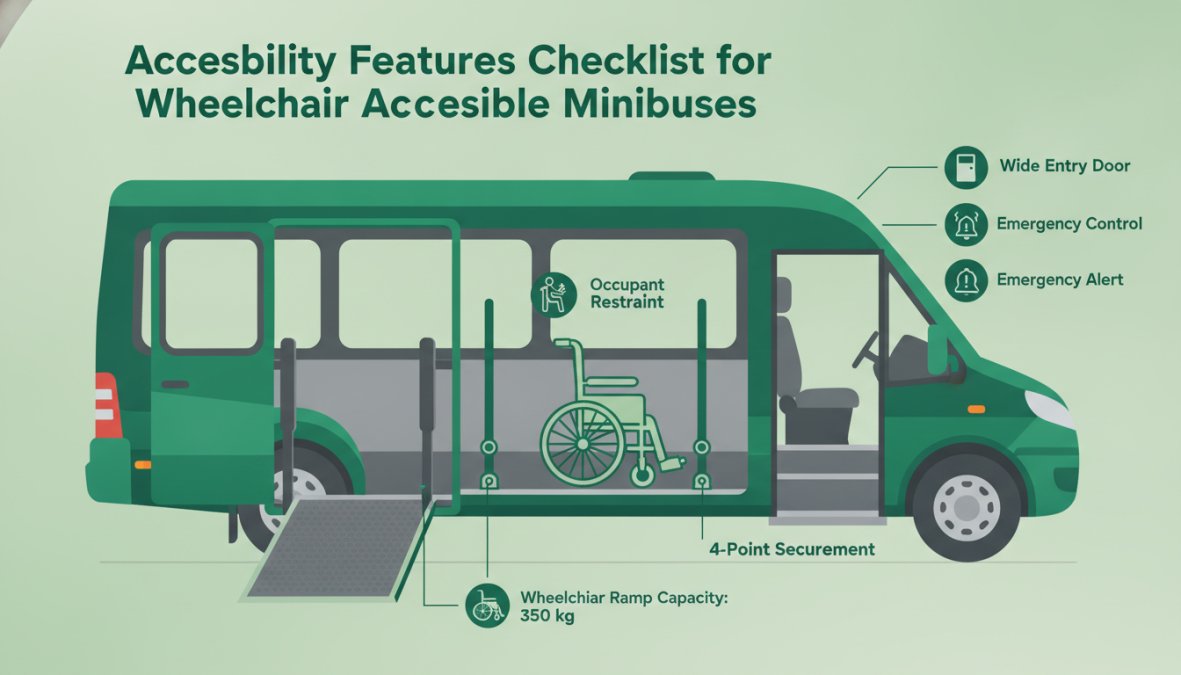
Ramps, tail-lifts, and boarding solutions:
Boarding is the critical moment where accessibility either works or fails. Tail-lifts remain the most common option for UK charities. A hydraulic or electric platform deploys from the rear, raising wheelchairs to floor level. Advantages include reliability and proven safety records. Disadvantages include slower boarding (30-45 seconds per passenger) and vulnerability in poor weather.
Ramps offer faster boarding and simpler mechanics, but they require sufficient space behind the vehicle and work best on level ground. Level-access boarding with a low-floor vehicle and internal ramp represents the premium option, maximizing speed and minimizing barriers, but vehicles are more expensive and less common in the UK market.
Most UK charities choose tail-lifts for reliability. Ensure any lift system includes emergency manual operation, weather protection, smooth operation, and regular servicing contracts.
Interior adaptations and safety certification:
Essential features include grab rails positioned at 750-900mm height throughout the vehicle, accessible doors with widths of at least 750mm, climate control for passenger comfort, and accessible toilets on larger vehicles serving long journeys. Safety certification requires compliance with European Standard EN 12640-1 for accessible minibuses.
D1 licensing and Section 19 permit requirements:
If your vehicle seats 9-16 passengers, your drivers need a D1 category driving licence. This differs from standard car licences and involves additional testing focused on passenger safety and vehicle control.
Operating a minibus for charitable purposes requires a Section 19 permit from your local authority. This permit confirms your vehicle meets safety standards and your operation serves genuine charitable purposes. Section 19 permits cost approximately £150-300 and require renewal every five years.
Vehicle warranty and safety certification:
A comprehensive warranty protects your charity against unexpected repair costs. New vehicles typically include 3-5 year manufacturer warranties. For accessible minibuses, pay particular attention to warranty coverage for tail-lift systems, wheelchair securement equipment, climate control systems, and electrical systems.
Your minibus must pass annual MOT testing, PCV inspections if required by your insurance, accessible equipment inspections, and fire safety checks. Budget for these inspections as ongoing operational costs.
Identifying grant opportunities for charities:
Several funding bodies support accessible minibus procurement. Local authority transport grants vary by region, with many councils offering small grants (£5,000-£15,000) for community transport projects. Charitable trusts including the National Lottery Community Fund and Lloyds Bank Foundation fund minibus purchases. Corporate sponsorship and crowdfunding can supplement grant funding.
Grant applications require clear statements of need, detailed cost breakdowns, operational plans, sustainability plans, and impact measurement. Allow 3-6 months for grant applications and approval.
Leasing vs. buying: Financial planning and cost-effectiveness:
Buying advantages: Full control over vehicle specification, equity building, no mileage restrictions, and potential customisation.
Buying disadvantages: High upfront capital requirement, full responsibility for maintenance and repairs, depreciation risk, and outdated technology.
Leasing advantages: Predictable monthly costs (typically £800-£1,500), maintenance and repairs included, regular vehicle replacement, and no depreciation risk.
Leasing disadvantages: No equity building, mileage restrictions (typically 40,000-60,000 miles annually), excess wear charges, and lease term penalties.
For most charities, leasing proves more cost-effective when accounting for total cost of ownership. A five-year lease typically costs less than purchasing, maintaining, and eventually replacing an owned vehicle. If you're exploring this option, Minibus Leasing Special Offers can help you compare competitive rates tailored to charity operations.
Total cost of ownership for new vehicles:
Calculate your true annual cost:
Vehicle cost (depreciation): A new accessible minibus costs £35,000-£55,000. Over five years, it depreciates 40-60%, meaning £7,000-£11,000 annual value loss.
Maintenance and repairs: New vehicles cost £1,500-£2,500 annually. Older vehicles cost significantly more. A tail-lift failure alone costs £3,000-£5,000.
Insurance: Minibus insurance for charities costs £2,000-£4,000 annually.
Fuel: A modern accessible minibus achieves 20-25 miles per gallon. At current fuel costs, expect £3,000-£5,000 annually for typical charity usage.
Driver training: PCV licence training costs £1,500-£2,500 per driver.
Miscellaneous: MOT testing, road tax, and contingency repairs add £500-£1,000 annually.
Total annual cost of ownership: £15,000-£25,000 for a purchased vehicle. A comparable lease typically costs £10,000-£18,000 annually with all maintenance included.
Maintenance and vehicle reliability considerations:
Vehicle reliability directly impacts your service delivery. A minibus breakdown strands passengers and cancels planned activities. New vehicles (leased or purchased) offer maximum reliability. Used vehicles (typically 3-8 years old) offer cost savings but introduce reliability uncertainty. Professional pre-purchase inspections (costing £300-£500) reveal many issues but not all.
For charities, reliability matters more than cost savings. Budget for proper maintenance regardless of ownership model: regular servicing at manufacturer-recommended intervals, prompt repair of developing issues, seasonal maintenance, and annual safety inspections beyond the legal MOT requirement.
Essential training requirements and volunteer driver standards:
Drivers of minibuses seating 9-16 passengers require D1 category driving licences. Beyond licensing, comprehensive training covers passenger safety, accessible equipment operation, and emergency procedures.
Tail-lift operation requires hands-on training covering pre-deployment safety checks, smooth operation, emergency manual operation, passenger positioning, and weather considerations.
Wheelchair securement training ensures correct positioning of restraint straps, checking security before moving, communicating with passengers, and recognising incompatible wheelchairs.
Passenger assistance training covers helping people board safely, offering physical assistance appropriately, recognising distress, and communicating clearly.
Emergency procedures training prepares drivers for evacuating passengers safely, operating emergency exits, responding to medical emergencies, and communicating with emergency services.
Budget 2-3 days for initial training per driver, then annual refresher training. Professional training organisations offer minibus-specific courses costing £500-£1,500 per driver.
Best practices for safe passenger handling:
Establish operational standards that prioritise safety: pre-journey checks of the minibus, clear passenger communication during boarding and travel, smooth driving, monitoring passenger comfort during journeys, and post-journey checks.
Never purchase or lease a minibus without driving it first. A test drive reveals how the vehicle handles, whether accessibility features work practically, and whether it suits your operational needs.
What to evaluate during a test drive:
Request a test drive with the specific model you're considering. Ideally, test drive with a wheelchair user to evaluate real-world accessibility. Evaluate handling and visibility, acceleration and braking, suspension and ride quality, climate control, accessibility equipment operation, interior layout, noise levels, and fuel efficiency.
Involving stakeholders in the selection process:
Invite beneficiaries, drivers, support staff, and maintenance personnel to experience the minibus. Beneficiary feedback identifies practical issues that procurement teams miss. Driver input on handling, visibility, and comfort is invaluable. Support staff can evaluate accessibility equipment intuitively. Maintenance personnel can assess serviceability and identify expensive repair scenarios.
Selecting a wheelchair accessible minibus for charity is complex, but breaking the decision into these components makes it manageable. The vehicle you choose will serve your beneficiaries for years, removing barriers to independence and enabling participation in community life.
Essential features include a reliable tail-lift or ramp for wheelchair boarding, secure wheelchair securement systems, accessible interior layout with adequate space, and compliance with safety standards. The vehicle must also meet D1 licensing requirements and include safety certification. Consider features like low-floor entry, grab rails, and emergency equipment specific to passenger safety.
Leasing offers lower upfront costs, included maintenance, and access to newer vehicles with latest accessibility features. Buying provides long-term cost-effectiveness if your charity has stable, predictable transport needs and sufficient capital. Calculate your total cost of ownership over 5-7 years, factoring in maintenance, insurance, and potential grant funding. Leasing suits charities with variable demand; buying suits established operations with consistent usage.
Many charities access funding through local authority grants, charitable trusts, and government schemes supporting accessible transport. Research grant applications through your sector body and local community development programmes. Some funders specifically support minibus accessibility for special needs transport and mobility independence initiatives. Document your charity's transport needs and beneficiary numbers when applying, as these strengthen applications.
Drivers require appropriate licensing (typically D1 category for passenger transport) and specialised training in wheelchair securement, passenger assistance, and emergency procedures. Volunteer drivers need formal training on accessibility equipment operation, including tail-lift or ramp use. Your organisation should develop training protocols covering passenger safety, vehicle operation, and compliance with Section 19 permits, ensuring all drivers understand accessible transport best practices.

